
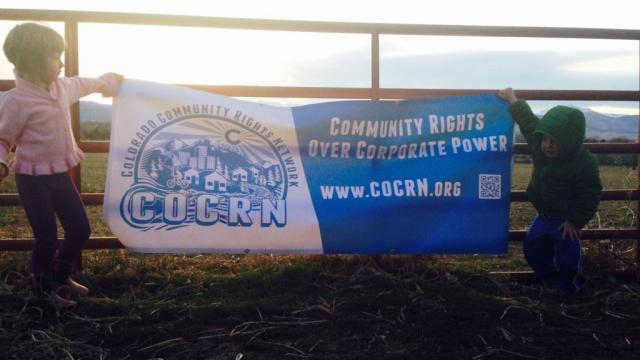
In Colorado, local governments cannot raise the minimum wage, pass rent control laws, or ban fracking. A system of state “preemption” – a favorite tool of the fossil fuel industry – stands in their way.
Local activists have long been outspoken about this legal barrier to keeping fossil fuels in the ground. Now, a coalition embodying a range of economic and environmental justice fights is coming together to directly challenge the basis for state preemption: on August 17, a statewide initiative was launched by Coloradans for Community Rights to do just that. It may be the first time that anti-extraction and workers’ rights movements have allied behind a concrete political tactic in modern US history.
The “Colorado Community Rights Amendment,” which needs some 99,000 signatures to qualify for the 2016 ballot, disrupts preemption by granting local governments a constitutional right to raise state standards – empowering them to boost the minimum wage, bolster environmental protections, and strengthen tenant rights, for example.
It would recognize the authority of local governments “to enact local laws that protect health, safety and welfare by recognizing or establishing rights of natural persons, their local communities and nature.” (A similar community rights initiative was proposed in 2014, but did not collect enough signatures to qualify for the ballot.)
Crucially, the proposed amendment also elevates local lawmaking above “competing rights, powers, privileges, immunities, or duties of corporations.” This means that if a local law conflicts with a corporations’ constitutional “right,” the local law would prevail – in direct contradiction to our current legal structure, which allows corporations to sue local, state, and federal governments that restrict property rights. The amendment doesn’t read like a manifesto, but it could be revolutionary.
This coalition is not only taking on well-established law – it aims to break it. As Cliff Willmeng, a registered nurse and organizer with the Coloradans for Community Rights, says: “All movements identify the law as illegitimate, and voluntarily organize to break it.”
The initiative is part of a multi-state “Community Rights Movement” working to introduce the right to local self-government, and to elevate that right above corporate legal privileges and the state governments that act to protect them. The movement’s work, which takes legal council from the Pennsylvania-based Community Environmental Legal Defense Fund, has recently gained some mainstream notoriety; this summer, CELDF received a grant from the Leonardo DiCaprio Foundation.
In Colorado, the Community Rights Amendment would also undermine the bedrock “private law exception,” which has historically limited local governments’ authority to regulate private relationships between employer and employee or landlord and tenant, for example. It’s this “exception” that provides the ideological basis for preventing cities from raising the minimum wage or passing sick leave ordinances.
Willmeng says, “the Colorado Community Rights Amendment fuses all of this stuff together, you’ve got a lot more tributaries starting to lead in. Where it will go, I just don’t know…. It’s not just fracking, it’s rent control, it’s cyanide use, it’s the local living wage, all of that stuff is all underneath that same kind of preemption.”
I sat down with Andrea Mérida of 15 Now Colorado, a group supporting the effort to qualify the initiative for the 2016 ballot and fighting to raise the state minimum wage.
Why do you think local governments should be able to raise the minimum wage?
Andrea Mérida: Very simply, we see a wage high enough to live in dignity as a human right, and we believe it is the responsibility of local governments to ensure that every taxpayer enjoys that right.
In 2006, Arizona passed a ballot measure that struck down the state’s minimum wage preemption. However, the measure did not establish any constitutional right to local community self-government, as the “Colorado Community Rights Amendment” would.
Why not just replicate what Arizona did in Colorado?
AM: 15 Now Colorado wants to go one step further. Our calculations show that $15 an hour is already a compromise, and that in order to live in dignity, workers really should be earning upwards of $20 an hour. Rents in the Denver metro area are skyrocketing, and ultimately local governments also need the flexibility to consider further actions such as rent control and breaking up utility monopolies to help workers make ends meet. If we don’t strengthen local rights now, we will be back at the ballot box again soon, because the cost of living could quickly outpace any minimum wage increase.
What was the hardest obstacle to making this coalition a reality? How was it overcome?
AM: This coalition was such a logical step to strengthen 15 Now Colorado’s work that there was no difficulty at all.
Why are 15 Now organizers sympathetic to the anti-fracking strand of Coloradans for Community Rights?
AM: Because we believe in the holistic vision of a dignified life, we cannot turn a blind eye to the effects of environmental racism on working-class communities who would most benefit from a minimum wage hike. These are the communities with the most polluted air and water, and fracking is wreaking havoc in these communities and more all across Colorado.
What is the significance of this coalition?
AM: Single-issue organizing has one fatal flaw: it can be siloed and defeated easily with the right corporate resources targeted at it. The human right to live in dignity is part of a holistic vision that we all hold, and solidarity is our best weapon against market-based forces that seek to put the priorities of profit over people.
Why do you think it makes sense to incorporate a community rights critique of preemption into the fight for economic justice?
AM: 15 Now Colorado believes that it’s time to recalibrate the way we see ourselves in society. Government exists to serve the interests of workers first, but unfortunately, this is not the reality. Too often the requirements of excessive profit trump the right to live in dignity, and by using our state constitution to change that paradigm, we believe that we can finally create a Colorado that serves everyone.
Many people are wary of local self-governance in America. Racist discrimination comes to mind. How does the proposed 2016 Colorado Community Rights Amendment address these concerns?
AM: The language of the proposed amendment makes very clear that no law can be passed that takes away rights already established. It would not be possible, for example, for a state law to preempt Colorado’s public accommodations law, for example.

3 WAYS TO SHOW YOUR SUPPORT



- Log in to post comments


