
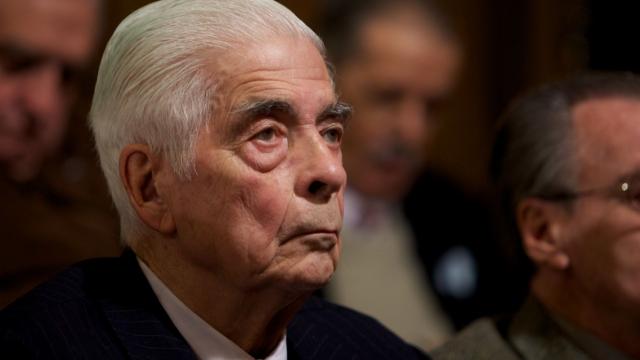
An Argentine court last week sentenced former General Luciano Benjamin Menendez to life in prison for crimes against humanity committed at secret Dirty War-era detention centers in the late 1970s, making a landmark step in the struggle for justice for human rights abuses during one of the darkest chapters in the South American country’s history.
Menendez stood trial with 42 other defendants who were also sentenced after a nearly four year so-called “mega-trial” involving events related to over 700 victims.
The general was in charge of two clandestine jails, known as La Perla and La Ribera, in the province of Cordoba where torture, assassinations, and other human rights abuses were carried out during the 1976-1983 military dictatorship. He was charged with over 600 cases of torture, over 300 murders and forced disappearances, unlawful detentions, and other crimes against humanity committed at the two detention centers between 1976 and 1978.
Thousands of people, including the families of victims and social movements such as the iconic Mothers and Grandmothers of the Plaza de Mayo, filled the streets outside of the federal court in the province of Cordoba to await the announcement under the banner of remembering the 30,000 disappeared during the dictatorship.
Former military intelligence agent Arnoldo Jose Lopez, former military man Ernesto Guillermo Barreiro, and former military captain Hector Pedro Vergez were also found to be among the principle masterminds responsible for the abuses and sentenced to life in jail for charges of hundreds of aggravated homicides, among other crimes.
Ricardo Alberto Lardone and Oreste Valentin Padovan, both considered among the special command at La Perla responsible for carrying out torture and kidnappings, were also sentenced to life in jail.
A total of 28 of the 43 accused were handed life sentences, nine were sentenced to up to 21 years, and six were acquitted.
The case was also historic for marking the first time a court in Cordoba tried charges of illegal apprehension of babies during the dictatorship, a military practice of stealing babies from political dissidents, detainees, and victims of forced disappearance and handing them over the families linked to the military regime. The Grandmothers of the Plaza de Mayo has struggled for nearly 40 years to identify their missing grandchildren and reunite them with their families.
The La Perla case dealt with forced disappearance of Silvina Monica Parodi de Orozco, who was over six months pregnant when she and her husband Daniel Francisco Orozco were kidnapped. Silvina’s mother Sonia Torres is still searching for her missing grandchild, whose whereabouts has never been known.
The landmark trial brought together 21 separate cases of crimes against humanity at the hands of the Argentine military, police, and paramilitary forces immediately leading up to and in the years after the 1976 military coup against left-wing President Isabel Peron. The case heard some 600 witnesses provide testimony over the course of 350 hearings related to the 716 victims. Less than half, 340, of the victims survived. Most of the others, 311, were disappeared with no documentation of what happened to them, and the rest were killed.
La Perla was the second most important detention center in the country in the early years of the military dictatorship. Between 2,500 and 3,000 victims of state terrorism were detained at the secret military prison between 1976 and 1977, and it is though to have stopped operating by 1978, according to local media.
A 1979 U.S. Department of State memo included in a batch of over 1,000 pages of recently-declassified documents related to Argentina’s Dirty War reveals that the U.S. Embassy was aware that “physical torture” was practiced at La Perla in 1976 and 1977. A 1978 State Department recommendation memo to then-President Jimmy Carter characterized General Menendez as as a “hardline general,” and another document indicated that Menendez was pushing for “continued strong efforts to battle ‘ideological subversion.'”
Argentina’s U.S.-backed Dirty War disappeared an estimated 30,000 victims in its brutal state terrorism campaign against suspected political dissidents, which involved systematic forced disappearances, torture, rape, and assassinations. Argentine human rights groups have dubbed the bloody era a “genocide” against political dissidents.
3 WAYS TO SHOW YOUR SUPPORT



- Log in to post comments


Comments
Jenifer replied on
Nice Article
I am going through this post and thinking of it’s theme and trying to understand what is this post about.<a href="http://www.goescheneralp.info/the-best-ways-of-writing-your-assignment">http://www.goescheneralp.info/the-best-ways-of-writing-your-assignment</a>