
Read

User menu

Search form

With Chavez Victory, the Bolivarian Revolution Continues

With Chavez Victory, the Bolivarian Revolution Continues
Mon, 10/8/2012 - by Common Dreams

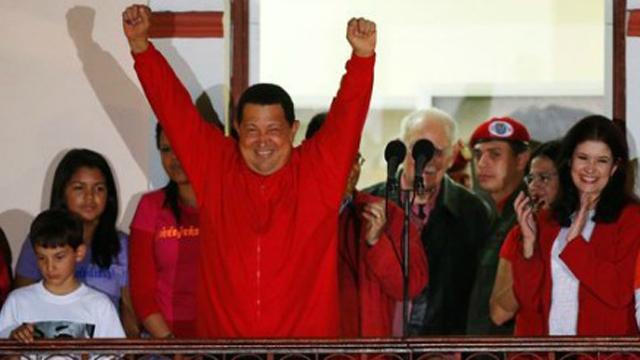
Capturing an estimated 54 percent of the vote in national elections, President Hugo Chavez has won re-election in Venezuela, according to an announcement by the nation's official electoral council.

National Electoral Council president Tibisay Lucena said Monday that with most votes counted, Chavez handily defeated challenger challenger Henrique Caprile and will now serve another six years as President.

"The revolution has triumphed!" Chávez told the crowd that gathered at the Presidential Palace in Caracas. "Today we've shown that Venezuela's democracy is one of the best democracies in the world, and we will continue to show it," he declared. "Venezuela will continue along the path of democratic and Bolivarian socialism of the 21st century."

Voter turnout reflected a huge interest among the Venezuelan electorate, as over 80 percent of eligible voters went to the polls on Sunday.

Capriles conceded defeat at his campaign headquarters, but promised his supporters that would "continue to work for Venezuela."

"I gave it my all and I'm proud of what we built," he said.

It was Chávez's third re-election victory in nearly 14 years in office and though the challenge from Capriles seemed to gain steam at times, the election results affirm that a majority roundly support the brand of socialism which has marked Venezuela under his leadership.

"Hugo Chávez’ re-election to another 6-year term shows that Venezuela, like the rest of South America, prefers governments of the left that have improved living standards and greatly reduced poverty and inequality," said Mark Weisbrot, Co-Director of the Center for Economic and Policy Research (CEPR) in Washington, D.C.

“Chávez is often portrayed as though he were from Mars, but really the similarities between what he has done and what his neighboring left governments have done are much greater than the differences,” said Weisbrot.

Other left governments, including Argentina, Brazil, Ecuador, and Bolivia have also reduced poverty and inequality and at the same time taken more control over their energy resources. Weisbrot noted that all of these governments are closely aligned and have similar goals for regional economic integration – Venezuela was recently admitted to Mercosur at the first opportunity – and all have become much more independent of the United States.

“It’s really not surprising that all of these governments get re-elected, and generally despite most of the media and the wealth and income of the country being in the hands of the opposition,” said Weisbrot. “These governments have delivered on a number of their promises.”

3 WAYS TO SHOW YOUR SUPPORT

ONE-TIME DONATION

Just use the simple form below to make a single direct donation.

DONATE NOW

MONTHLY DONATION

Be a sustaining sponsor. Give a reacurring monthly donation at any level.

GET SOME MERCH!

Now you can wear your support too! From T-Shirts to tote bags.

SHOP TODAY

Sign Up

Article Tabs

From a pro-democratic perspective, civil society and new media organisations are surging in the aftermath of the Orban regime.

The country’s new prime minister, Andy Burnham, has promised a break from the politics of the last 40 years—realizing more broadly that Labour must stand up for the 99% against big business, or the party will become irrelevant.

The tragic shooting of Lorenzo Salgado Araujo is just the latest example of ICE having a fundamental disrespect for human life — further proving why the agency should be stripped of funding and shut down, and its rank-and-file agents and leadership prosecuted.

While the U.S., EU and their allies are enabling Rojava—the strongest force against Islamic State— to fall, it is vital for internationalists to continue to support this beacon of democracy and liberation.

June 23, 2026 may be remembered as the beginning of the end of the Democratic Party establishment.

The current wave of food recalls is a direct byproduct of President Donald Trump’s administration deliberately removing the safeguards put in place aimed at protecting American consumers more than a century ago.

From a pro-democratic perspective, civil society and new media organisations are surging in the aftermath of the Orban regime.

We can still celebrate success while simultaneously putting a cap on net worth.

The country’s new prime minister, Andy Burnham, has promised a break from the politics of the last 40 years—realizing more broadly that Labour must stand up for the 99% against big business, or the party will become irrelevant.

Much like the resistance to AI data centers, the opposition to Flock surveillance cameras has brought the left and the right together against billionaires who are trying to force America into becoming even more of a police state.

Much like the resistance to AI data centers, the opposition to Flock surveillance cameras has brought the left and the right together against billionaires who are trying to force America into becoming even more of a police state.

Posted 1 month 3 weeks ago

The country’s new prime minister, Andy Burnham, has promised a break from the politics of the last 40 years—realizing more broadly that Labour must stand up for the 99% against big business, or the party will become irrelevant.

Posted 1 month 3 weeks ago

We can still celebrate success while simultaneously putting a cap on net worth.

Posted 1 month 1 week ago

The current wave of food recalls is a direct byproduct of President Donald Trump’s administration deliberately removing the safeguards put in place aimed at protecting American consumers more than a century ago.

Posted 2 weeks 1 day ago

From a pro-democratic perspective, civil society and new media organisations are surging in the aftermath of the Orban regime.

Posted 2 weeks 3 days ago

The current wave of food recalls is a direct byproduct of President Donald Trump’s administration deliberately removing the safeguards put in place aimed at protecting American consumers more than a century ago.

From a pro-democratic perspective, civil society and new media organisations are surging in the aftermath of the Orban regime.