Read

User menu

Search form

Could Fracking Escalate the West’s Water Wars?

Could Fracking Escalate the West’s Water Wars?
Thu, 5/16/2013 - by Claire Thompson
This article originally appeared on Grist

One of fracking’s few but feverishly touted upsides is that the natural-gas boom it’s spurred could help America move toward energy independence; it’s a crucial piece of Obama’s “all-of-the-above” energy strategy. But in building up our fuel supply, fracking threatens our supply of another crucial natural resource – water.

A new report from nonprofit Ceres (which maintains a neutral position on fracking in general) reveals that nearly half of the country’s fracking wells are located in water-stressed regions — in particular Texas and Colorado, where 92 percent of fracking wells are in extremely high-water-stress regions.

Ceres compiled its report using data from the World Resources Institute — which considers an area extremely water-stressed if 80 percent of its available water supply is already allocated for municipal, industrial, and agricultural uses — and FracFocus.org, a voluntary national registry of fracking wells’ locations and water usage.
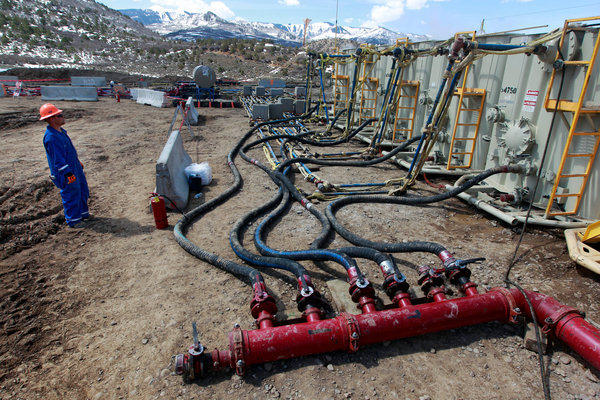
FracFocus shows that between January 2011 and September 2012, the 25,450 wells in its database used 65.8 billion gallons of water, or the amount of water 2.5 million Americans use in a year. Because the site doesn’t have data for every single well in the country, fracking’s total water impact is likely even higher.

It’s hard to put figures like that into context, especially because the impact of using a given amount of water varies from place to place. The New York Times explains:

"The overall amount of water used for fracking, even in states like Colorado and Texas that have been through severe droughts in recent years, is still small: in many cases 1 percent or even as little as a tenth of 1 percent of overall consumption, far less than agricultural or municipal uses. "But those figures mask more significant local effects, the report’s author, Monika Freyman, said in an interview. 'You have to look at a county-by-county scale to capture the intense and short-term impact on water supplies,' she said. “'The whole drilling and fracking process is a well-orchestrated, moment-by-moment process' requiring that one million to five million gallons of water are available for a brief period, she added. 'They need an intense amount of water for a few days, and that’s it.'”

For instance, in some Texas counties, the report says, fracking accounted for more than 20 percent of a region’s water use.

As summer approaches, huge areas of the Western U.S. still haven’t recovered from last year’s devastating drought. Things could get ugly, reports the San Francisco Chronicle:

"'The spread of fracking could lead to competition among drillers, farmers and homeowners,' said Freyman … “'It’s already starting to happen … The companies will be able to get their water, because they can afford to pay the most. But it’s going to increase the competition and conflicts for water, especially in regions that are experiencing drought.”

Perhaps it would be wise to put a hold on fracking until those extremely stressed water supplies have a chance to regenerate? But halting the practice altogether is not among Ceres’ recommendations. Rather, the group points to some drillers who have started using brackish or otherwise non-potable water in their operations, and, according to the Chronicle, “Ceres wants the companies that engage in fracking to do a better job planning for water use and recycling, and having discussions about both with the public.”

Discussions with the public. Think that’ll do the trick?

Originally published by Grist.
 

3 WAYS TO SHOW YOUR SUPPORT

ONE-TIME DONATION

Just use the simple form below to make a single direct donation.

DONATE NOW

MONTHLY DONATION

Be a sustaining sponsor. Give a reacurring monthly donation at any level.

GET SOME MERCH!

Now you can wear your support too! From T-Shirts to tote bags.

SHOP TODAY

Sign Up

Article Tabs

From a pro-democratic perspective, civil society and new media organisations are surging in the aftermath of the Orban regime.

The country’s new prime minister, Andy Burnham, has promised a break from the politics of the last 40 years—realizing more broadly that Labour must stand up for the 99% against big business, or the party will become irrelevant.

The tragic shooting of Lorenzo Salgado Araujo is just the latest example of ICE having a fundamental disrespect for human life — further proving why the agency should be stripped of funding and shut down, and its rank-and-file agents and leadership prosecuted.

While the U.S., EU and their allies are enabling Rojava—the strongest force against Islamic State— to fall, it is vital for internationalists to continue to support this beacon of democracy and liberation.

June 23, 2026 may be remembered as the beginning of the end of the Democratic Party establishment.

The current wave of food recalls is a direct byproduct of President Donald Trump’s administration deliberately removing the safeguards put in place aimed at protecting American consumers more than a century ago.

From a pro-democratic perspective, civil society and new media organisations are surging in the aftermath of the Orban regime.

We can still celebrate success while simultaneously putting a cap on net worth.

The country’s new prime minister, Andy Burnham, has promised a break from the politics of the last 40 years—realizing more broadly that Labour must stand up for the 99% against big business, or the party will become irrelevant.

Much like the resistance to AI data centers, the opposition to Flock surveillance cameras has brought the left and the right together against billionaires who are trying to force America into becoming even more of a police state.

Much like the resistance to AI data centers, the opposition to Flock surveillance cameras has brought the left and the right together against billionaires who are trying to force America into becoming even more of a police state.

Posted 1 month 3 weeks ago

The country’s new prime minister, Andy Burnham, has promised a break from the politics of the last 40 years—realizing more broadly that Labour must stand up for the 99% against big business, or the party will become irrelevant.

Posted 1 month 3 weeks ago

We can still celebrate success while simultaneously putting a cap on net worth.

Posted 1 month 1 week ago

The current wave of food recalls is a direct byproduct of President Donald Trump’s administration deliberately removing the safeguards put in place aimed at protecting American consumers more than a century ago.

Posted 2 weeks 1 day ago

From a pro-democratic perspective, civil society and new media organisations are surging in the aftermath of the Orban regime.

Posted 2 weeks 4 days ago

From a pro-democratic perspective, civil society and new media organisations are surging in the aftermath of the Orban regime.

The current wave of food recalls is a direct byproduct of President Donald Trump’s administration deliberately removing the safeguards put in place aimed at protecting American consumers more than a century ago.