

CAIRO – Egypt is grieving as the streets continue to run red with blood and angry supporters of ousted President Mohamed Morsi show little signs of backing down. More than two weeks after the June 30 protests that led to the toppling of Morsi's regime, calls for reconciliation have increased as the country braces for yet another turbulent transition while it awaits to elect new leaders.
The most recent violence occurred on Monday morning, as cement factory workers in the northern Sinai city of al-Arish were traveling on their way to work when an RPG hit their carrier, killing at least three people and injuring dozens.
The festivity of the holy month of Ramadan appears to be vanishing as divisions grow and the situation in Cairo remains uncertain. Morsi supporters are continuing their sit-in in at Raba’a al-Adawiya Square, while the state moves forward in its efforts to appoint an interim prime minister and produce a roadmap that will see a Parliament and president elected within nine months.
In the conflict, both pro- and anti-Morsi sides have lost family members and friends, and it seems that more families are now split among themselves over whom to support.
A stay-at-home mother of two, Mona, 43, believes that what is happening is a theft of the Egyptian peoples’ will.
“We elected Morsi, they can’t come and overthrow him, it’s not what the voters wanted, and that is not what democracy is,” she said.
Mona’s statement is in tune with the Muslim Brotherhood pleas that Egyptian democracy respect the ballot box -- and that once an election has been set it cannot be changed, even as economic and national catastrophes peak their heads.
But many families will have to reconcile themselves with having a Morsi supporter or conservative Islamists close by. Mona’s cousins, she says, have stopped taking her calls after heated debates on and offline, and as the intensity of the news remains present in Egyptians’ living rooms.
“The media is very biased against Morsi so it is a natural thing to find others believing them,” she continued.
But the media, which largely sided with the armed forces in their attempts to curb rising Islamic violence in the streets and against the state, is also accused of being a dividing force for reconciliation.
“They incite people against those with a beard or a Niqab. I have friends who have to announce they don’t like the Muslim Brotherhood in order to fit in,” she added.
Yet the harassment some might find is not equal to the armed attacks pro-Morsi protesters launched across the country. Last week, dozens were killed in the Cairo neighborhoods of Manial, Tahrir and Bein al Sarayat. Meanwhile, the army is fighting a battle on Sinai soil to combat attacks against its outposts and to counter illegal smuggling of firearms.
As the former head of the International Atomic Energy Agency, and now acting interim Vice President, Mohamed ElBaradei, said, “violence breeds violence.”
The scope of violence reaching Egyptians through the news, social networks or even word of mouth has left many weary and sour towards the Brotherhood and their supporters. International headlines have predicted Egypt is on the brink of civil war, while observers inside Egypt saw the violence as the last dying breath of the Brotherhood.
One video shot with a mobile phone went viral, showing a group of bearded men tossing teenagers off a roof of a building in Sidi Gaber, in Alexandria. One attacker, carrying a black jihadist flag, was singled out and police issued a warrant for his arrest, which took place two days later.
The extent of the violence in the video, where the men beat the teenager’s body after he was thrown off a high tower, shocked Egyptians as it alerted them to the mass of violence taking place in their backyard.
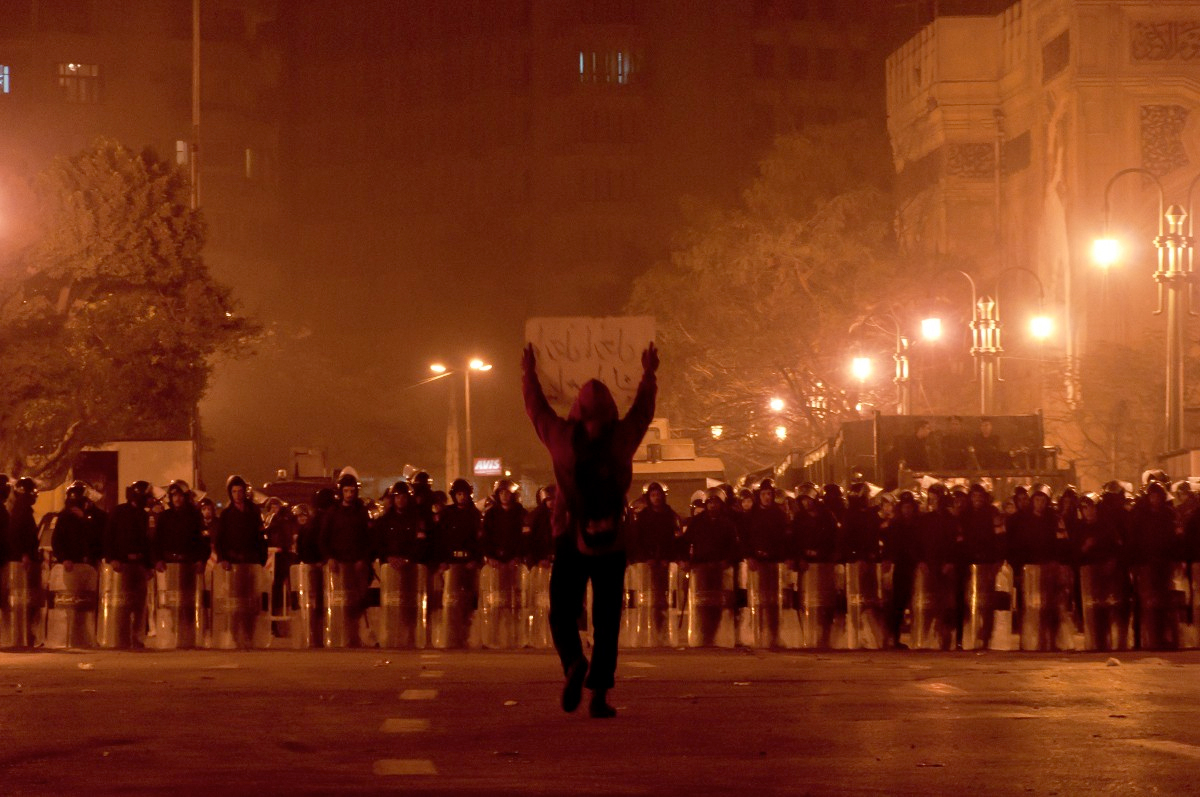
The death of 57 Egyptians, including four officers, at the Republican Guard compound on July 8 added further fuel to the fire, and left the army in a difficult position over accusations of using “unequal force.” The incident drew international criticism and calls for an independent investigation, and helped spread fear among Morsi supporters, motivating some to fight back.
Many of the deposed president's supporters came into Cairo from other villages and cities, and appear cut off from the world. A few thousand have remained since late June, vesting faith in Brotherhood leaders with their ongoing jihadi and “war on Islam” speeches. Some local reports mention that many of these supporters fear state retaliation against them if they leave the sit-in.
Military flyers dropped on the sit-in a few days ago promised not to harm protesters if they wish to leave, but to protect them if they remain.
It has become a familiar scene here to have military tanks dispersed in the streets, while Apache helicopters hover over homes and public places. Across the country the military carry out public safety missions and combat “terror.” Yet they are accused of arriving late on occasions or using excessive force, as in the compound deaths.
But while the political class calls for an end to violence, reconciliation seems unrealistic without the disarmament of Islamic militants. Photos showing children wearing t-shirts that read “martyr on call” and other Jihadist rhetoric at the pro-Morsi sit-in seems to have widened the wedge.
Graffiti has mushroomed on the walls of Raba’a streets and in the surrounding areas, with calls for action against the military -- and specifically General Abdel Fattah al-Sisi, who led Morsi's ouster from power. “Al-Sisi is a traitor” is a common statement there.
The lack of a strong nonviolence initiative, whether on an official or a personal level, will make reconciliation hard to achieve. And with the beginning of the holy month of Ramadan, a month when families get together, share food and socialize, politics is becoming a dominant theme at the iftar – the meal to break the fast – table.
“We will get together because it’s Ramadan and we have to visit and share, but it will be difficult for sure,” added Mona. “We have to recall the spirit of Ramadan and act upon it.”
But maybe what politics ruined, Ramadan can recover, as families across Egypt disengage themselves from the turbulent news and recall the spirit of family and community -- even while dozens leave an empty chair at the table for their departed ones.
Meanwhile, hundreds of families are choosing to break their fast in Tahrir Square, engulfed in its revolutionary spirit, as they take their children for a meal. Two and half years after the January 2011 revolution calling for social justice, dignity and freedom, Egyptians are preparing for the difficult interim period ahead.
3 WAYS TO SHOW YOUR SUPPORT



- Log in to post comments


