

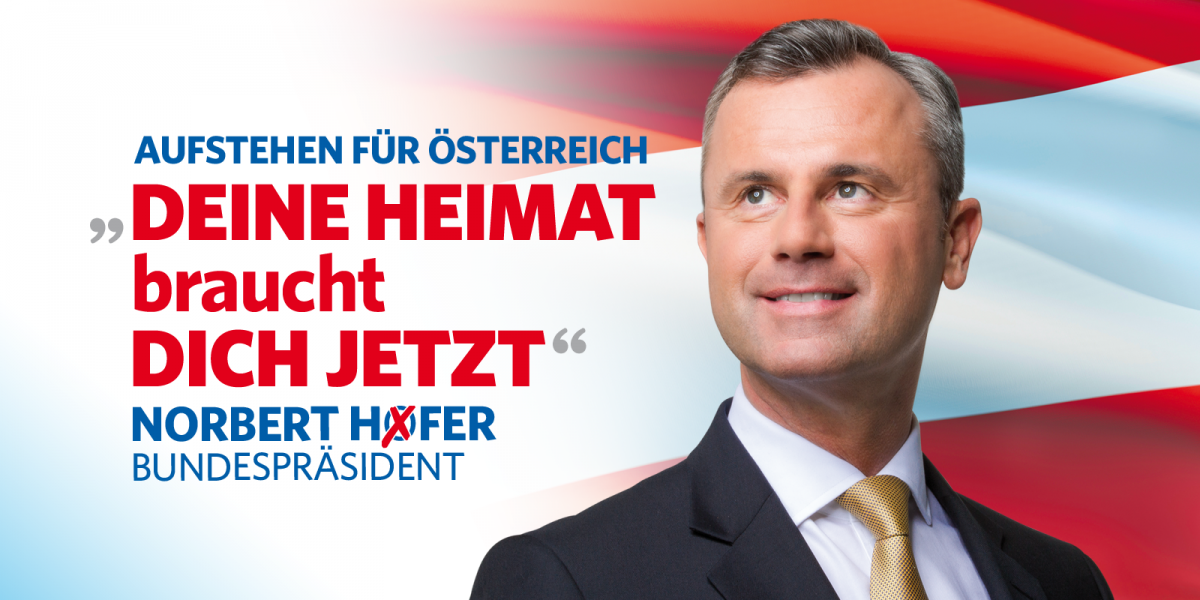
After months of political jousting, vote recounting and mishaps with ballot envelopes, Austrians will take to the polls on December 4 for the third time this year to choose their next president. And when they do – choosing between the independent candidate Alexander Van der Bellen and his opponent Norbert Hofer of the populist, xenophobic, right-wing Freedom Party – the results will not only echo within Austria but could set the tone of Europe's political future.
Austrian Chancellor Christian Kern believes the European Union is at its breaking point. Speaking to reporters on Tuesday in Vienna, he worried that that the union was failing to resonate with its constituents.
"After Brexit, after Trump, we're staring into the abyss,” said Kern. “We have to decide now: do we want to modernize the European project, make it more just and rescue it, or do we risk its existence?"
Far-right parties, long a stich within the European political fabric, are now successfully selling themselves as a solution to popular discontent with establishment politics. Once seen as radical factions within their respective countries, they've incrementally gained ground using well-timed political agendas focused on populist and anti-immigrant rhetoric.
"All this is fueled by the refugee crisis that started in 2015. It's like putting gasoline into a burning fire," said Andreas Orator, a professor of European law at the Vienna University of Economics and Business. "Many of these right-wing parties gained momentum because many people felt that established politics had no answers to the influx of refugees and migrants."
In Austria, Hofer's Freedom Party was one of the first to take advantage of popular anti-establishment sentiments. The party secured 35 percent of votes in the first round of elections in April while Van der Bellen, the former chairman of Austria’s Green Party, came in second. That election ended the back-and-forth governance between the center-left Social Democrats and the conservative Austrian People's Party that had ruled the country for seven decades.
Van der Bellen won the second round of elections in May by a razor-thin margin. But those results were annulled due to allegations of the mishandling of absentee ballots and tampering stemming from bad glue on envelopes.
Should Hofer win the presidency, he would be the country's first right-wing head of state since the end of World War II, putting the Freedom Party in a striking distance of the chancellorship after parliamentary elections in 2018.
"They [traditional parties] now see that this is the last chance they have to rule with a majority in the Austrian parliament," said Orator. "There's a high likelihood that the Freedom Party will come in first of all major parties in the general elections."
As the world continues to reel from a successful Brexit referendum and the surprise election of Republican real estate magnate and ex-reality TV celebrity Donald Trump in the U.S., populist fads in Europe are becoming a new, accepted fact. "Populism is no longer seen as a short-term phenomenon, but rather as something that will probably be here for quite some time," said Heiko Giebler, a research associate at the Berlin Social Science Center.
Outside of Austria, Marine Le Pen's Front National in France, Geert Wilders' Party for Freedom in the Netherlands and the Five Star Movement in Italy are running on anti-E.U., anti-immigrant platforms and solidifying their voter bases. Rightwing politicians in Hungary and Poland have already consolidated their power.
British voters’ decision to quit the E.U. in June and Trump's ascent to power in the United States illustrated that the trend could reach to the world’s bastions of democracy.
"Trump's success was a wake up call that this is really happening, and that populist movements all over the world are really successful at this point,” said Giebler. “We need to take them more seriously than we did beforehand."
But there may be a duality to the domino effect of populist success in Europe, Orator said. While right-wing leaders like Hofer may be able to build upon the success of Trump and Brexit as proof of popular discontent with establishment politics, it may also bolster others wanting to protect the European project.
"The Brexit result also tapped those who want to defend a strong presence within the European Union," he said.
The integrity of the European project faces major tests as France, the Netherlands, Italy and Germany all enter election season next year. If those countries' right-wing factions overtake the establishment, they'll still face their own tests as well – and if they can’t reform the systems they criticized in order to assume power, voters could lose faith in them, too, said Giebler.
"Some populist parties are no longer new contenders, but rather are themselves part of national parliaments or governments," he said. "So at a certain point, they will have to deliver on their promises. And I think that if they are not able to do so their voters will be rather quickly disappointed."
3 WAYS TO SHOW YOUR SUPPORT



- Log in to post comments


