
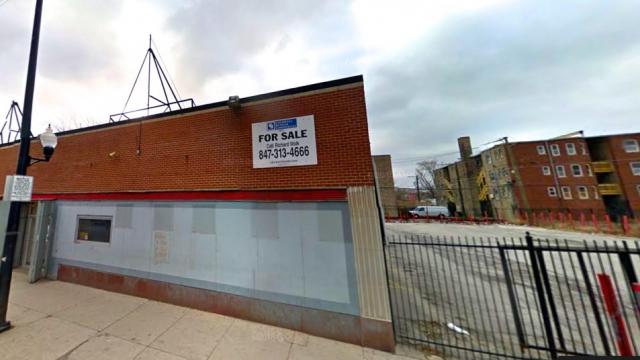
In just five years, the State of Illinois dedicated more than $2.4 million to the 4800 block of West Adams Street in Austin.
But don't look for new developments or freshly paved roads on that stretch of street, because that's not where the money went. No, $2.4 million is the amount of money the state spent on incarcerating people for drug offenses from that block alone.
"Honestly that doesn't really surprise me. ... There's a lot of drug activity around here, a lot of these boys operate out of these vacants," said Byran Rose, pointing to a pair of boarded-up apartment buildings across the street. Rose, who grew up in Austin, has lived on the block for 14 years.
"But the police come around here every chance they get, harrassing and arresting people whether there's drugs or not."
More than once, Rose said, officers have grabbed him while he stood outside his house and hauled him to a city jail "for no reason," before releasing him without a charge a few days later.
"I tell you what, I wish instead of spending so much money on [incarcerating people], they'd come fill some of these crater holes behind my house," Rose said. "Every time it rains, it turns into a damn swimming pool, I can barely drive through."
The 4800 block of West Adams and 4,636 other blocks in the city were the focus of Chicago's Million Dollar Blocks, a new data project published last week. A collaboration between social justice advocates and tech company DataMade, the site features an interactive block-by-block breakdown of how much money the city spent on jailing criminals from 2005 to 2009.
Based on data released by the Chicago Justice Project last year, the site was developed as a way "to see how incarceration affects communities on a local level," according to Dan Cooper, one of the project's leaders.
"All we hear about is how the state is in billions of dollars in debt, and meanwhile we have more than a billion dollars every year pumped into a corrections system that's had a track record of failure," said Cooper, the co-director of Adler University's Institute on Social Exclusion.
"We're always hearing about money being spent on development, and here you have this shadow budget pumping tons of money into taking people out of neighborhoods, instead of bringing them in."
Million Dollar Blocks looks at more than 300,000 criminal records, showing what developers called a "conservative estimate" of how much the Illinois Department of Corrections spent on people from each block and neighborhood.
Cooper said he and his colleagues assumed the minimum sentence for each offense, when in reality the state likely spends much more.
Developers at DataMade spent months putting together data based on offenders' home addresses, assuming that the state spends an average of $22,000 on each criminal every year.
DataMade founder Derek Eder said his team didn't factor in offenders who served more than one sentence, again suggesting that the actual amount spent on incarceration is even larger than what the site projects.
Alongside the map is a brief report breaking down some of the ways mass incarceration impacts local communities, plus suggestions for how the state could more effectively reinvest its corrections budget.
Daryl P., who's lived in Austin his whole life, said the state's incarceration pattern is hardly making the area less dangerous.
"They just keep taking people out of here and pumping them back in, and then once [ex-convicts] get back here they're just like Romans, doing as the Romans do," said Daryl, who declined to give his full last name.
Daryl said he's had multiple stints in prison.
"There ain't no rehabilitation when you're locked up. ... If anything, being around all those criminals, it makes you slicker. It makes you want to get back into it."
The state has already embraced some criminal justice reforms since 2009, and Gov. Bruce Rauner has beaten the drum for reducing the state's prison population since his campaigning days. But Cooper said the state should do more than aim for "the low-hanging fruit."
"We want to show that it really isn't enough just to do things like shortening sentences or lightening drug charges," Cooper said. "We need to shift money into rehabilitation programs, and move away from this overreliance on a punishment that's so severe, it's left a lot of neighborhoods worse off."
Other findings from the project include:
• Illinois spent almost twice as much on incarcerating people from Austin ($550 million) as it did on jailing people from any other neighborhood. Runners-up included Humboldt Park ($293 million), North Lawndale ($241 million) and West Englewood ($187 million).
• The state spent the least on incarcerating people from Edison Park ($1.24 million), followed by O'Hare ($1.43 million), Forest Glen ($2.33 million) and Hegewisch ($3.7 million).
• Of the more than 4,600 blocks included in the project, 851 of them had at least $1 million committed to the Department of Corrections.
3 WAYS TO SHOW YOUR SUPPORT



- Log in to post comments


