
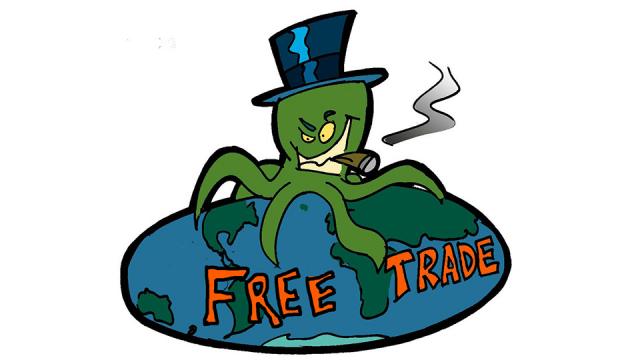
In May, an international trade agreement was signed that effectively serves as a kind of legal backbone for the restructuring of world markets. While the Trade in Services Agreement (TISA) negotiations were not censored outright, they were barely mentioned in our media. This marginalization and secrecy was in stark contrast to the global historical importance of what was agreed upon.
In June, WikiLeaks made public the secret draft text of the agreement. It covers 50 countries and most of the world's trade in services.
It sets rules that would assist the expansion of financial multinationals into other nations by preventing regulatory barriers. It prohibits more regulation of financial services, despite the fact that the 2007-08 financial meltdown is generally perceived as resulting from a lack of regulation. Furthermore, the US is particularly keen on boosting cross-border data flow, including traffic of personal and financial data. Despite all this, we heard little about it.
Yet is this discrepancy between importance and secrecy really surprising? Is it not rather a sad but precise indication of where do we, in western liberal democratic countries, stand with regard to democracy?
A century and a half ago, in Das Kapital, Karl Marx characterized the market exchange between worker and capitalist as "a very Eden of the innate rights of man. There alone rule Freedom, Equality, Property and Bentham." For Marx, the ironic addition of Jeremy Bentham, the philosopher of egotistical utilitarianism, provides the key to what freedom and equality effectively mean in capitalist society.
To quote The Communist Manifesto: "By freedom is meant – under the present bourgeois conditions of production – free trade, free selling and buying." And by equality is meant the legal formal equality of buyer and seller, even if one of them is forced to sell his labor under any conditions (like today's precarious workers).
The main culprits of the 2008 financial meltdown now impose themselves on us as experts leading us on the painful path to financial recovery. Their advice should trump parliamentary politics. Or, as Mario Monti put it: "Those who govern must not allow themselves to be completely bound by parliamentarians."
What, then, is the higher force whose authority can suspend the decisions of the democratically elected representatives of the people? As far back as 1998, the answer was provided by Hans Tietmeyer, the then governor of the Deutsche Bundesbank, who praised national governments for preferring "the permanent plebiscite of global markets" to the "plebiscite of the ballot box."
Note the democratic rhetoric of this obscene statement: global markets are more democratic than parliamentary elections, since the process of voting goes on in them permanently (and is permanently reflected in market fluctuations) and at a global level, not only within the limits of a nation state.
This, then, is where we stand with regard to democracy, and the TISA agreement is a perfect example. The key decisions concerning our economy are negotiated and enforced in secret, and set the coordinates for the unencumbered rule of capital. In this way, the space for decision-making by the democratically elected politicians is severely limited, and the political process deals predominantly with issues towards which capital is indifferent (like culture wars).
This is why the release of the TISA draft marks a new stage in the WikiLeaks strategy: until now its activity has been focused on making public how our lives are monitored and regulated by the intelligence agencies – the standard liberal topic of individuals threatened by oppressive state apparatuses. Now another controlling force appears – capital – which threatens our freedom in a much more twisted way: by perverting our very sense of what the word means.
3 WAYS TO SHOW YOUR SUPPORT


- Log in to post comments


