
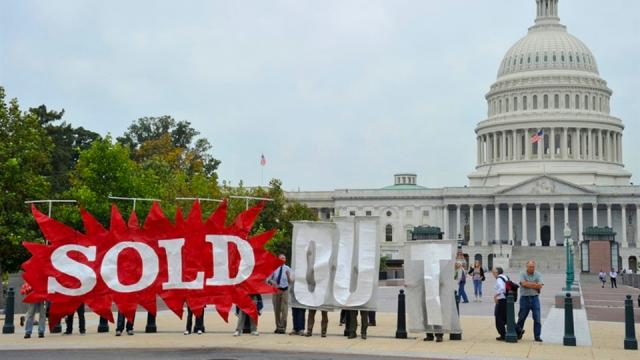
You’ve probably been hearing warnings about the Trans-Pacific Partnership (TPP) “trade” agreement that is being negotiated. And you might have heard that the big corporations are going to push to use something called “fast track” trade promotion authority (TPA) to push it through.
It’s time to learn about TPP and fast track, and then call your member of Congress to let them know if you want them to hand the giant multinationals an end-run around democracy and national sovereignty.
The Fast Track Push Is Coming
“Fast track” trade promotion authority, if passed, means Congress yields its constitutional authority and obligation to review and amend trade agreements. A “fast track” treaty has to be voted on quickly, cannot be amended, and Congress has to give it an up-or-down vote.
The U.S. Trade Representative (USTR) Michael Froman is pushing Congress to pass “fast track,” in hope of pushing through the TPP agreement by the end of the year. Politico lays it out in “Froman pushing Congress to finalize trade deals”:
"President Barack Obama was often criticized in his first term for moving too slowly on trade, but now his chief negotiator is pressing Congress to pick up the pace as the White House pushes to conclude a landmark trade deal in the Asia-Pacific by the end of the year. "[. . .] Froman and his team at USTR are pushing to finish the TPP talks by the end of the year, putting pressure on Congress to move a TPA bill to set the stage for the final phase of talks."
Fast Track To Push TPP
The next “trade” treaty will be the Trans-Pacific Partnership (TPP). This is a huge treaty with only a small part covering trade. Most of the agreement (according to leaks) sets down a new kind of regulatory structure for the giant corporations that would supersede the ability of any country to rein them in. The treaty is being negotiated in secret with only business interests “at the table.” Representatives of others with a stake in the outcome are not part of the process. Groups representing the interests of consumers, labor, human rights, the environment, democracy or even smaller and innovative companies that might want to compete with the giant multinationals are not part of the negotiations.
Economist Dean Baker explains that TPP is not about “free trade” and growth, writing:
"Of course the TPP is not about free trade, in most cases the formal trade barriers between the countries negotiating the pact are relatively low. The main thrust of the negotiations is to impose a regulator structure in a wide range of areas — health, safety, environmental — which will override national and sub-national rules. This has little to do with trade and in some cases, such as the increased patent protection for prescription drugs being pushed as part of the deal (which is noted in the article), will actually involve increased barriers to trade."
In The Trans-Pacific Partnership: A Trade Agreement for Protectionists, Baker writes:
“The TPP is about crafting rules that will favor big business at the expense of the rest of the population in both the United States and in other countries. "… The world has benefited from the opening of trade over the last four decades. But this opening has been selective so that, at least in the United States, most of the gains have gone to those at the top. It is possible to design trade deals that benefit the population as a whole, but not when corporate interests are literally the negotiators at the table."
Other “Trade” Agreements Have Cost Us Dearly
One after another “trade” agreements come along that, rather than helping lift the working people of the world, instead help the multinationals use exploited workers to break unions and lower wages. These agreements also let companies manufacture in countries that do not require environmental protection while bringing the resulting lower-priced goods here with no added cost at the border, undermining our own protections. Allowing these things makes our democracy, and its good wages and protections, a competitive disadvantage in world markets.
Previous trade agreements were passed with the promise of increases in growth and wages here, but the opposite has resulted. And they have increased rather than reduced our trade deficits. They have only served to enrich the already-wealthy.
NAFTA: According to the Economic Policy Institute (EPI) briefing paper “Heading South: U.S.-Mexico trade and job displacement after NAFTA,” “As of 2010, U.S. trade deficits with Mexico totaling $97.2 billion had displaced 682,900 U.S. jobs.” (That is net jobs, taking into account jobs gained.)
China: In August, 2012 EPI estimated that the U.S. lost 2.7 million jobs as a result of the U.S.-China trade deficit between 2001 and 2011, 2.1 million of them in manufacturing. Aside from job losses wages US wages fell due to the competition with cheap Chinese labor costing a typical household with two wage-earners around $2,500 per year.
Columbia – “murders and threats”: A report issued Monday by Reps. George Miller (D-Calif.) and James McGovern (D-Mass.) titled The U.S.-Colombia Labor Action Plan: Failing on the Ground says:
"Despite the LAP, murders and threats against union members and harmful subcontracting persist in Colombia largely unabated. At a minimum, 413 threats were documented, and 22 trade unionists were murdered for their union involvement in 2012.1 On April 1, 2013, the 991st death threat against a member of the labor movement was received since President Juan Manuel Santos became president in June 2011.2 Because of the fear of violence or employer retaliation associated with organizing or joining a union and the prevalence of anti-union and anti-worker prejudice, only four percent of Colombian workers are union members. "[. . .] “The members of the delegation conclude that the Government of Colombia is woefully falling short of compliance with the Labor Action Plan, and in many cases, these shortfalls have made working conditions for workers worse than before it came into effect,” the report said. “Before asking Congress to approve another trade agreement, such as the TPP, which poses similar labor and human rights issues, the Administration must first demonstrate concrete and effective improvements in workers’ rights on the ground in Colombia under the Labor Action Plan.”
Korea: EPI reported in July that the U.S.-Korea free trade agreement had already cost the U.S. 40,000 jobs and increased our trade deficit by $5.8 billion. According to EPI:
"The tendency to distort trade model results was evident in the Obama administration’s insistence that increasing exports under KORUS would support 70,000 U.S. jobs. The administration neglected to consider jobs lost from the increasing imports and a growing bilateral trade deficit. In the year after KORUS took effect, the U.S. trade deficit with South Korea increased by $5.8 billion, costing more than 40,000 U.S. jobs. Most of the 40,000 jobs lost were good jobs in manufacturing."
Promises, Promises
The Politico story quoted above claims that President Obama is criticized for “moving too slowly on trade.” If anything, President Obama is criticized for promising in his 2008 campaign to renegotiate NAFTA, and reneging once in office.
GET INFORMED:
If you want to help stop “fast track,” call your member of Congress today.
*Visit Stop TPP
*Visit the Eyes on Trade blog
Expose the TPP is a great action-oriented site.
There’s also Flush the TPP.
The AFL-CIO recent convention passed a plan for people-oriented trade. Read the resolution here.
3 WAYS TO SHOW YOUR SUPPORT



- Log in to post comments


