
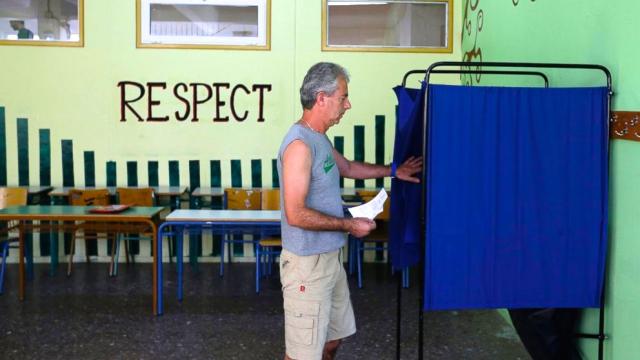
Greeks on Sunday decisively rejected a bailout deal proposed by the country's international creditors, which demanded new austerity measures in return for emergency funds. The vote amounted to a stinging rebuke of the austerity measures imposed on Greece since 2010.
Greece's Interior Ministry announced Sunday night that it projects more than 61 percent of voters decided against the deal.
A win of the "no" camp would constitute a major victory for Greek Prime Minister Alexis Tspiras, who had campaigned heavily against the deal put forward by the European Central Bank, the International Monetary Fund and the European Commission. But it will also raise uncertainty about the country's financial future and its place in the eurozone.
"Even in the most difficult circumstances, democracy can't be blackmailed – it is a dominant value and the way forward," Tsipras tweeted on Sunday night, adding that Greece intends to restart negotiations with Europe next week.
Waving flags and chanting "No, No, No," thousands of "no" voters descended on Athens's Syntagma Square on Sunday night in anticipation of an official announcement about the referendum's result.
"This is an imprint of the will of the Greek people and now it's up to Europeans to show if they respect our opinion and want to help," Nikos Tarasis, a 23-year-old student, told Reuters.
Sunday's vote came after a week of heated rhetoric from the Greek government and European leaders. Athens's years-long bailout program ran out without a renewal agreement Tuesday, the same day the country failed to make a 1.6 billion euro debt payment to the IMF.
Greek Prime Minister Alexis Tsipras announced the referendum last Saturday in a surprise address when it became clear that, after months of negotiations, both parties still differed on new budget cuts demanded by the creditors in return for emergency funds.
Tsipras implored Greeks to vote against accepting the terms of the bailout throughout the week, arguing that a "no" vote would strengthen Athens's position in further negotiations.
The prime minister cast his ballot for the "no" campaign in front of the cameras Sunday, saying "no one can ignore the will of the people to take their lives in their hands."
Antonis Samaras, former Greek prime minister and current opposition leader, announced his resignation hours after the polls closed.
European leaders, on the other hand, had voiced heavy support for the "yes" campaign, insisting that a "no" vote would leave Greece no option but to leave the eurozone.
Martin Schulz, the head of the European Parliament, told German radio on Sunday that Greece would have to introduce another currency if the "no" vote prevailed. "If they say ‘no’ they will have to introduce another currency after the referendum because the euro is not available as a means of payment," Schulz said.
But in Sunday's referendum, Greek voters sent a clear message they had enough of Europe's austerity demands.
"If the Europeans really wanted Greece to stand on its feet, then they could have done so without imposing such harsh measures," 26-year-old Yiannis Gkovesis told the Associated Press.
"We don't want austerity measures anymore. This has been happening for the last five years and it has driven so many into poverty. We simply can't take any more austerity."
It is unclear how and when talks between Greece and its creditors would move forward. Greek government officials said on Sunday they wanted to restart negotiations immediately, Reuters reported. However, a European official denied that talks would take place so soon.
German Chancellor Angela Merkel and French President Francois Hollande have called an emergency summit on Tuesday to discuss the financial crisis. Both leaders will meet in Paris on Monday to deliberate on a joint response.
The euro fell sharply after news about the Greek vote spread throughout the eurozone, according to Reuters.
Millions of Greeks came out on Sunday to cast their votes at polling stations across the country. According to Greece's Interior Minister Nikos Voutsis, the participation rate was more than 50 percent, well over the 40 percent needed for the referendum to be legal.
The referendum comes after a week of extreme uncertainty in the Mediterranean country. Most Greek banks have been closed all week and capital controls were put in place to prevent the collapse of its financial system. Supermarkets, gas stations and ATMs saw long lines. Some senior citizens waited for days in front of the few banks that were open to collect their pensions.
More uncertainty is ahead. Louka Katseli, chairwoman of the National Bank of Greece, warned on Friday that ATMs in the country will start running dry within hours after the vote if the European Central Bank does not provide new funds or ceilings on withdrawals are not reduced.

3 WAYS TO SHOW YOUR SUPPORT



- Log in to post comments


