
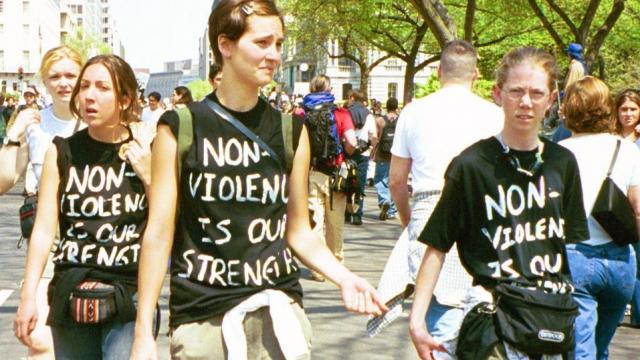
As an American writer, I often examine the story of our nation for emergent archetypes of U.S. identity. Several are terribly embarrassing for a citizen of conscience: the Couch Potatoes of Consumer-Capitalist Society, the American Gladiator of War-Rage and Bigotry, the Avaricious and Appalling Wall St. Tycoon.
Yet, one plucky character threads its way stolidly through the story of the U.S., challenging the apathy and atrocities of other archetypes, marginalized in the media, misrepresented in history, proposing itself as an audacious, eternal figure in the identity of this nation: the Activist, linking arms with fellow citizens and striving for change. Flawed and heroic, with blind spots the size of Texas, with imperfect vision yet awe-inspiring determination, this character has appeared in many millions of Americans of all races, genders, sexualities, classes, faiths, creeds, and ages.
Against the backdrop of violence and greed, this character shows up again and again, refining the tools of nonviolent action into something as American as apple pie.
Nonviolent action, you say?
Yes, nonviolent action. We are steeped in a culture of violence, but as I was researching in preparation for writing my novel, The Dandelion Insurrection, which depicts a nonviolent movement in a slightly fictional United States, I was surprised to discover how frequently nonviolent action has been used to make change in the U.S. ... and how powerfully it has shaped our nation. The Civil Rights Movement comes to everyone’s mind, and perhaps the United Farmworkers’ struggle, but nonviolent action also liberated slaves via the Underground Railroad, brought us women’s suffrage and environmental protections, formed the core of the labor movement tactics, replaced child labor with public education, and, according to John Adams, won the American Revolution.
Often minimized in our history books, the tactics of nonviolent action played a powerful role in achieving American Independence from British rule. One hundred and fifty years before Gandhi, the colonists were employing many of the same tactics the Indian Self-Rule Movement would use to free themselves from Great Britain. The boycotting of British goods (tea, cloth, and other items) significantly undermined British profits from the colonies. Noncooperation with unjust laws eroded British authority as the colonists refused to comply with laws that restricted assembly and speech, allowed the quartering of soldiers in colonists’ homes, and imposed curfews.
Non-payment of taxes would prove to be a landmark issue for the independence movement. The development of parallel governments and legal structures strengthened the self-rule and self-reliance of the colonists and grew local political control that would ultimately prove strong enough to replace British governance of the colonies. Acts of protest and persuasion, petitions, pamphlets, rallies, marches, denouncements, legal and illegal publications of articles, and disruption of British meetings and legal proceedings were also employed.
Reflecting on these actions, John Adams remarked that the independence of the United States was won long before a single shot was fired. Acts of noncooperation, civil disobedience, protest and persuasion, intervention, parallel institutions, and economic boycotts brought the independence movement to such a powerful position that the so-called War of Independence was not the Americans’ way of achieving freedom, but rather, the British Crown’s attempt to regain what was already lost.
Most Americans are familiar with the violent methods of the revolutionary period, but unaware of the potent effectiveness of the nonviolent actions that strengthened the internal organization of these American activists. The founding fathers and mothers were not perfect by any stretch of the imagination: subjugation of women, enslavement of Africans, genocide of native tribes, blatant racism, class prejudice and discrimination – the list goes on.
Yet, an examination of how they waged struggle for independence from British rule will reveal early applications of the same tools the suffragettes would use for women’s rights, the centuries-old peace movement would use for anti-war struggles, the African-Americans would use for civil rights, the labor movement would use to win eight-hour work days, minimum wages, health and safety standards, etc. Although it was Gandhi who first used the term “nonviolent resistance,” it was an American, Henry David Thoreau, who coined the term “civil disobedience”.
Nonviolent action is as American as apple pie. It is part of our history and heritage. It has shaped this nation powerfully and potently. It has been one of our more noble contributions to global struggles for justice and equality. At a time when the American identity hangs between the archetypes of violence, greed, and apathy, the lineage of the nonviolent activist offers us an alternative... one it would behoove every U.S. citizen to emulate.

3 WAYS TO SHOW YOUR SUPPORT



- Log in to post comments


