Read

User menu

Search form

How the Wealth and Income Gap Is Impacting Americans' Diets

How the Wealth and Income Gap Is Impacting Americans' Diets
Wed, 9/10/2014 - by Tara Culp-Ressler
This article originally appeared on Thinkprogress

Americans’ diets have gradually been improving, but the gains aren’t being shared equally across socioeconomic lines, according to a new study published in the Journal of the American Medical Association Internal Medicine. Low-income people’s diets have gotten worse over the past decade as richer people’s nutrition has been improving.

Researchers examined Americans’ diet quality over a 12 year period, using an index of healthy eating developed by the Harvard School of Public Health in which a perfect score is 110.

Between 1999-2000, U.S. adults averaged about 40 points on that scale. Although the average climbed to 47 points in 2009-2010, the study authors caution that doesn’t necessarily signal a lot of good news. It’s only a modest improvement, and the gap in nutritional quality between rich Americans’ and poor Americans’ diets actually doubled over that time period.

The growing disparity is likely due to the recent recession, which deepened income inequality and made it harder for low-income Americans to afford healthy food. “Declining diet quality over time may actually widen the gap between the poor and the rich,” Dr. Frank Hu, one of the co-authors of the study, told the Associated Press.

The national obesity epidemic is inextricably related to poverty, as low-income Americans are more likely to struggle with their weight. More than 33 percent of adults who earn less than $15,000 per year are considered to be obese, compared with about 25 percent of people who earn more than $50,000 per year.

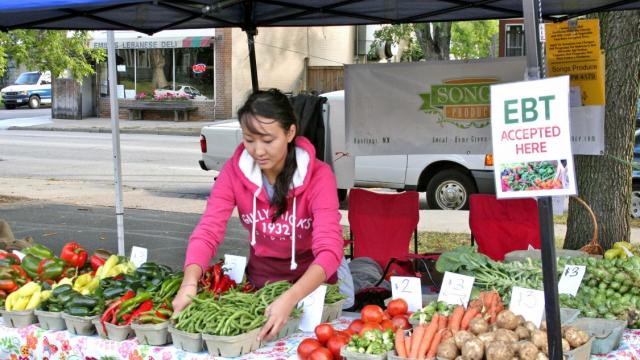
That’s partly because impoverished Americans often lack access to nearby grocery stores where they can buy healthy food; it’s also because some types of processed food are less expensive than more nutritious options like fresh produce and whole grains.

Indeed, the members of Congress who commit to taking the minimum wage challenge quickly learn that it’s difficult to make healthy choices on an extremely limited food stamp budget. Poor Americans are also less likely to have the time and energyto invest in an effective exercise regimen, and are more likely to turn to bogus diet pills that don’t deliver the promised results.

Although efforts to address Americans’ obesity rates are often framed in terms of people’s personal responsibility to make healthier choices, experts argue there also need to be substantial policy changes to address these issues of economic inequality.

“All parents are interested in feeding their families healthy meals,” Jessica Caouette, a cooking instructor with Cooking Matters, a nonprofit that teaches low-income families how to prepare nutritious meals on a budget, told the National Geographic. But, according to Caouette, “price is a concern for low-income families.”

Although some Republican lawmakers have proposed punitive measures like limiting the types of food that Americans are allowed to purchase through the food stamp program, advocates like Caouette have taken a different approach — figuring out ways to teach low-income Americans the skills to eat healthy on just a few dollars a day.

Originally published by ThinkProgress

3 WAYS TO SHOW YOUR SUPPORT

ONE-TIME DONATION

Just use the simple form below to make a single direct donation.

DONATE NOW

MONTHLY DONATION

Be a sustaining sponsor. Give a reacurring monthly donation at any level.

GET SOME MERCH!

Now you can wear your support too! From T-Shirts to tote bags.

SHOP TODAY

Sign Up

Article Tabs

The world has lost an incredible thinker and doer. I have lost an amazing friend. A void exists where before it was filled with David's optimism, humour and joy.

Kevin Zeese speaks at a rally for Chelsea Manning. By Ellen Davidson.

Kevin fought to bring truth every day. We must not lose this struggle.

To win the climate argument, advocates must show how Covid-19 bailout funds could be redirected – instead of making similar mistakes as the 2008 financial crisis.

The most analogous failure to the impending economic turbulence is the financial crisis of 2008, caused, primarily, by the deregulation of the financial industry.

#MeToo, India sexism, women's rights, sexual abuse

Activists are continuing the fight but are exhausted, balancing careers and a movement, that, to most, has become a personal battle.

The world has lost an incredible thinker and doer. I have lost an amazing friend. A void exists where before it was filled with David's optimism, humour and joy.

Kevin Zeese speaks at a rally for Chelsea Manning. By Ellen Davidson.

Kevin fought to bring truth every day. We must not lose this struggle.

David Graeber at his home in Manhattan in in 2005. A public intellectual, professor, political activist and author, he captivated a cult following that grew globally with each book he published over the last decade.Credit...Jennifer S. Altman for NYT

He wrote about crushing debt, pointless jobs and the negative effects of globalization. And he played a leading role in the Occupy Wall Street movement.

To win the climate argument, advocates must show how Covid-19 bailout funds could be redirected – instead of making similar mistakes as the 2008 financial crisis.

The most analogous failure to the impending economic turbulence is the financial crisis of 2008, caused, primarily, by the deregulation of the financial industry.

The world has lost an incredible thinker and doer. I have lost an amazing friend. A void exists where before it was filled with David's optimism, humour and joy.

Posted 6 days 12 hours ago
Kevin Zeese speaks at a rally for Chelsea Manning. By Ellen Davidson.

Kevin fought to bring truth every day. We must not lose this struggle.

David Graeber at his home in Manhattan in in 2005. A public intellectual, professor, political activist and author, he captivated a cult following that grew globally with each book he published over the last decade.Credit...Jennifer S. Altman for NYT

He wrote about crushing debt, pointless jobs and the negative effects of globalization. And he played a leading role in the Occupy Wall Street movement.