
Read

User menu

Search form

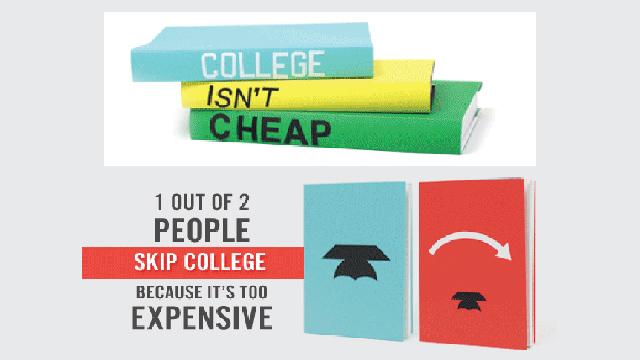
Infographic on Education: Numbers No Student Wants to Hear

Infographic on Education: Numbers No Student Wants to Hear
Mon, 1/14/2013 - by Jason
This article originally appeared on Frugal Dad

There are dozens of benefits that justify earning a higher education, including – but by no means limited to – better employment prospects, access to jobs with higher pay and the broadening of a college student’s social and mental horizons.

Even so, approximately one in two high school graduates choose to forgo these potential benefits because they cannot reconcile the cost of the college experience with the bleak reality of the financial situation in which many new college grads find themselves.

There’s no denying that college is outrageously expensive. And, unfortunately, it is only getting worse; while the average family income in the United States grew 147% in the years between 1982 and 2007, the cost of college grew by a staggering 440% in that same period.

What that means in terms of real numbers is that the average cost of a four-year degree from a state school is now $30,000. Most American families do not have that kind of money up front, which necessitates that they borrow it from private or government programs that issue student loans.

Unfortunately, student loans leave college graduates an average of $20,000 in debt when they finish school. And approximately 10% of graduates will have twice that debt to repay. Collectively, American students owe more than $1 trillion.

Figures like these, in combination with the fact that only half of all college graduate obtained a full-time job in 2011, are why more than 6 million graduates cannot pay back their student loans. The economic recession that began in 2008 has made it exceptionally difficult for college graduates to find jobs in their field. The upshot is that students take on lower-paying jobs that do not require degrees in order to make ends meet. Even so, that limited income is, in many cases, not enough to pay back their debt.

One in six default on their loans and a whopping 85% of 2011 college graduates were forced to move back in with their parents after school because they could not afford their own living space. To keep your children from contributing to that statistic, there are several ways to start saving well ahead of the day they move into the dorms:

• Start when your kids are young

• Contribute regularly to a savings account

• Invest wisely in equities

• Take advantage of 529 College Savings Plans

• Utilize tax credits for parents of college students

Of course, parents do not have to shoulder the entire responsibility of their children’s education. There are many ways for students to help pay for their own education, including earning scholarships, applying to federal student aid programs and participating in work study opportunities.

To make sure teenagers are contributing to their college funds, parents can encourage them to grow their own income by saving money from a part-time job. Remember, saving just $20 per week by making small sacrifices leads to $1,000 in savings over a year. And with college tuition rates steadily increasing, every dollar counts.

College Isn't Cheap

3 WAYS TO SHOW YOUR SUPPORT

ONE-TIME DONATION

Just use the simple form below to make a single direct donation.

DONATE NOW

MONTHLY DONATION

Be a sustaining sponsor. Give a reacurring monthly donation at any level.

GET SOME MERCH!

Now you can wear your support too! From T-Shirts to tote bags.

SHOP TODAY

Sign Up

Article Tabs

The world has lost an incredible thinker and doer. I have lost an amazing friend. A void exists where before it was filled with David's optimism, humour and joy.

Kevin Zeese speaks at a rally for Chelsea Manning. By Ellen Davidson.

Kevin fought to bring truth every day. We must not lose this struggle.

To win the climate argument, advocates must show how Covid-19 bailout funds could be redirected – instead of making similar mistakes as the 2008 financial crisis.

The most analogous failure to the impending economic turbulence is the financial crisis of 2008, caused, primarily, by the deregulation of the financial industry.

#MeToo, India sexism, women's rights, sexual abuse

Activists are continuing the fight but are exhausted, balancing careers and a movement, that, to most, has become a personal battle.

The world has lost an incredible thinker and doer. I have lost an amazing friend. A void exists where before it was filled with David's optimism, humour and joy.

Kevin Zeese speaks at a rally for Chelsea Manning. By Ellen Davidson.

Kevin fought to bring truth every day. We must not lose this struggle.

David Graeber at his home in Manhattan in in 2005. A public intellectual, professor, political activist and author, he captivated a cult following that grew globally with each book he published over the last decade.Credit...Jennifer S. Altman for NYT

He wrote about crushing debt, pointless jobs and the negative effects of globalization. And he played a leading role in the Occupy Wall Street movement.

To win the climate argument, advocates must show how Covid-19 bailout funds could be redirected – instead of making similar mistakes as the 2008 financial crisis.

The most analogous failure to the impending economic turbulence is the financial crisis of 2008, caused, primarily, by the deregulation of the financial industry.

The world has lost an incredible thinker and doer. I have lost an amazing friend. A void exists where before it was filled with David's optimism, humour and joy.

Posted 6 days 12 hours ago
Kevin Zeese speaks at a rally for Chelsea Manning. By Ellen Davidson.

Kevin fought to bring truth every day. We must not lose this struggle.

David Graeber at his home in Manhattan in in 2005. A public intellectual, professor, political activist and author, he captivated a cult following that grew globally with each book he published over the last decade.Credit...Jennifer S. Altman for NYT

He wrote about crushing debt, pointless jobs and the negative effects of globalization. And he played a leading role in the Occupy Wall Street movement.