
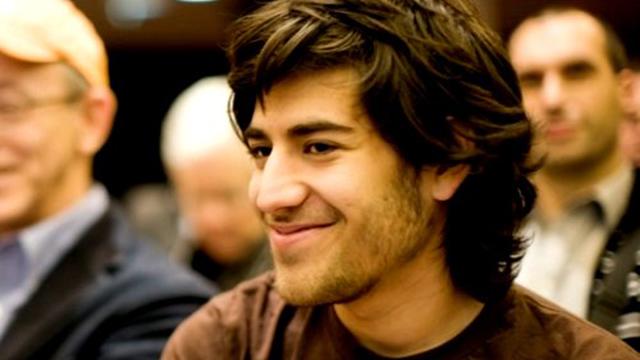
They came from all over Silicon Valley, hundreds packing the pews of an old church to pay their respects to Aaron Swartz, the 26-year-old programmer and Internet activist who took his own life this month.
They didn't just come to mourn a fallen comrade, they said. They came to carry on his fight. The memorial service held last week at the Internet Archive, a nonprofit group that occupies a former church in San Francisco, was as much political rally as solemn tribute.
"Aaron Swartz was not a criminal. He was a citizen and a brave soldier in a war which continues today, a war in which corrupt and venal profiteers try to steal and hoard and starve our public domain for their own private gain," said Carl Malamud, a technologist and outspoken advocate for open access to information.
In death, Swartz has become a political martyr for the cause he championed in life: making scientific and scholarly research — much of it taxpayer-funded — freely available, not sequestered behind online pay walls out of the reach of the public.
The broader Internet freedom movement has also claimed Swartz as a cause. The self-described "hactivist" group Anonymous knocked out the website of the U.S. Sentencing Commission twice over the weekend to protest the government's treatment of Swartz.
Facing the possibility of a lengthy prison sentence if convicted on criminal charges for downloading millions of academic articles, Swartz hanged himself in his Brooklyn, N.Y., apartment. Friends say he had struggled with depression.
"Aaron's death should radicalize us," Taren Stinebrickner-Kauffman, Swartz's girlfriend, said in an emotional appeal to the open-access movement Thursday night.
Since his death, academics who support open access have posted their research online for all to see and download. And those in the movement say young people who never knew Swartz are joining their ranks, taking part in memorial hackathons and protests around the globe.
"I think a lot of people are going to be inspired by Aaron to act," said Peter Eckersley, technology projects director of the Electronic Frontier Foundation and a former roommate of Swartz's.
The battle over open access has been raging for years — and Swartz's death only promises to make that battle even more heated, activists say.
Most people can't afford the high prices charged for scholarly and scientific research published in hard-copy journals or on the Web behind pay walls, creating what Malamud says is "a members-only country club of knowledge."
With the rise of the Internet, activists had hoped to change that. About a decade ago, scholars and scientists, libraries and universities started to publish peer-reviewed research online free of charge after the release of the Budapest Open Access Initiative in 2002.
The movement steadily gained steam, said Heather Joseph, executive director of the Scholarly Publishing and Academic Resources Coalition, which works to broaden public access to scholarly research. In 2005, the National Institutes of Health adopted an open access policy. Nearly 2.5 million articles are on the NIH database, and more than 700,000 people access PubMedCentral every day. But NIH is still the only federal agency with an official public access policy on the books.
Activists have pushed legislation that would extend the NIH policy to other federal science agencies. But commercial and nonprofit publishers, professional societies and many academics have pushed back, introducing their own legislation to roll back open access at NIH. They argue that making all scholarly and scientific research freely available would upend a centuries-old system of peer review and publication and bankrupt academic journals.
Rob Weir, who teaches history at Smith College in Massachusetts, is the associate editor of a small journal. He says Swartz ignored the hidden costs and dangers of making research freely available.
"I am sorry that Swartz died," Weir wrote in an essay on the Inside Higher Ed website. "I do assert, though, that he was no hero. The appropriate label is one he once proudly carried: hacker. Hacking, no matter how principled, is a form of theft."
Swartz did not believe he was the one stealing. Activists say Swartz took personal risks to unlock the world's vast archives of knowledge, convinced that letting computers access massive amounts of data that's currently restricted could lead to scientific breakthroughs and greater social good.
"It's time to come into the light and, in the grand tradition of civil disobedience, declare our opposition to this private theft of public culture," Swartz wrote in an open-access manifesto. "We need to take information, wherever it is stored, make our copies and share them with the world."
In 2008, Swartz and Malamud used a free trial of the federal government's Public Access to Court Electronic Records to download 20 million pages of court documents, about 20% of the database. The federal government investigated but did not prosecute.
Three years later, federal prosecutors charged Swartz with breaking into the computer networks at the Massachusetts Institute of Technology to gain illegal access to JSTOR, a subscription service for scientific and literary journals. According to the government's indictment, Swartz downloaded 4.8 million articles and documents, nearly the entire library. Prosecutors alleged he intended to create a Napster for scholarly and scientific research.
"Aaron came from a generation that had grown up with computers and grown up with the Internet. For that generation the question was not 'How do we enforce copyright?' The question was 'Why isn't everything on the Web already?'" Eckersley said.
Brewster Kahle — founder of the Internet Archive, a group that preserves Web pages and makes books and other texts more widely available in digital form — said Swartz was true to his principles. His was an "open-sourced" life, Kahle said, adding that Swartz blogged prolifically, openly sharing his intellectual curiosity and innermost — and at times darkest — thoughts on the Web.
Several years ago Swartz put up a Web page that started with "If I get hit by a truck …" and appointed a "virtual executor." His final instructions for the executor was to make all the contents of his computer hard drives freely available to everyone on the Internet.
3 WAYS TO SHOW YOUR SUPPORT



- Log in to post comments


