
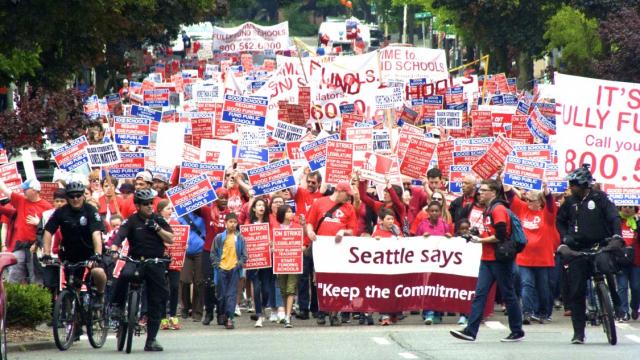
By most accounts, the weeklong strike by 5,000 teachers, librarians and other public-school employees in Seattle that ended Sept. 17 was about wages. The Seattle School Board said the union was asking for $172 million in increased funding, nearly three times what it could afford. The employees’ union, the Seattle Education Association, wanted a significant wage increase to recruit and retain quality educators; members have gone six years without a cost-of-living adjustment. A new teacher earning $44,372 annually in Seattle would spend nearly two-thirds of his or her take-home pay on the median rent of $1,858 in the city.
The union settled for smaller wage increases — about 10 percent over three years — than it initially sought, but it claimed victory because the school board agreed to nearly every other demand. The Seattle teachers prevailed because they made the strike about much more than wages. It is part of a greater struggle over the future of America’s cities: whether they become semiprivatized playgrounds for elite professionals or can thrive on different communities, classes and ideas democratically co-existing.
The battle over who controls Seattle is intimately linked to who controls public education. In 2012, what Valerie Strauss in The Washington Post called a “who’s who of billionaires” — including members of the Walton family (heirs to the Walmart fortune) and Seattle titans Bill Gates of Microsoft, Jeff Bezos of Amazon and venture capitalist and liberal darling Nick Hanauer — funded a measure to open 40 taxpayer-funded charter schools in Washington. Days before the teachers went on strike, the state Supreme Court ruled the charter schools violated the state constitution by funneling public money to a privately run enterprise.
The court slapped the legislature with a $100,000-a-day fine because in 2012 it found that lawmakers were shirking their constitutional duty to close a chronic funding gap between wealthy and poor school districts. (Some suggested that the Walton and Gates families, with a combined net worth of $235 billion, could fund the charter schools with their pocket change.)
This assault on public education in Seattle and nationwide is the context for the strike. In May teachers throughout Washington state staged one-day walkouts to protest the legislature’s dithering over school funding. The Seattle teachers’ union knew it needed public support to launch a strike against powerful political and economic elites, so it linked workplace issues — workloads, fair evaluations and pay — to community issues such as funding and stronger student education and well-being. It is a strategy known as social justice unionism and takes a page from the playbook of successful teacher organizing in Chicago and Los Angeles and Portland, Oregon.
Demands include fewer standardized tests and new social equity teams to address biases, such as suspension rates for black children in Seattle schools four times as high as for white kids. Teachers also want at least 30 minutes for recess, since schools in poorer areas have reduced playtime to as little as 15 minutes. And they’re asking for more counselors and psychologists to reduce caseloads as high as 400 students per employee.
The Seattle School Board eventually agreed to all these demands, after rejecting them before the strike, but it isn’t the one calling the shots. Power rests with money — Bill Gates, the Waltons and billionaire Eli Broad, who have spent billions of dollars trying to demolish public education and teachers’ unions nationwide. They have done this through foundations and the charter school movement and have received help from many politicians, pundits and the American Legislative Exchange Council, an organization of conservative legislators and private-sector representatives that pushes legislation at the state and local level.
This privatization scheme adheres to basic capitalist logic. The plutocrats have shaped the winner-take-all economy in Seattle, where a few grab most of the income and remaining residents scramble for trickle-down benefits, even as the flood of money swamps them with rising living costs. Seattle is one of the wealthiest metropolitan areas in the world with 88,000 millionaires among 3.6 million people. Elected officials leave no corporation behind, whether it’s giving $8.7 billion in tax incentives to Boeing or allowing Amazon to transform Seattle’s South Lake Union neighborhood into a hip amenity-rich enclave for thousands of its “brogrammers.”
For everyone else in Seattle, life gets harder and harder. Even Mayor Ed Murray described it as “economic apartheid.” Since 2010, rents have shot up 70 percent, leaving half of renters rent stressed and threatening to erase the move toward a $15-an-hour minimum wage in the city. With no state income tax, Washington has the most regressive tax structure in the nation, with the poorest 20 percent shelling out seven times as much of their income, by percentage, in state and local taxes as the top 1 percent. In 2010, Microsoft and Amazon helped defeat a state income tax on the 1 percent, the same group that gobbled up 59 percent of income growth from 1979 to 2007.
Seattle has a serious racism problem. Its police are under a Justice Department consent decree for unconstitutional use of force as well as “serious concerns” about discriminatory policing. In 2012 voters in King County, which encompasses Seattle, approved $210 million for a 144-bed prison for its juvenile system, in which black youths account for 42 percent of incarcerated minors — five times African-Americans’ percentage of the city’s population. The city is 70 percent white and getting whiter, thanks to the tech boom. But its public school enrollment is majority minority, with 35 percent of white children going to private schools. The reliance on irregular funding mechanisms like bonds and levies has left Seattle with inadequate mass transit, which poorer and browner households increasingly depend on as they get pushed out to the margins.
Schools pay the highest price for this state of affairs. Since 1975 Washington’s Supreme Court has ruled repeatedly that state “funding is not ample, it is not stable, and it is not dependable,” as constitutionally required. In 2006 it was found that student transportation was underfunded by at least $93 million a year. The reliance on special levies, unsurprisingly, has little effect on wealthier school districts while starving poorer ones of minimum funding. There are an estimated 2,100 homeless children in Seattle’s school system, and the real number may be significantly higher.
It took the courts 40 years to get to this point, and the billionaires are plotting their next moves, possibly including a special legislative session to rescue the charter schools. Except now there is an invigorated teachers’ union and an angry public standing in their way, showing there are alternatives to cities turning into theme parks for the rich.
3 WAYS TO SHOW YOUR SUPPORT



- Log in to post comments


