
Chilly New Hampshire winters have always inspired fierce competition and debate among energy providers. In the Monadnock Region, a liberal enclave in the purple state’s patchwork of political affiliations, residents might get a new choice in the form of natural gas.
But that option is likely years off, at least according to Kinder Morgan spokesman Richard N. Wheatley. Kinder Morgan, one of North America's largest energy companies, owns or operates about 80,000 miles of pipelines mostly carrying fossil fuels. The company's recently completed Northeast Upgrade Project installed more than 40 miles of pipe in New Jersey and Pennsylvania, increasing natural gas capacity in the area.
The Tennessee Gas Pipeline company, a subsidiary of Kinder Morgan, gave a presentation of how the company’s expanding Northeast Upgrade Project could extend to the Monadnock Region if there was sufficient demand.
Such pipelines are never built “on spec,” Wheatley said. That leaves the choice in the hands of residents and businesses, a position more and more communities are finding themselves in with regard to natural gas.
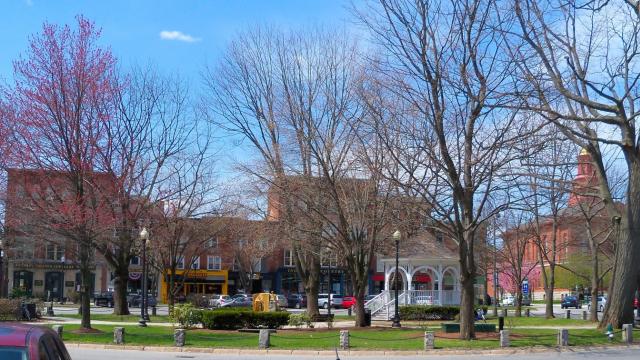
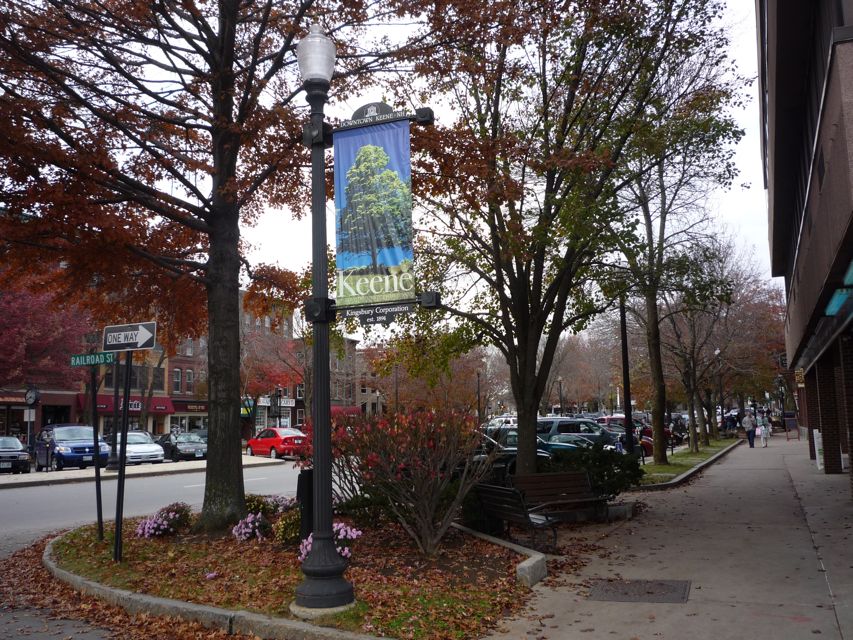
Keene, N.H., with a population of about 23,000, is the area’s largest “city” – and the Tennessee Gas Pipeline presentation showed a pipe headed directly for it, along with similar offshoots to the nearby towns of Jaffrey and New Ipswich. Keene has been somewhat of a pioneer of alternative energy, and part of that has taken place under the watchful eye of the head trash guy – Solid Waste Manager Duncan Watson.
Watson, who is also the city's assistant public works director and recycling coordinator, oversees Keene's picturesque dump, located on some of the best real estate in town. The landfill boasts a view of the mountainous landscape as well downtown – a sight made famous when the 1995 film “Jumanji” ran animated elephants and rhinos through it. Real life four-legged creatures can be found at the landfill; sheep graze on the grass above the garbage instead of mowing it, which saves on fuel. Meanwhile, methane recapturing units were installed within the landfill to obtain the electricity to power the recycling center.
But that level of stewardship was not enough for Watson, who helped secure a half-million dollar federal grant to have the methane used for a greenhouse, an algae farm for animal feed, and a possible fish hatchery. In the utopian words of the EPA’s website, the project aims to “create a more sustainable place to live, work and recreate.”
Watson said he has seen communities benefit from natural gas, but about whether it would be a good thing for Keene he has mixed feelings. It hasn’t been something he’s had to think about much. The last time a pipeline was proposed for Keene it was shot down because of safety and location concerns.
That was more than 20 years ago, he said. The positive is that it would provide an alternative, possibly a cheaper one, for the local residents. One of the negatives is where the gas comes from – and the speculation about the harmful effects of hydraulic fracturing, better known as fracking.
Much has been written about just how harmful fracking is. The process, which involves drilling and using water along with a potent mixture of chemicals to widen rock fissures, is designed to get at natural gas trapped inside underground shale. The advantage is a large, domestic source of energy; the drawbacks include drinking water contamination and greenhouse gas emissions, specifically methane, from the drill sites.
There has even been some investigation into whether fracking causes earthquakes. But is it worse than coal, where much of New Hampshire’s energy comes from? “In general, unless you’re talking about certain renewables, you’re talking about a series of bad choices,” Watson said. “When you ask whether fracking is worse than coal or nuclear, you’re weighing bad choices against each other.”
Businesses and other energy consumers (that’s everyone) could benefit from a competitive source of natural gas, at least in the pocketbook, according to Maureen Smith. A director at Orr and Reno Law Firm, based in New Hampshire’s capital city of Concord, Smith works with representatives in the energy and environment sectors.
“Natural gas has its advantages, but getting gas up here is one of the biggest challenges,” Smith said. One of those advantages is lowering wholesale electricity prices, she said. According to Smith, markets that see natural gas introduced have lower electricity rates. Natural gas, with its ability to be quickly turned on or off, may also play a supporting role in smoothing out supply from renewable energy sources that fluctuate, like solar and wind.
Charles “Chuck” Weed, a state representative from Keene with a liberal voting record to match his name, objects to natural gas, primarily because of fracking. “Fracking, I think, is really dangerous and increases substantially the danger of climate change as well as destroying water reserves,” he said. Equipping each home with solar panels and creating more wind turbines on the high hills surrounding town are the directions he would like to see the city move in.
But Weed, who is one of 400 representatives in New Hampshire’s statehouse, said he doubted that would happen and thought it would be a while before climate change directed policy in New Hampshire. “Not until the crisis is so clear that we can’t avoid it,” he said.
Natural gas may be a ways off in New Hampshire, but in the New England market at large, gas has already become the dominant player, according to Smith. If Keene were to reject a pipeline, that might mean higher prices than the rest of the region – a difference that would be difficult to make up with savings gleaned from decomposing garbage and sheep.
But that higher price might also reflect placing a value on energy other than fossil fuels.
3 WAYS TO SHOW YOUR SUPPORT



- Log in to post comments


