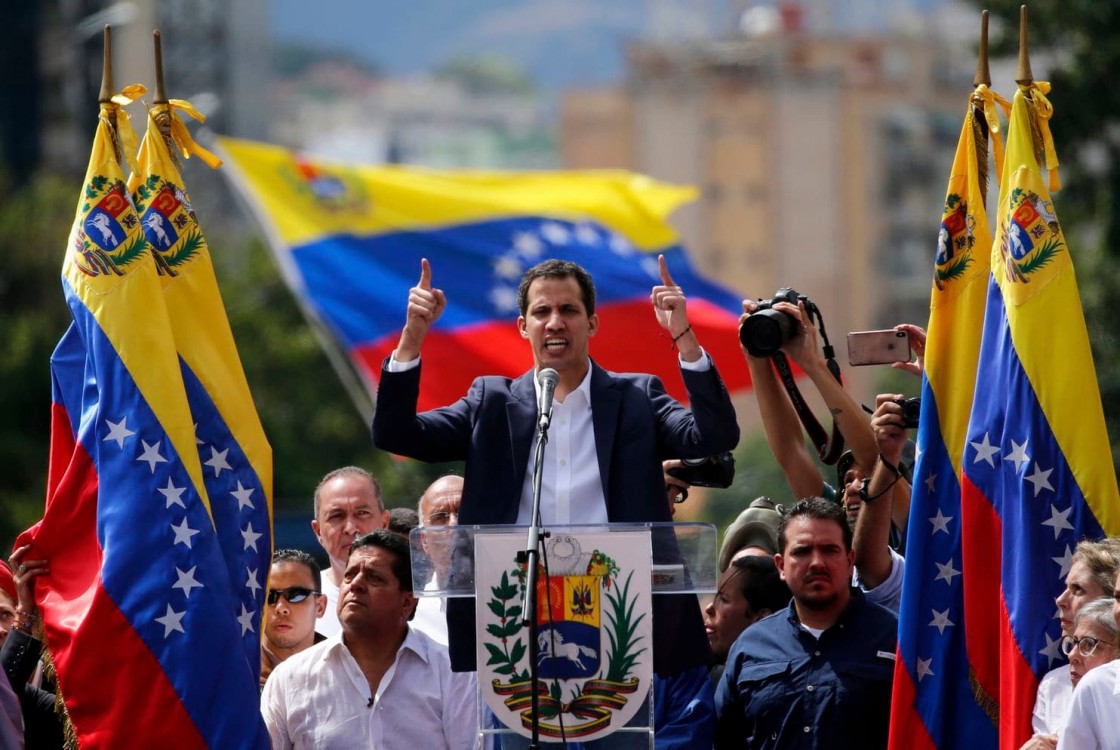
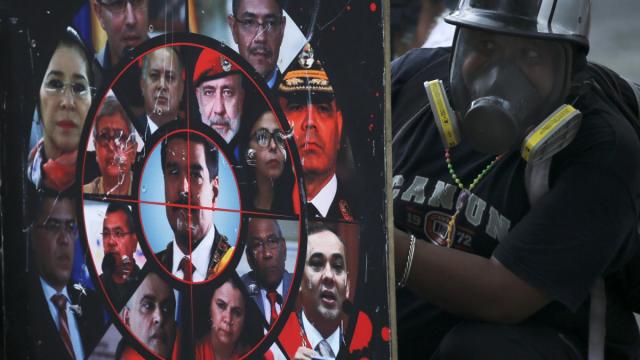
The situation is indeed bleak in Venezuela. The crisis has been particularly harmful to Venezuelan citizens who face chronic food shortages, lack of access to medicine, crumbling and unstable transportation systems, hyperinflation, political unrest, violence and inadequate health care. A massive number of citizens have fled the country in order to escape the instability. But something must be done to rectify the suffering of the Venezuelan people.
U.S. Recipe for Regime Change
Fortunately, the United States government is on the case. It has a tried-and-true approach to handling these messy matters and it has a proven track record to boot. The general tactic is simple:
• Fund opposition groups and covertly send them armaments.
• Politically denounce the regime in power or opposition group (whichever is in contrast to United States interests).
• Diplomatically isolate the regime.
• Ideologically condemn the country (typically left-wing governments).
• Economically ravage the country and its citizens with sanctions and blockades.
• “Stabilize” the country by installing a leader (typically a right-wing dictator) that will acquiesce to United States interests.
Time and again our government has followed this approach in Central and South America, and the results speak for themselves. Here are a few brief examples:
Nicaragua
President Ronald Reagan signed legislation to covertly support Contra forces against the reigning Sandinistas. He also supported the production and shipment of arms to the area. Around 10,000 to 43,000 people were killed in that war.
El Salvador
The Reagan and Carter administrations provided military aid to the government. The United States sent military advisers to help the right-wing government combat left-wing guerrillas. Around 75,000 civilians lost their lives in that war.
Guatemala
President Eisenhower, under pressure from the United Fruit Company, authorized the CIA (operation PBSUCCESS) to aid in the overthrow of the democratically elected left-wing Jacobo Arbenz. They succeeded and installed a right-wing dictator, Carlos Castillo Armas. Many social reforms were reversed and decades of civil war ensued. About 200,000 civilians died in this civil war, including the genocide of the Maya population.
Chile
The CIA covertly spent approximately $3 million to oppose the democratically-elected President Salvador Allende. After providing military aid to the Chilean armed forces in order to overthrow him, the U.S. installed a right-wing dictator, Augusto Pinochet, and supported him throughout his tenure. Tens of thousands of Chileans were disappeared, tortured, jailed or executed.
Similar tactics were employed in other countries such as Argentina, Brazil, Cuba and many others. The fact is, the United States has routinely taken covert, drastic action to alter the political course of events in countries around the world – but it put emphasis on those that were in its "backyard," Latin America. It has made these decisions without regard to their practicality, the financial resources required, the will of the local population, the potential death toll, and most importantly, the human suffering these actions would ultimately cause and continue causing long after the fact.
The U.S. government won’t ask for our – the public's – opinion because it doesn’t want to hear it. It never did. Washington is going to do what it wants regardless. The case of Venezuela today appears no different.
U.S. sets sights on Venezuela
President Trump and his top aides have repeatedly noted that “all options are on the table” regarding Venezuela. Bear in mind that “all options are on the table” is a platitude long used by presidents and national security advisors to indicate that military action is imminent or perhaps already in motion. Here’s what our government has already done to destabilize the regime of Venezuelan President Nicolas Maduro:
• Given opposition leader Juan Guaido some control over Venezuelan assets.
• Sent humanitarian aid via trucks.
• Officially recognized the President of the Venezuelan National Assembly, Juan Guaido, as Interim President.
• Imposed sanctions on the Venezuelan state-owned oil firm PDVSA.
The U.S. government, in short, is employing its tried-and-true approach in lock step. But this time, Washington's world planners didn’t even offer us the traditional courtesy of spinning a nice story soaked in military and geopolitical jargon. Instead, it has become increasingly steadfast and grotesquely candid in its pursuit to acquire Venezuela’s oil reserves.
National Security Adviser John Bolton recently stated, “Venezuela is one of the three countries I call the troika of tyranny. It will make a big difference to the United States economically if we could have American oil companies really invest in and produce the oil capabilities in Venezuela. It’d be good for the people of Venezuela. It’d be good for the people of the United States.”
Congressional support for intervention
Democrats who now control the House could ultimately step up to try and stop Team Trump's crazy antics. During Trump’s recent State of the Union address, they stayed seated, unified and many of them clad in white, when Trump reiterated his plans to build the wall. They stayed seated as well when he mentioned introducing legislation to prohibit late-term abortion.
But as soon as Trump barked out his support for an alternative government in Venezuela, they rose in near unison with Republicans, clapping like seals in support. Our country is so divided, on so many issues, yet intervening in foreign countries is a united addiction we just can’t tear ourselves away from.
Granted, there has been some congressional resistance to the use of military force in Venezuela. But the resistance is not sufficient to stop our government on its current war path.
Double standards
All of which begs the question: How does our government decide when to get involved and when not to? For example, why didn't Washington intervene militarily in Brazil? Brazil has been rife with political turmoil, upheaval and unrest over the past decade. President Dilma Rousseff was the target of a highly controversial and politically driven impeachment trial, and the populist Lula de Silva was the victim of an even more controversial arrest and incarceration. The country's new president, Jair Bolsonaro – a polemic character who has come under scrutiny for his intense far-right stances, comments and policies – was narrowly elected after winning a runoff vote.
Why hasn’t our government stepped in to help the poor people of Brazil? It’s simple: Brazil doesn’t have the easily marketable resources – ie. oil – that Venezuela has and therefore isn't crucial to U.S. economic interests. Our government only intervenes if there is a strategic economic or military advantage for doing so.
Citizen consent and consequences
No matter your stance on the current sociopolitical and economic crisis in Venezuela, the American public should be duly informed and have a say in the actions of its government. And as United Nations members politely tap their gavels in air conditioned and elaborately decorated rooms; as national advisers sit in their office buildings conveniently shielded from the horrors of everyday strife; as presidents callously issue orders behind bulletproof glass; and as state department memos are meticulously drafted in basements monitored by security officers, human suffering continues. The governments of the world are out of touch with the consequences of their actions.
The needs of a country’s citizenry are never considered when governments and important advisers posture for power and position. Far worse, the victims of their terrible decisions are never asked their opinion, and never will be asked. The everyday person will continue to be used as a pawn in global leaders’ endless chess game: dispensable, replaceable, negligible.
Only when we return the focus to exposing and rectifying the human suffering as a result of our government’s policies will we begin to heal and carry out effective solutions to these dynamic issues.