
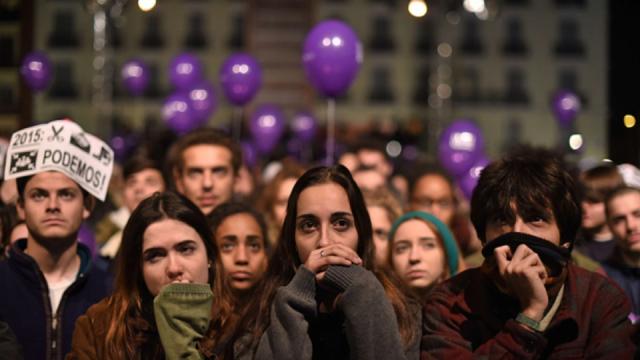
Spain was plunged into the political unknown on Sunday night as no single party emerged as the winner in its closest general election since the end of the Franco dictatorship 40 years ago.
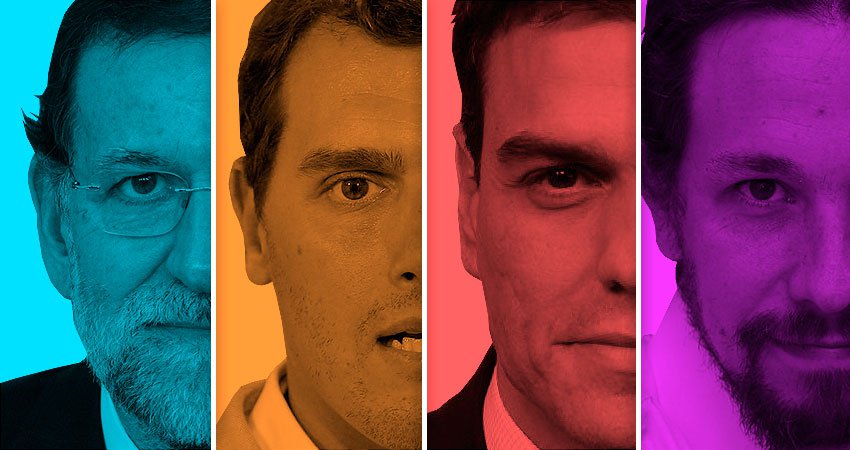
The governing Popular Party (PP), led by the Prime Minister, Mariano Rajoy, secured 28.7 per cent of the vote. That put the party in first place, but well below what it needs to maintain its majority.
Mr. Rajoy will now be given the first opportunity to persuade rival parties to join him in government before parliament reconvenes next month. But the night belonged to Podemos, and its leader, the ponytailed Pablo Iglesias. The left-wing party, which did not even exist two years ago, finished third with 20.6 per cent.
The mainstream left-wing opposition, the PSOE, just beat Podemos into second place with 22 per cent.
For four decades the PP and the PSOE have dominated Spanish politics, swapping power at regular intervals. Their combined grip on office is now almost certainly at an end. The 60-year-old Mr. Rajoy, who lost two elections before his landslide four years ago, now faces a fight for his political career.
Throughout the campaign, commentators have suggested that the PP – always the favorite to emerge as the strongest single party – could overcome a hung parliament by striking a deal with the new centrist party Ciudadanos, which collected 15.2 per cent of the vote.
Crucially for Mr. Rajoy, however, the election arithmetic – even with Ciudadanos – appears to work against him. Although he only needs a simple majority to be confirmed as prime minister when the Spanish parliament reconvenes on Jan. 13, he will need at least 176 seats to carry through his program. According to the exit poll, which surveyed 180,000 people, a combination of the PP and Ciudadanos will not reach that magic number.
As well as the four large parties, several smaller parties from across the political spectrum are also likely to gain a number of seats. Many of the Spanish regions have their own parties, which now could be in a position to extract major concessions from the government.
“It’s going to be messy,” Antonio Barroso, a senior vice-president at Teneo Intelligence, told The Independent on Sunday night. “On the one hand, the exit poll confirms that the era of political fragmentation has come to Spain and that makes things look tough for Rajoy … it is the smaller parties that are now the kingmakers, and who knows what they will want in return.”
The government’s campaign has centred relentlessly on Spain’s improving, yet still fragile, economy. While it is among the fastest growing in the eurozone, opponents argue that the growth is to do less with the government’s policies as prevailing conditions. The economy is also hamstrung by unemployment, which stands at more than 21 per cent.
Mr. Barroso said that the result had echoes of Portugal’s election earlier this year. In October, a centre-right party, Portugal Ahead, won the biggest number of seats. Within days of being sworn into office, however, it lost a confidence motion and was replaced by a broad left-wing coalition that wants to moderate the pace of economic reforms.
Podemos has also campaigned on slowing the PP’s austerity measures and in January held a million-strong rally in Madrid’s central Puerta del Sol to demand that conditions imposed by the EU were lifted. Almost half of all younger people in Spain are unemployed, and with home repossessions still rising as banks, which got €41.3bn in EU bailout money to prevent their collapse in 2012, continue to the pull the plug on borrowers, Spain has become evermore divided.
At a polling station in Madrid’s trendy La Latina district, it was clear that the new parties had captured the imagination of the capital’s voters.
“Today will change everything in Spain,” said Rodrigo Diaz, a 36-year-old computer engineer, who voted for Ciudadanos. “The PP may well win but it will need agreement from the new parties. Of course, it is not a good thing that the PP will still be around, but hopefully whichever party joins them will be able to improve social policy.”
The PP has always drawn its support from older, more rural and wealthier voters. Those in La Latina said that fears the new parties lacked the experience to govern were unfounded. “Of course it’s going to be complicated now, but the young believe in these new parties, it’s time to back them,” said Lourdes Morcsende, a 28-year-old primary school teacher. She voted for Podemos. “The PP says that Podemos has no experience, but just look at what the PP has done to Spain.”
Final totals are expected to be published on Wednesday.
3 WAYS TO SHOW YOUR SUPPORT



- Log in to post comments


