
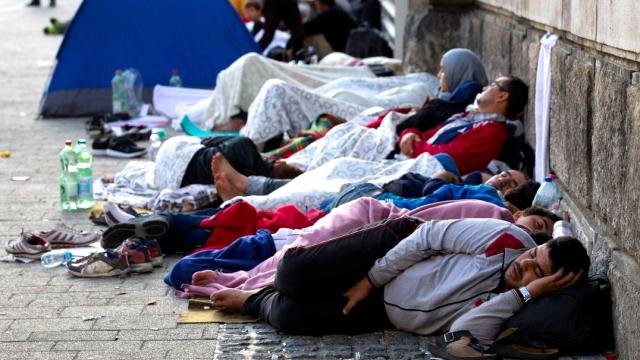
Braving cancelled trains, police truncheons and torrential rain, record numbers of refugees continued to struggle through Europe as the continent remained bitterly divided over how to respond to its biggest migration crisis since the second world war.
Rushing to cross the border before harsh new anti-refugee laws and the completion next month of a four-meter high razorwire fence, 3,221 people entered Hungary over land from Serbia in just 24 hours, police said – the highest number yet.
After 3,700 crossed its border overnight, Austria was forced to suspend cross-border train services, saying it could no longer handle the “massive” volume of passengers. “It would be irresponsible to simply let people keep streaming in and spend the night at train stations,” a spokesman for the state railway said.
In Serbia, state television said a record 5,000 people had arrived at the frontier, while further south, on Macedonia’s border with Greece, 50 buses transporting around 2,500 refugees, and three trains carrying more than 3,000 people, were seen leaving from the town of Gevgelija.
On Greece’s northern border with Macedonia, about 7,000 refugees, including families with young children, battled through pouring rain and deep mud. Soaked to the skin, the crowd sheltered under whatever they could find: plastic sheeting, bin bags, a beach umbrella.
Many stumbled into potholes and lost their shoes; desperate parents held small children above their heads so Macedonian police would let them through. Border guards used batons and riot shields in an effort to slow the refugees, many of whom had come from the Greek island of Lesbos, where authorities have finally registered about 17,000 arrivals over the past few days – clearing a huge backlog and allowing them to continue their journey northwards.
Abas Jizi, a 30-year-old supermarket employee from Deir Ezzor in Syria, was among them. He said he had waited 10 days with his wife and three young children to get his papers on Lesbos, arriving in Athens on Wednesday. He had no choice but to leave Syria, he said. “In my country the situation is very bad. The helicopters fly over the city and they bomb.”
The Greek government chartered two extra ferries and sent more registration staff to relieve overcrowding on the Aegean island, where up to 20,000 people have arrived after making the perilous sea crossing from Turkey and more boats continue to land daily. Conditions there were “very bad,” Jizi said.
The United Nations refugee agency, UNHCR, has said it expects at least 42,000 refugees, mostly from Syria, Afghanistan and Pakistan and heading for Austria and ultimately Germany and Sweden, to arrive in Hungary by next week.
In Budapest, chaos again reigned at the Hungarian capital’s international Keleti train station; dozens of police wearing surgical masks and gloves blocked access to train platforms for large groups of people, many of whom had waited up to 10 hours for a train and held tickets for Vienna.
Volunteers helping refugees on the country’s border with Serbia say conditions are “disastrous” and the coming cold weather would make them worse. “We don’t have there tents where people can sleep, have a rest,” said Kathrin Niedermoser, a volunteer with an Austrian aid group. “We don’t even have electricity, which means we don’t have warm water.”
Around 2,000 Hungarian soldiers are training to help police control the flow of migrants, the country’s defense minister, Istvan Simicsko, said. More are working on the construction of the 4m-high fence, expected to be completed by early October, he said.
Janos Lazar, chief of staff to Hungary’s hardline prime minister, Viktor Orban, said the fence should “be adequate to protect the country,” adding that Hungary considered Serbia and Greece “safe” countries in which people could seek asylum – meaning “different rules” would apply to refugees and migrants arriving in Hungary through those countries from next week.
Hungary’s justice minister, László Trócsányi, said an area similar to an “airport transit zone” would be set up at the border. “While it is located in the territory of the given state, the entry into the transit zone does not qualify, in immigration terms, as an entry into that state,” he said.
Further north still in Denmark, whose government took out adverts in Lebanese newspapers to discourage migrants after 3,200 people arrived since Sunday, a major ferry route stayed closed but some train services resumed after being suspended on Wednesday.
The Danish police chief, Jens Henrik Højbjerg, said refugees who did not want to claim asylum in the country were being allowed to travel freely on towards Sweden – a move described as “unfortunate” by the Stockholm government, which expects to receive around 80,000 refugees this year. Finland’s government on Thursday proposed increasing taxes on high earners to help pay for a 10-fold increase in refugees expected to arrive this year.
The political wrangling, meanwhile, continued in European capitals over how to tackle the crisis. The European parliament backed the plan of E.U. Commission president Jean-Claude Juncker to divide 160,000 refugees currently in Hungary, Greece and Italy across the other member states.
But Germany, which has already welcomed 450,000 refugees this year and wants compulsory long-term E.U. quotas with no limits on numbers, warned the plan was a “drop in the ocean”.
Juncker’s proposals were “a first step, if one wants to be polite”, said the deputy chancellor, Sigmar Gabriel. Many of Germany’s eastern neighbors, though, are fiercely opposed to binding quotas. Romania’s president, Klaus Iohannis, said on Thursday there was “no way” his country would accept the 6,351 people it is being asked to welcome.
3 WAYS TO SHOW YOUR SUPPORT



- Log in to post comments


