
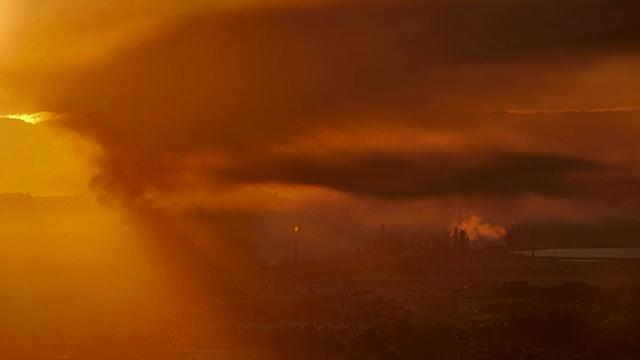
In late November, while other parts of New Jersey were recovering from the superstorm, the quiet town of Paulsboro was blindsided by a very unnatural disaster. A train derailed while crossing a local bridge, sending freight cars tumbling into the water below and releasing a toxic swirl of the flammable gas known as vinyl chloride, used to make PVC plastics. In the following days, chaos ensued as residents hurriedly evacuated. Authorities struggled to manage the emergency response, leaving people confused and frustrated by a lack of official communication about hazards.
Though the derailment came as a shock to residents, this was an accident waiting to happen, environmental advocates say. Paulsboro is just one of the latest in a spate of recent disasters (including others involving vinyl chloride) in industries that handle massive amounts of toxins with minimal oversight.
At a recent community meeting about the aftermath of the incident, residents expressed exasperation at the government’s disaster-response team, accusing officials of keeping them in the dark about toxic risks, reports the South Jersey Times:
“How much is all of our lives worth to you?” Michael Hamilton, a Pine Street resident, asked. “What if somewhere down the line we develop cancer? Who is responsible, and when will you take responsibility?”
Community activists and officials are seeking accountability for the chemical fallout as well. There are immediate concerns—that residents were not adequately informed about the exposure risks, or that in the initial emergency response, workers may not have received appropriate protective gear.
But in the backdrop looms what many see as a chronic government failure to uphold key aspects of federal environmental safety law. In a joint statement following the incident, Greenpeace, the Virginia-based Center for Health, Environment & Justice (CHEJ), and the New Jersey Work Environment Council (WEC) renewed their demand for the Environmental Protection Agency (EPA) to revamp chemical safety rules under the Clean Air Act. They want Washington to set new rules to push industrial facilities to implement “inherently safer technologies” or safer chemical processes whenever feasible.
The idea, which would parallel in part New Jersey’s current regulations, is to move the industry holistically toward safer processes that are intrinsically less hazard-prone."We've seen over the past decade, disaster after disaster," WEC Chemical Safety Project Coordinator Denise Patel tells In These Times. Noting that stronger safeguards in New Jersey have goaded companies to take measures to reduce environmental and safety risks, she added, “We know there are safer chemicals, we know there are safer technologies that these companies could be using."
In a petition recently sent to the EPA, a coalition of environmental, labor and community groups, including United Steelworkers and Communications Workers of America, argued that weak federal regulation has left industrial facilities vulnerable to severe threats ranging from transport crashes to terrorist attacks. Moreover, the limited scope of federal safety standards means that some facilities, like gas refineries and water treatment plants, suffer from especially paltry oversight.
Broad-based reform of industrial practices, the petition argues, would get ahead of the problem by limiting overall quantities of highly dangerous chemicals, so that “safety is built into the process, not added on, and hazards are reduced or eliminated, not simply controlled.” Mike Schade, a CHEJ campaign coordinator, tells In These Times via email, “There are safer available alternatives which if required would reduce the transport of vinyl chloride and other toxic chemicals. Requiring safer chemical processes at chemical plants is the best way to prevent disasters on rail lines, which carry the majority of the most dangerous substances.”
Meanwhile, the Paulsboro incident falls chiefly under the jurisdiction of federal authorities and is currently under investigation by the National Transportation Safety Board, though critics stress the need for more preventive, rather than reactive, safety measures.
In addition to guarding against catastrophes like the railway accident, tighter chemical regulation could have a subtler but longer-term impact on the health of workers who deal with occupational exposure everyday. For example, vinyl chloride exposure on the job is associated with cancer and liver disease.
It might be perverse serendipity that the Paulsboro wreck took place in New Jersey. Despite a bad rap as a toxic waste haven, the state has established relatively strong chemical safety mandates under its Toxic Catastrophe Prevention Act, which has led to significant reforms in the technology of facilities that handle toxics.
WEC has played an active role in enforcing these regulations by enlisting labor unions in monitoring facilities and in conducting workplace safety trainings. The group also works with environmental inspectors to make sure work sites are complying with the law.
"The workers who work around the plant are the ones who are the most knowledgeable about what's going on,” said Patel, “so it's actually an incredible asset to the inspectors for them to be able to walk around and say, you know, 'This pipe's been making a new noise for the last month.'"
Still, advocates warn that toxic hazards persist across New Jersey. Even though the state's laws are relatively strong, they still allow facilities to harbor extreme concentrations of toxics. Rick Hind, legislative director for Greenpeace, says via email that the Obama administration can use its authority under the Clean Air Act to strengthen regulations on a nationwide basis without pushing new legislation: “All he has to do is direct the EPA [to] develop the program.”
Obama’s regulatory track record is tepid, however: Contrary to Republican charges that the president represents “big government,” he’s advocated rolling back regulations, and his administration hasn’t been much more active than that of his predecessor in pushing new regulations.
Still, advocates hope that Paulsboro will finally spur federal action before another disaster tests the extent to which the government values people’s lives. Underlying the wreckage of the derailed train, after all, is a derailed regulatory system.
3 WAYS TO SHOW YOUR SUPPORT



- Log in to post comments


