
A coalition led by the Scandinavia-based Sami people along with environmentalists are currently blockading a planned copper mine near the Repparfjord in northern Norway. The action began on June 15 and has continued throughout the summer.
Europe's last indigenous people, the Sami, are resisting a new wave of mines planned across their homeland in northern Norway, Sweden, Finland and north-west Russia.
A combination of the Nordic countries, global mining corporations and international organisations such as the European Union are proposing and supporting these projects to extract “transition minerals” they believe are necessary for the “green transition,” despite widespread opposition from the Sami.
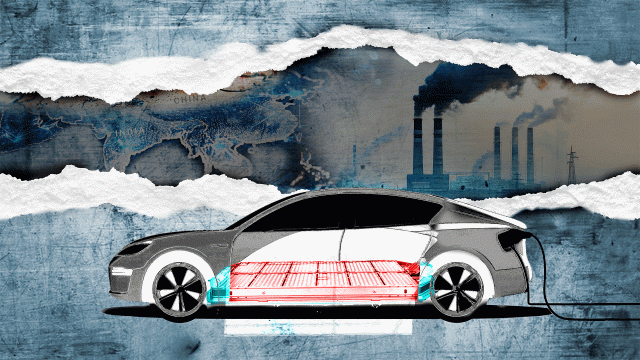
Copper is an excellent conductor of electricity, which makes it indispensable for the manufacture of electric vehicles, among other things. The switch to cars with electric motors is central within green capitalism's decarbonisation plans, including those of the European Union.
Yet despite the hype – from the mine to the factory to the road and disposal – electric vehicles are not actually “green.”
In fact, the owners of the copper mine near Repparfjord, Nussir ASA, are planning to discharge toxic waste directly into the ecologically-rich fjord.
This is just one example of how the expansion of mining planned throughout the Sami homeland is threatening their people’s existence. The Sami Council calls this “green colonisation,” which adds to previous waves of colonisation and land grabbing, restricting their access to land, destroying ecosystems and threatening their lifeways – not least, reindeer herding.
Worldwide, many more mines will need to be dug if EVs are rolled out to replace combustion engine cars. The planned EV mass rollout will also bring other severe and devastating consequences, which can be avoided if we rethink how we move around.
EV's and “extra-action”
An EV vehicle requires about six times more minerals than a conventional combustion engine car. Worldwide, “green sacrifice zones” are increasing in area – lands destroyed by activities such as mining activities, supposedly in the service of a green transition.
Already there are many copper mines that are in position to supply the raw materials for the growing EV industry, such as the Grasberg Mine in West Papua, mines in Zambia's “copperbelt province”, and the Santa Rita mine in New Mexico.
But the toxic legacy of these mines is already spreading downriver into seas and oceans.
Electric vehicles also require cobalt, lithium and nickel alongside many more minerals. All these were mined before the green transition. Yet now international powers such as the World Bank, European Union and the United States are funding the expansion of these mining industries.
In reaction, academics including Professor Diana Vela Almeida from Utrect University have co-written a paper asserting that old colonial powers are effectively “greening their imperialism,” and “establish[ing] new territories of extraction under the guise of “ecological consciousness.”
One way to define extractivism is “extra-action.” For instance, reindeer herders in Norway will no longer be able to continue their lifeway, due to the extra-action planned near the Repparfjord, as the copper mine will deplete the ecosystem more than it can sustain.
This principle is applicable to electric vehicles not being the solution for the ongoing climate catastrophe. EV's are supposed to reduce carbon emissions. Yet when calculating for the whole supply chain — from mining to processing to production to all the infrastructure and electrical energy needed to run them — EVs can have a very similar carbon footprint to combustion engine cars.
In fact, EVs have been called “Elon Musk's electric planet-suicide vehicles” for their massive carbon footprints, according to Richard Smith, writing in the peer-reviewed Ecological Citizen.
In other words, our atmosphere cannot handle the extra-action of a mass-rollout of electric vehicles.
Rage against cars
Thirty years ago, two vehicles slowly collided on a busy north London street. In response, the drivers bashed each others’ cars with sledgehammers. Road rage? Kind of. Their theatre brought traffic to a standstill. Hundreds waited nearby, and ultimately took over the road for a rave party with a massive sound system.
From this moment, the Reclaim the Streets (RTS) movement was born.
Yet the global movement against the dominance of the car was already there before RTS spread and exerted more pressure. The movement questioned the private car as a symbol of freedom, and instead criticised cars on many grounds: from the millions of people killed and maimed in car crashes, to the land taken up by cars for parking and driving; the time lost to congestion; the structural inequality of the least privileged having to live closest to noisy, polluting and dangerous roads; the way cars exclude people from public space; and air and climate pollution, among many other harmful social and environmental impacts.
EVs only solve one of these problems, namely local air quality. It is estimated that 70 percent of downtowns in the U.S. were used by cars in 2002.
In 2050, the same amount of space would be taken up if EVs replaced these vehicles.
In recent decades, many movements have challenged the dominance of the car – from Reclaim the Streets to the Dutch cycling revolution; from plans for car-free zones or “superblocks” in Barcelona, to the growing movement for free or cheap and accessible public transport. This last dynamic is seeming to prevail: by restricting car traffic in city centres and other measures, we have moved closer toward car-free cities, where private vehicles are only allowed for people with special mobility needs.
Car makers' “green” opposition
In many European cities, the car seems to have had its day. But here's the catch. Stockholm has plans – currently on hold – to only allow electric cars in the city centre.
From London to Paris, Rome to Athens, and in many other cities, drivers with old cars, highly polluting cars or diesel vehicles are increasingly being excluded from city centres by tolls and taxes, or other additional costs or restrictions.
On the other hand, many city centres are welcoming electric vehicles and even offering free parking, in a charge that is being led by Norway.
In Norway, the European Union and beyond, the car industry has positioned itself as the green saviour, and electric vehicles are set to replace combustion engine vehicles in the near future.
This is a huge missed opportunity. We could redesign our cities without all the extra-action destruction that private transport brings. Imagine a city centre with up to 70 percent more space to live in. Envision streets without car accidents. If we embraced integrated public transport, there would be much more space for parks and social space in our cities.
On a global scale, and in places far beyond city limits, the question of whether we get rid of the car is even more important. Our cities cannot afford the mass introduction of EVs. The climate and global ecosystems cannot afford this planned expansion.
And firstly, the people living in a sound relationship with their lands, like reindeer herders in Nordic Europe, who cannot afford the expansion of mining to produce more private vehicles that will drive further overconsumption in cities.