
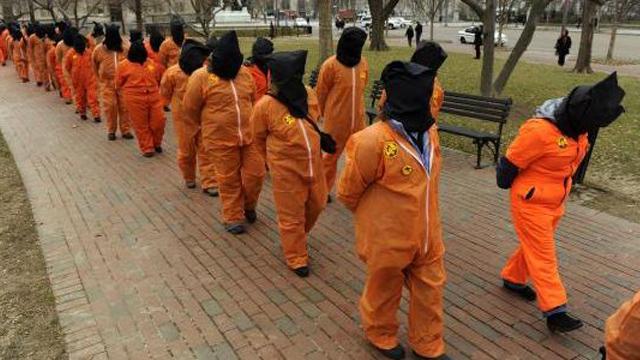
What a difference four years makes.
In 2008, Democrats were eager to draw a contrast with what they then portrayed as Republican excesses in the fight against Al Qaeda. Since then, the Obama administration has in many cases continued the national security policies of its predecessor—and the Democratic Party's 2012 platform highlights this reversal, abandoning much of the substance and all of the bombast of the 2008 platform. Here are a few places where the differences are most glaring:
Indefinite Detention
2008: "To build a freer and safer world, we will lead in ways that reflect the decency and aspirations of the American people. We will not ship away prisoners in the dead of night to be tortured in far-off countries, or detain without trial or charge prisoners who can and should be brought to justice for their crimes, or maintain a network of secret prisons to jail people beyond the reach of the law. We will respect the time-honored principle of habeas corpus, the seven century-old right of individuals to challenge the terms of their own detention that was recently reaffirmed by our Supreme Court."
2012: Nothing. The Obama administration has maintained the practice of indefinitely detaining certain suspected terrorists. It has also made use of "proxy detention," by which foreign countries detain US citizens under questionable conditions, although the administration did do away with the Bush-era "black sites."
Warrantless Surveillance/PATRIOT Act
2008: "We support constitutional protections and judicial oversight on any surveillance program involving Americans. We will review the current Administration's warrantless wiretapping program. We reject illegal wiretapping of American citizens, wherever they live. We reject the use of national security letters to spy on citizens who are not suspected of a crime. We reject the tracking of citizens who do nothing more than protest a misguided war…We will revisit the Patriot Act and overturn unconstitutional executive decisions issued during the past eight years."
2012: The platform is silent on this issue. This isn't surprising since, at the urging of the Obama administration, congressional Democrats passed up the opportunity to reform the PATRIOT Act when they had a majority in both houses of Congress.
Gitmo
2008: "We will close the detention camp in Guantanamo Bay, the location of so many of the worst constitutional abuses in recent years. With these necessary changes, the attention of the world will be directed where it belongs: on what terrorists have done to us, not on how we treat suspects."
2012: "[W]e are substantially reducing the population at Guantánamo Bay without adding to it. And we remain committed to working with all branches of government to close the prison altogether because it is inconsistent with our national security interests and our values." In 2009, most Democrats voted against funding to close Gitmo, and there were substantial internal battles within the administration over doing so.
Racial Profiling in Fighting Terrorism
2008: "[W]e will ensure that law-abiding Americans of any origin, including Arab-Americans and Muslim-Americans, do not become the scapegoats of national security fears."
2012: Nothing. The Obama administration has in fact retained the FBI's Bush-era guidelines allowing race or religion to play some role in investigations.
Torture
2008: "We reject torture."
2012: "Advancing our interests may involve new actions and policies to confront threats like terrorism, but the President and the Democratic Party believe these practices must always be in line with our Constitution, preserve our people's privacy and civil liberties, and withstand the checks and balances that have served us so well. That is why the President banned torture without exception in his first week in office." Despite Obama's executive order banning torture, Americans who allege they have been detained abroad by foreign governments at the United States' request say they have been abused while in custody. It does not appear as though anyone will face charges over the Bush administration's torture program, including those who went beyond its legal guidelines.
The section of the 2012 Democratic platform titled "Staying True to our Values at Home" states, "We must always seek to uphold these values at home, not just when it is easy, but, more importantly, when it is hard." The distance between the 2008 and 2012 platform shows just how hard it has been, and starkly illustrates the extent to which the Democratic Party has given up on its 2008 promises to roll back the national security state that emerged and expanded in the wake of the 9/11 attacks.
3 WAYS TO SHOW YOUR SUPPORT



- Log in to post comments


