
TUNIS, Tunisia—Energy has been running high in Tunis this week, partly because the city is still reeling from the February assassination of the country’s lead social and political opposition figure, Chokri Belaid. On Thursday night, a thousand people gathered on the central Avenue Habib Bourguiba - site of the Tunisian Revolution, which began the Arab Spring - to rally in remembrance of the man many called the "Arab Chavez" for the hope he represented in leading the country toward genuine democracy.
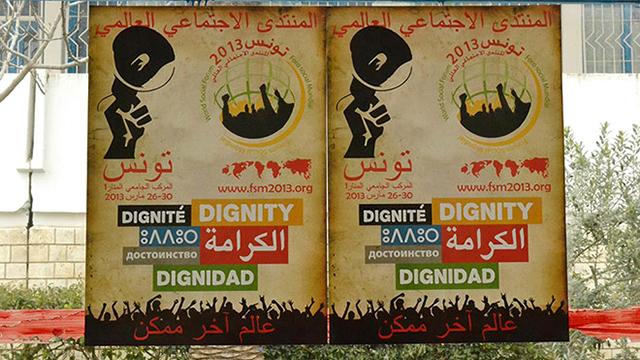
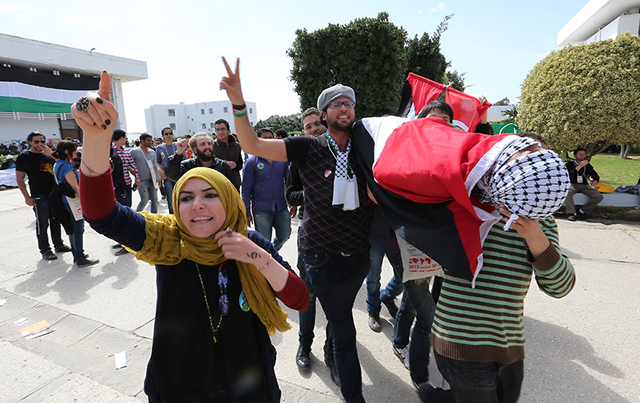
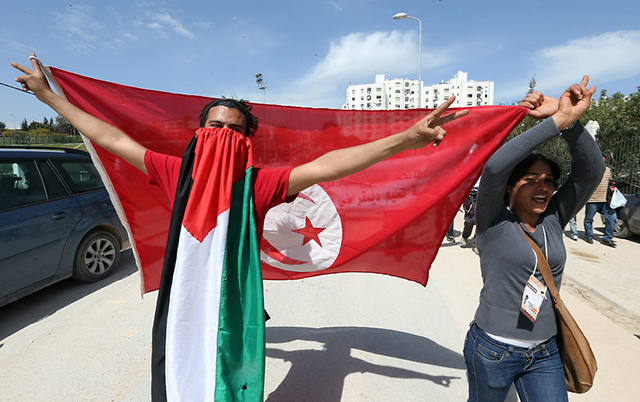
But the other source of vibrancy on the Tunis streets is the World Social Forum, now in its third day, which drew tens of thousands of students, trade unionists, academics and activists from across the Arab world and around the globe, injecting a cosmopolitan atmosphere here that reaffirmed Tunisia’s important symbolic and political role on the world stage.
The classrooms at the El Manar University campus have been filled all week with talks and workshops aimed at growing a global activist network that builds off the momentum of the Arab Spring and the worldwide social movements of 2011. One of the most impacting meetings took place Thursday, when more than 100 people filled a lecture hall, organized by the coalition Stop Corporate Impunity, to hear an array of speakers on a panel called “Confronting the Power of Transnational Corporations and Unpacking the Global Investment, Trade and Financial Regimes.”
Stop Corporate Impunity formally declared itself as an organizing body last June at a gathering in Rio. Since then, some 150 organizations have joined the coalition, which seeks to radically realign the relationship of power between corporations and people by establishing mechanisms to prosecute transnational companies that break laws and damage communities and ecosystems with impunity. The goal is to work towards a global framework where mega-corporations are eliminated altogether.
“What we are witnessing with corporate power is actually a crime against humanity on a major scale, but we don’t yet have the instruments to deal with those crimes,” said Brid Brennan, who works with the Transnational Institute, which helped organize the coalition. One of the instruments being developed is an international People’s Tribunal that will be able to bring legal cases against destructive, as-yet-unaccountable corporations.
Brennan stressed the urgency of thinking and acting in new, different ways in relation to transnational corporations, by creating “a new convergence to confront this new [form] of corporate power, which has not only taken over sectors of the economy—it has taken over the planet.”
Put simply: “We need a global campaign to reign in the power of corporations and to dismantle them,” she said. Winning the communications war, both for public and expert opinion, and building a People’s Treaty to provide a framework for sanctioning and bringing corporations to trial for their crimes, are two primary goals.
“Of course we’re not rosy-eyed idealists. We have a great sense of corporate power. We have seen so many of our comrades shot, imprisoned and continually criminalized for their resistance. But we believe in our contra-power: the fact that we have so much resistance alive in so many parts of the world is the source of our hope.”
The architecture of impunity
Other speakers in the lineup, hailing from South America to Africa to Asia, articulated the stakes involved in mounting a challenge to the world’s most powerful transnational companies. One woman, Lilia, representing La Via Campesina in Paraguay, discussed direct ties linking the coup d’etat that occurred in her country last June with the U.S. agri-giants Monsanto and Cargill—companies which were instant beneficiaries of legislation passed by the new corporate-friendly regime, which cancelled popular suspensions on planting transgenic soy, cotton and other crops.
A veteran of oil battles in Nigeria spoke eloquently about the “shameless” abuse and exploitation in his country by Shell, Chevron and other oil firms. “Oil companies are more or less like gods” in Nigeria, where some 4,000 spills have yet to be cleaned up, he said. But there have also been modest steps forward - growing networks of groups are building new “webs of resistance” against oil corporations that break the law with impunity. And pressures for greater transparency are rising from civil society through demands on energy giants, accused of producing more oil than they declare, to “publish what you pump.”
Meanwhile, a young Filipina woman named Joanna told the audience that her land in northern Luzon, which sits on a mineral belt rich in gold, copper, manganese and other metals, has made her ancestral home the eternal target of transnational mining interests which are bent on ruining it. “Where there was once a paradise, it has now turned into a nightmare affecting not only the present generation but the coming generations,” she said.
On the question of power—and how transnational corporations, like the ones destroying her region, can be defeated—she invited people to ask: “Who built the power, who created the power, who is managing the power, how is the power distributed?”
“A development being imposed on us, which is not compatible with our way of life, is an outright violation of our rights,” she added, and “it is high time that we challenge these multinationals [that are] distorting the facts and destroying the truths. We stand firm against those who dare to violate our homes. We stand firm against those who dare to destroy our lives and the future we choose to dream for our children.”
Speaking about large corporations’ impact on global policy through their dominance within institutions like the International Monetary Fund, World Bank, World Trade Organization, NAFTA, ASEAN, G20 and the like, a man representing Spain’s Ecologistas en Accion used the term “debtocracy” to describe the current stranglehold.
“It’s not enough to make boycott campaigns or shame campaigns or to [limit] some of the transnational corporations’ profits,” he said. Free trade, free capital flow and private property have become sacrosanct terms, untouchable in political discourse, yet they lay at the heart of the financial crisis which is why, he added, “if we want to destroy the transnational corporations, then we have to at the same time dismantle the whole architecture of impunity that was built by the states and by the corporations.”
Eliminating Tax Havens, Instituting a Robin Hood Tax on Transactions
At another panel on Thursday, which aimed at a reform that is already within reach, activists from Europe, the U.S. and Africa made a clear case for cutting tax havens and establishing a Financial Transaction Tax as a means of raising revenue to help countries dig out of the crisis.
In some places, like Scandinavia, new models are being tried to create regional and municipal tax haven-free zones. Sweden now has three municipalities committed to not buying goods from companies that use tax havens. Norway has 10 such municipalities. The initiative, which began in Norway in 2006, is also spreading to parts of Finland and even, lately, to France.
“We are at this crossroads,” said Benedikte Hansen, who is helping lead the effort in Norway where welfare services are increasingly being privatized—in the child care and elderly care sectors especially—by multinationals that use tax havens. News about corporations avoiding paying taxes regularly shows up in the local papers, Hansen said, fueling public anger that has translated into municipal policies which could set a precedent: that corporations which don’t pay their share, and therefore curb competitiveness with smaller firms, aren’t welcome.
Hernan Cortes of the World Forum of Civil Society Networks, which is working on the issue in the E.U., raised the point that tax havens aren’t always far from home the way we think. “It’s very easy for politicians to talk about tax havens in places with sun and sand and yachts and caipirinhas. But we have tax havens next to our countries that we don’t talk about like Ireland, Andorra, Austria, Holland, and Delaware in the U.S.
In terms of the benefits of taxing financial transactions for countries trying to grow, a man from Kenya said: “The FTT is especially useful and important for poorer countries because it’s a way to fund future development versus taking out huge loans. We can finance our own development through taxes, and if those taxes are used well, they can be used to the citizens’ advantage.”
Although voices from the U.S. are noticeably absent in many of the discussions going on at the World Social Forum, one woman representing National Nurses United echoed the need to impose stiffer taxes on corporations across the pond—and said the momentum to do so is growing, even if most Americans aren’t yet aware of it.
“For nurses, the financial transaction tax is an incredibly simple idea” that will limit the worst kind of speculation and change the way goods are allocated, she said. “If we can curb the power of the financial sector by taxing them, we will achieve the goal of the Robin Hood Tax.”
On April 20, National Nurses United along with others in a coalition will announce a formal Robin Hood Tax proposal during a protest planned at the IMF and World Bank offices in Washington, DC.
3 WAYS TO SHOW YOUR SUPPORT



- Log in to post comments


