
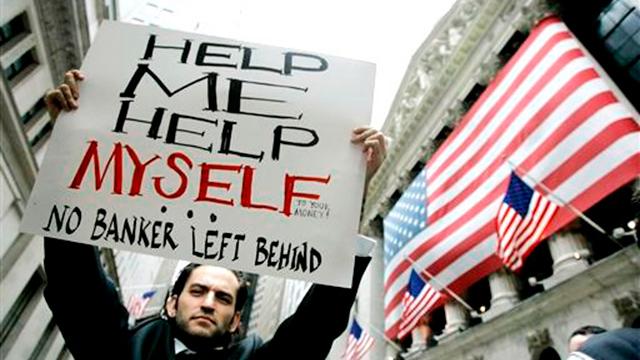
Many people became rightfully upset about bailouts given to big banks during the mortgage crisis. But it turns out that they are still going on, if more quietly, through the back door.
The existence of one such secret deal, struck in July between the Federal Reserve Bank of New York and Bank of America, came to light just last week in court filings.
That the New York Fed would shower favors on a big financial institution may not surprise. It has long shielded large banks from assertive regulation and increased capital requirements.
Still, last week’s details of the undisclosed settlement between the New York Fed and Bank of America are remarkable. Not only do the filings show the New York Fed helping to thwart another institution’s fraud case against the bank, they also reveal that the New York Fed agreed to give away what may be billions of dollars in potential legal claims.
Here’s the skinny: Late last Wednesday, the New York Fed said in a court filing that in July it had released Bank of America from all legal claims arising from losses in some mortgage-backed securities the Fed received when the government bailed out the American International Group in 2008. One surprise in the filing, which was part of a case brought by A.I.G., was that the New York Fed let Bank of America off the hook even as A.I.G. was seeking to recover $7 billion in losses on those very mortgage securities.
It gets better.
What did the New York Fed get from Bank of America in this settlement? Some $43 million, it seems, from a small dispute the New York Fed had with the bank on two of the mortgage securities. At the same time, and for no compensation, it released Bank of America from all other legal claims.
When I asked the Fed to discuss this gift to the bank, it declined. To understand how the settlement happened, we must go back to the dark days of September 2008. With the giant insurer A.I.G. teetering, the government stepped in. As part of the rescue, A.I.G. sold mortgage securities to an investment vehicle called Maiden Lane II overseen by the New York Fed. A.I.G. was bleeding from its toxic mortgage holdings, many of which were issued by Bank of America, and it received $20.8 billion for securities with a face value of $39.2 billion.
In 2011, aiming to recover some of that $18 billion loss, the insurer sued Bank of America for fraud. The case, filed in New York state court, sought $10 billion in damages from the bank, $7 billion of that related to securities that A.I.G. sold to Maiden Lane II. Bank of America, for its part, argued that A.I.G. had no standing to sue for fraud on the Maiden Lane securities. With the sale, Bank of America contended, the right to bring a legal claim against the bank for fraud passed to Maiden Lane II. That entity, controlled by the New York Fed, never brought fraud claims against the bank.
Not so fast, said A.I.G. Under New York law, which governs Maiden Lane II, an entity has to explicitly transfer the right to sue for fraud, it said. The original agreement between the New York Fed and A.I.G. never specified such a transfer, the insurer contended.
To settle this question, A.I.G. filed a separate lawsuit against Maiden Lane II in a New York court last month.
A.I.G.’s $10 billion fraud case against Bank of America, meanwhile, was moved to federal court. For pretrial purposes, the bank asked that Mariana R. Pfaelzer, a federal judge in the central district of California, oversee aspects of the case involving the bank’s Countrywide unit, which was in California. Its request was granted. On Jan. 30, Judge Pfaelzer said she would rule on the issue of who owns the legal claims.
Initially, in an October 2011 letter to A.I.G., the New York Fed agreed that the insurer had the right to seek damages under securities laws on instruments it sold to Maiden Lane II.
But more recently, the New York Fed began helping Bank of America battle A.I.G. In late December, the New York Fed provided two declarations to the bank. One stated that Maiden Lane II had “intended” to receive all litigation claims relating to the mortgage securities, meaning that it alone would have had the right to sue. Another said that the October letter was not an interpretation of the Maiden Lane agreement.
But Jon Diat, an A.I.G. spokesman, said in a statement that “A.I.G. and the Federal Reserve Bank of New York never discussed or agreed on any transfer of A.I.G.’s residential mortgage-backed securities fraud claims to Maiden Lane II.” He added that A.I.G. believes “it is the rightful owner of these claims and remains committed to holding Bank of America and other counterparties responsible for the harm caused.”
Last week, the New York Fed opposed A.I.G.’s efforts to have the question of who owns the legal rights decided in New York, whose law governs the Maiden Lane II agreement, rather than in California. It was in this filing that the New York Fed disclosed its confidential July 2012 deal with Bank of America, releasing it of any liability arising from fraud in the Maiden Lane II securities.
Let’s recap: For zero compensation, the New York Fed released Bank of America from what may be sizable legal claims, knowing that A.I.G. was trying to recover on those claims.
To anyone interested in holding banks accountable for mortgage improprieties, the Fed’s actions are bewildering. If the Fed intended that Maiden Lane II own the right to sue Bank of America for fraud, why didn’t it pursue such a potentially rich claim on behalf of taxpayers? The Fed made $2.8 billion on the Maiden Lane II deal, but the recovery from Bank of America could have been much greater. Why did it instead release Bank of America from these liabilities and supply declarations that seem to support the bank in its case against A.I.G.?
The New York Fed would not discuss this matter, citing the litigation. But taxpayers, who might have benefited had the New York Fed brought fraud claims, deserve answers to these questions.
In an interview, Senator Sherrod Brown, Democrat of Ohio, who serves on the Banking Committee, said the New York Fed’s behavior in this case “underscores that the more we learn about these bailouts, gifts and advantages that Wall Street gets, the clearer it becomes that one set of rules applies to the largest megabanks and another set of rules to the smaller financial institutions and the rest of the country.”
A court will decide who actually owns these particular fraud claims against Bank of America. But the issue of Bank of America’s responsibility for paying for the misdeeds of Countrywide during the financial crisis remains much at issue. The New York Fed is among a group of institutions that agreed in 2011 to settle with the bank for pennies on the dollar over mortgage securities its Countrywide unit misrepresented as high quality when they were sold.
That deal, for $8.5 billion, has not been approved by the court. Other mortgage securities investors have objected to it, calling the amount too small.
A New York Fed spokesman said it supported the settlement because it would generate significant value without potentially high litigation costs.
But Walker F. Todd, a former official at the Federal Reserve Bank of Cleveland, warned: “As a public entity, the Federal Reserve needs to take its custody of public funds seriously enough to ask for more than merely nominal compensation when it is giving up things of value to a bank holding company. If the central bank starts releasing binding legal claims for nominal compensation, it looks like just one more element of the secret or back-door bailout of the banking system.”
Sure does.
3 WAYS TO SHOW YOUR SUPPORT



- Log in to post comments


