
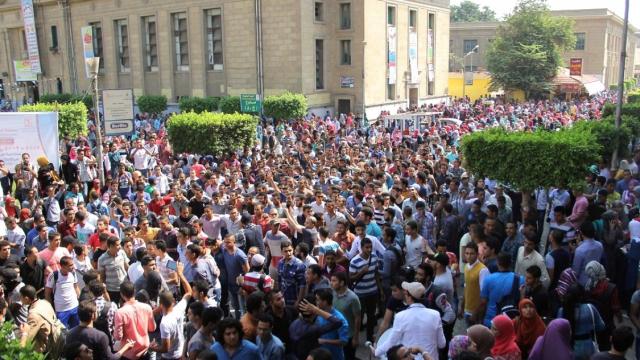
The Egyptian government risks causing a major student uprising against the state if the authorities continue their current policy of cracking down on dissent in university campuses, warned a new report by a Cairo-based NGO.
The warning came as the start of the new academic year in Egypt witnessed the arrests of more than 100 university students, amid widespread anti-government protests, and where a private security company using metal detectors has left bottlenecked queues outside universities.
The report, released Tuesday by Egypt's Democracy Index of the International Development Centre (IDC), also called on the authorities to release students arrested during protests in the first days of the academic year which began on Oct. 11.
The academic year had actually been scheduled to start on Sept. 27, but Egyptian authorities reportedly delayed the start of courses to prepare for anticipated demonstrations.
By last Wednesday, a collection of demonstrations that started over the weekend had widened to include universities nationwide. At least one person – a second-year engineering student named Omar Sherif – was killed on Tuesday in protests at Alexandria University. Sherif reportedly died after he was shot but the Ministry of the Interior has denied that live ammunition was used.
IDC's call was echoed by Human Rights Watch which also called on the Egyptian authorities to release more than 110 detained university students, some of whom were detained during pre-dawn raids on their houses.
"The arrests were apparently aimed at preventing a revival of campus protests that have erupted repeatedly since the overthrow of the former president, Mohamed Morsi, in July 2013," said HRW in a statement released last Tuesday.
"The arrests and subsequent activities appear to be solely directed at the students' peaceful exercise of the right to free assembly."
IDC's report also warned that political exclusion in the past has been the main cause of "major student intifadas (uprisings)," adding that the regular demonizaton of student protesters by pro-government media outlets is counterproductive as it incites further escalation, and leads students to retaliate in their own popular social media outlets.
A crackdown on student movements in universities, coupled with a weak political landscape in Egypt in general, has led to the strengthening of Islamist trends in the student movements, the report suggested.
A restriction of student activism would inevitably lead to instability in the political and administrative order of the country, warned IDC, calling for allowing more freedoms of expression for students.
New academic year, new rules
In November 2013, the authorities passed a law effectively banning protests that do not adhere to strict conditions, and threatening to jail those who break it.
This week's protests come amidst a slew of further changes that give university and government authorities greater power over students and their freedom of expression.
In June, Egypt's president Abdel Fattah al-Sisi issued a decree allowing him to directly appoint university and faculty deans.
Then, at the start of this academic year, university heads were asked to expel students taking part in demonstrations inside university campuses, a Higher Education Ministry official told Anadolu Agency.
The instruction, which was given verbally, allows university heads to expel students taking part in protests without having to refer them to a disciplinary committee first.
A new legal police force will also be set up and deployed within universities to patrol the campus, overturning a previous ruling – enacted in 2010 under former strongman Hosni Mubarak – that forbade police presence on campuses.
In addition, authorities have resorted to employing a private security company named 'Falcon' to handle 12 universities, which has reportedly resulted in students clashing with the contractors.
"Hiring private security companies, which has been costly, is not stopping students. It is only causing their irritation. Unfortunately, it will encourage forming secret organizations aiming at revenge from the state icons and security authorities," IDC's Democracy Index was quoted as stating.
"What the regime fails to understand is that students' revolutions are national movements and security opposition to them leads to extremism, and that student political movements are sources of democratic development," it added.
Students also complained of long search queues and confiscations of their belongings.
"Today [Saturday] the security men took perfumes from the girls, and their mirrors," one Azhar University student told The Cairo Post.
Nevertheless, the protesting students feel they must take part in the demonstrations.
"If the protests end, everyone will think things are ok, but they are not," Ismail Hussein, a 22-year old accountancy student at Cairo’s Ain Shams University, told MEE on Monday.
"We are finding it impossible to avoid clashes with police forces, they detain us haphazardly and use violence against us, while we are trying to use the most peaceful of tactics," he added.
3 WAYS TO SHOW YOUR SUPPORT



- Log in to post comments


