
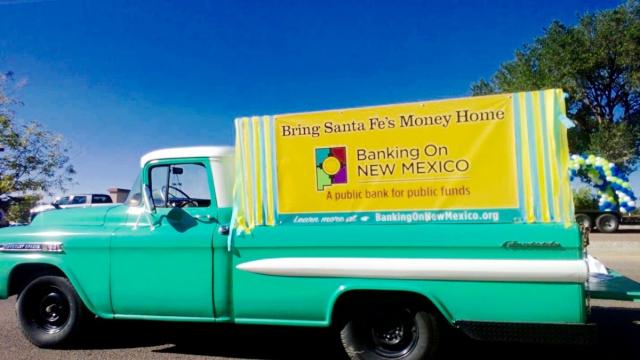
The crash of 2008 just keeps on giving. We didn’t make it happen, but somehow it’s ours to fix. Historically, governments look to raising taxes and cutting jobs and services to “fix the problem.” So it goes in the city of Santa Fe this year. This may be a short-term necessity, given the city’s current financial crisis, but Banking on New Mexico believes the time is right for a better long-term strategy that includes a public bank that will invest our public funds – interest earned from those taxes, fees and fines we all pay – back into our community.
The city has to deposit our public funds in a chartered bank somewhere, so why not in our own public bank? Our community would be the bank’s only shareholder. Bank loans would be to city and community projects, and the bank’s profits would benefit the public, not private shareholders. Our community’s cash might be safer too.
Toward that end, the city commissioned a public-bank feasibility study, which was released on Jan. 13. The study clearly establishes that a public bank would provide a strong economic benefit to our community.
In 2015, the Brass Tacks Team of Banking on New Mexico – a program of WeArePeopleHere! – completed a Five-Year Model Supporting a Public Bank for Santa Fe. We took some of the debt confronting our city council and staff and looked at what would happen if we used it to get a public bank up and running.
The public bank would open on July 1, 2017 by transferring $100 million of public funds, presently in a multinational bank, into Santa Fe’s own Public Bank. The bank’s first act of business would be to refinance $45.5 million of the city’s loan and bond debt at 4 percent. This is a low-risk way to get a bank up and running, and it would benefit the public as a whole. Most newly chartered banks expect to operate in the red for their first three years, but not our Santa Fe Public Bank. It sounds counterintuitive, but the fact that the city has ample deposits and a lot of debt makes it possible to put a public bank on solid financial ground in the first year.
In year one, the bank would make a modest profit of $500,000, and, by year five, the bank will have increased its lending to $90 million and made a profit of $10.5 million. Profits will continue to grow as more debt is refinanced and new lending happens in the community. This is a source of revenue that will not need to come from a tax increase.
The public bank also will save the city $1 million in year one and reduce the city’s total debt for that portfolio by almost $5 million (9 percent) over five years. Annual payments also would be reduced, giving the city a little breathing room.
Also in the first year, the bank would work with local banks and credit unions to invest an additional $5 million to start growing community resources such as affordable housing, renewable energy or entrepreneurial startups. We anticipate that, as the bank grows in experience, this kind of participation with local banks will increase substantially.
The city typically bundles several public projects into a $20 million bond. Bonds get repaid over a 15- to 30-year period. Often, the city has to start paying back the bond debt before projects are even ready to start. Bonds are expensive because of required bonding fees, dividends and the impact of paying interest over a long period of time. They also can’t be paid off early in the bond contract. Long payment periods greatly increase the total cost. Interest from the bonds in our study added 33 percent to the original bond cost; that is, a $20 million bond becomes $27 million in total debt.
A public bank can make smaller, shorter-term, lower-interest loans as projects become ready. Interest owed would be less than half of what is paid for bonds, and there are no bond fees or prepayment restrictions. We all know the miracle of lower-interest loans paid off over a shorter period of time saves money.
Cities across the United States are exploring the potential of a public bank for their community. They look to the example of the 97-year-old public Bank of North Dakota, founded by ranchers and farmers during some very tough times. They insisted their state follow a higher, long-term vision of fairness and a more just economy for the people of North Dakota. The BND has been turning a profit on behalf of the public for the past 40 years and has grown into a giant that outperforms most big banks. Its investment strategy is simple, conservative, and targets strategic, local lending that benefits the public. North Dakota has more community banks per capita than any other state, and they are thriving because of the support they receive from the BND.
We can reduce the cost of city debt, increase transparency of city funding and invest the bank’s profits back into our community. We call this better stewardship of the people’s money. For more information, visit Banking On New Mexico
3 WAYS TO SHOW YOUR SUPPORT


- Log in to post comments


