Watch

User menu

Search form

Inequality Redux: Just Why Do the Rich Keep Getting Richer?

Inequality Redux: Just Why Do the Rich Keep Getting Richer?
Mon, 11/16/2015 - by Positive Money
This article originally appeared on Positive Money

1. The current money system distributes money from the bottom 90% to the top 10%

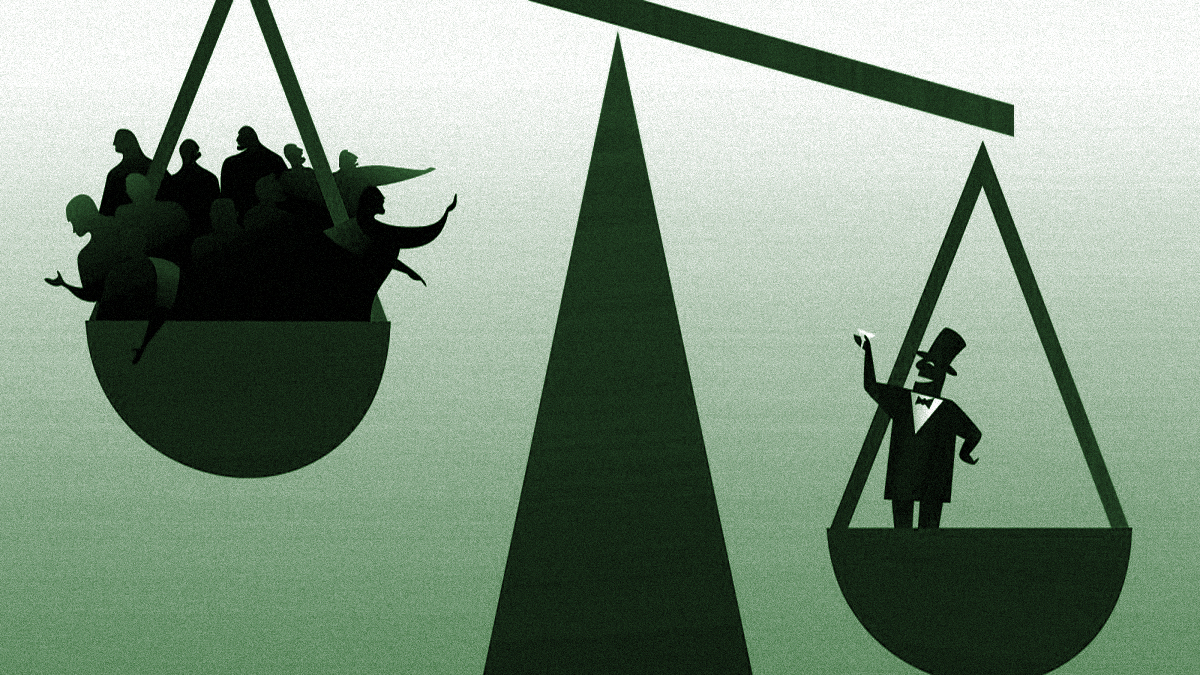
Because 97% of the money in the U.K. is created by banks, someone must pay interest on nearly every pound in the circulation. This interest redistributes money from the bottom 90% of the population to the very top 10%. The bottom 90% of the U.K. pays more interest to banks that they ever receive from them, which results in a redistribution of income from the bottom 90% of the population to the top 10%. Collectively we pay £165 million every day in interest on personal loans alone (not including mortgages), and a total of £213 billion a year in interest on all our debts.

2. It transfers money from the real economy to the banks

Businesses are also in a similar situation. The 'real' (non-financial), productive economy needs money to function, but because all money is created as debt, that sector also has to pay interest to the banks in order to function. This means that the real-economy businesses - shops, offices, factories etc -- end up subsidising the banking sector.

3. It transfers money from the rest of the U.K. to the City of London

Banks pay their staff out of their profits, which in large part comes from the interest they charge on loans. Because most of the high earning bank staff work in the City of London, this results in a geographic transfer of wealth from the U.K. to those working in the City of London.

4. The instability that the system causes means that temporary and low-paid jobs are insecure

When banks cause a financial crisis it leads to unemployment. It tends to be low-paid and temporary contract workers who are the first to get made redundant first, so that instability in the economy has a bigger effect on those on low incomes with insecure jobs.

5. High house prices increase inequality

When house prices are pushed up by banks creating money, those on low incomes suffer the most. People on low incomes often can't get a mortgage big enough to buy a house, so they don't benefit from the rise in house prices. Meanwhile, those who can get access to mortgages can buy multiple houses for buy-to-let and benefit from artificial inflation in house prices. Younger people also lose out, as the cost of buying their first house swallows an ever larger amount of their income, while older and retired people who own houses benefit. This all increases inequality across different income groups and between the young and old.
Originally published by Positive Money

3 WAYS TO SHOW YOUR SUPPORT

ONE-TIME DONATION

Just use the simple form below to make a single direct donation.

DONATE NOW

MONTHLY DONATION

Be a sustaining sponsor. Give a reacurring monthly donation at any level.

GET SOME MERCH!

Now you can wear your support too! From T-Shirts to tote bags.

SHOP TODAY

Sign Up

Article Tabs

From a pro-democratic perspective, civil society and new media organisations are surging in the aftermath of the Orban regime.

The country’s new prime minister, Andy Burnham, has promised a break from the politics of the last 40 years—realizing more broadly that Labour must stand up for the 99% against big business, or the party will become irrelevant.

The tragic shooting of Lorenzo Salgado Araujo is just the latest example of ICE having a fundamental disrespect for human life — further proving why the agency should be stripped of funding and shut down, and its rank-and-file agents and leadership prosecuted.

While the U.S., EU and their allies are enabling Rojava—the strongest force against Islamic State— to fall, it is vital for internationalists to continue to support this beacon of democracy and liberation.

June 23, 2026 may be remembered as the beginning of the end of the Democratic Party establishment.

The current wave of food recalls is a direct byproduct of President Donald Trump’s administration deliberately removing the safeguards put in place aimed at protecting American consumers more than a century ago.

From a pro-democratic perspective, civil society and new media organisations are surging in the aftermath of the Orban regime.

We can still celebrate success while simultaneously putting a cap on net worth.

The country’s new prime minister, Andy Burnham, has promised a break from the politics of the last 40 years—realizing more broadly that Labour must stand up for the 99% against big business, or the party will become irrelevant.

Much like the resistance to AI data centers, the opposition to Flock surveillance cameras has brought the left and the right together against billionaires who are trying to force America into becoming even more of a police state.

Much like the resistance to AI data centers, the opposition to Flock surveillance cameras has brought the left and the right together against billionaires who are trying to force America into becoming even more of a police state.

Posted 1 month 2 weeks ago

The tragic shooting of Lorenzo Salgado Araujo is just the latest example of ICE having a fundamental disrespect for human life — further proving why the agency should be stripped of funding and shut down, and its rank-and-file agents and leadership prosecuted.

Posted 1 month 4 weeks ago

The country’s new prime minister, Andy Burnham, has promised a break from the politics of the last 40 years—realizing more broadly that Labour must stand up for the 99% against big business, or the party will become irrelevant.

Posted 1 month 2 weeks ago

We can still celebrate success while simultaneously putting a cap on net worth.

Posted 1 month 1 day ago

The current wave of food recalls is a direct byproduct of President Donald Trump’s administration deliberately removing the safeguards put in place aimed at protecting American consumers more than a century ago.

Posted 1 week 15 hours ago