
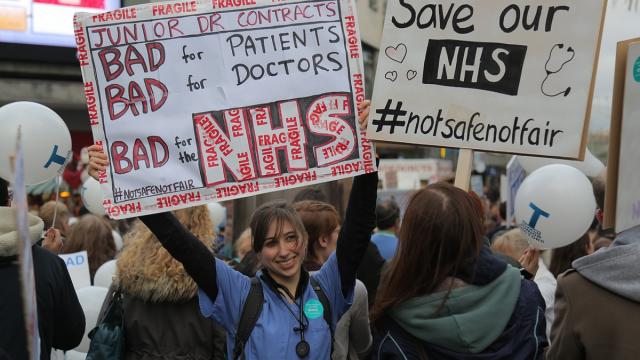
Unionized junior doctors across the United Kingdom have committed to strike today, providing only emergency care as they challenge government healthcare in a way unseen since the 1948 introduction of Britain's National Health Service.
The vast majority of the country's unionized junior doctors have agreed to the emergency care-only strike, with a full strike planned for Feb. 10 in an effort to upend plans that could alter U.K. healthcare. The industrial action comes after a series of unsuccessful negotiations between the British Medical Association (BMA) union and the government over proposed changes to working conditions following an original round of threats to strike, and reduced service in December.
In the event that Tuesday's actions go ahead, it will be the first time since the launch of Britain's NHS after World War II that medical professionals conduct a mass strike. The move is a direct attack on the decision by Tory Health Minister Jeremy Hunt to introduce a new contract that doctors say is unfair to them and unsafe to patients.
The proposed new contract would result in pay cuts of between 15 and 30 percent, and force doctors into a situation where they may have to work extremely long and difficult hours or risk losing their positions. Doctors say the new conditions would likely cause medical mistakes, as well as compromise physicians' quality of life.
“The government is faced with the current position – one that the BMA has sought to avoid throughout – because of a fundamental breakdown in trust with junior doctors, for which it is directly responsible,” said a BMA spokesperson.
“How can junior doctors have confidence in a government which, while giving public assurances, has been deliberately turning up the temperature behind the scenes in order to misrepresent them? No doctor takes industrial action lightly and we regret the disruption it will cause. However, junior doctors now feel that they have no option.”
The British Medical Association has adamantly clarified that, contrary to popular opinion, the needs of patients are paramount in their campaign.
“The biggest threat to patient care is the government’s insistence on removing safeguards which prevent junior doctors from being forced to work dangerously long hours without breaks, with patients facing the prospect of being treated by exhausted doctors,” the spokesperson continued.
“The government is threatening to impose contracts in which junior doctors have no confidence and which represent the first step in a wholesale attack on all NHS staff at night and over weekends. We want a contract that is safe for patients, fair for juniors and good for the NHS. This not the view of the few as the government would have the public believe: the BMA’s ballot of its members received a near unanimous vote for industrial action.”
Among the loudest voices supporting the junior doctors is Keep Our NHS Public. According to Dr. Jacky Davis, the group's treasurer and a consultant radiologist, “We back the junior doctors' fight with Hunt. He has acted in bad faith throughout and is using a bogus argument about a '24/7 NHS’ – which we already have – to achieve two aims: to reduce pay by reducing the number of hours designated ‘antisocial,’ and to stop pay progression.
"If the junior doctors lose, [Hunt] will roll this out for all other NHS staff," Davis added. "Plenty of hospitals have organized appropriate staff quotas without changing staff contracts. This has nothing to do with ’24/7 NHS’ and everything to do with lower pay and worse conditions. The junior doctors' fight is vital to our fight for the NHS.”
The group's co-chair, consultant pediatrician Dr. Tony O'Sullivan, said: “Junior doctors were given no choice by Jeremy Hunt but to move to strike to defend their contractual terms and conditions of work and the health service they work for. The doctors are right to say changes to their contract would be unfair for them and unsafe for patients.
"Hunt’s contract heralds loss of regulation, longer hours and lower rates of pay. He is trying to cheapen the cost of training NHS staff and reduce pay for out of hours work. This government plans to deregulate, to starve core services of adequate funding whilst encouraging cherry-picking of specialty areas put out to tenders from the private sector.”
In an interview with Occupy.com, Dr. Dominic Pimenta, who runs the widely-read JuniorDoctorBlog, said: “I would stand to lose 15 to 20 percent of my income under the new proposals. The proposals also say that doctors' hours will be monitored but there's no clear system in place. It's hard to administer anesthetic when you're on your third 72-hour week in a row.
"In 2015, there was a 15 percent drop in people applying to become doctors, thanks to the right-wing government and right-wing press continuously denigrating public service workers," Pimenta continued. "Doctors have really lost confidence in Jeremy Hunt. He can stand up and say things which are simply not true and the mainstream media will blindly reprint it word-for-word. Yet these 'facts' are easy to double-check on a search engine. It's very demoralizing.”
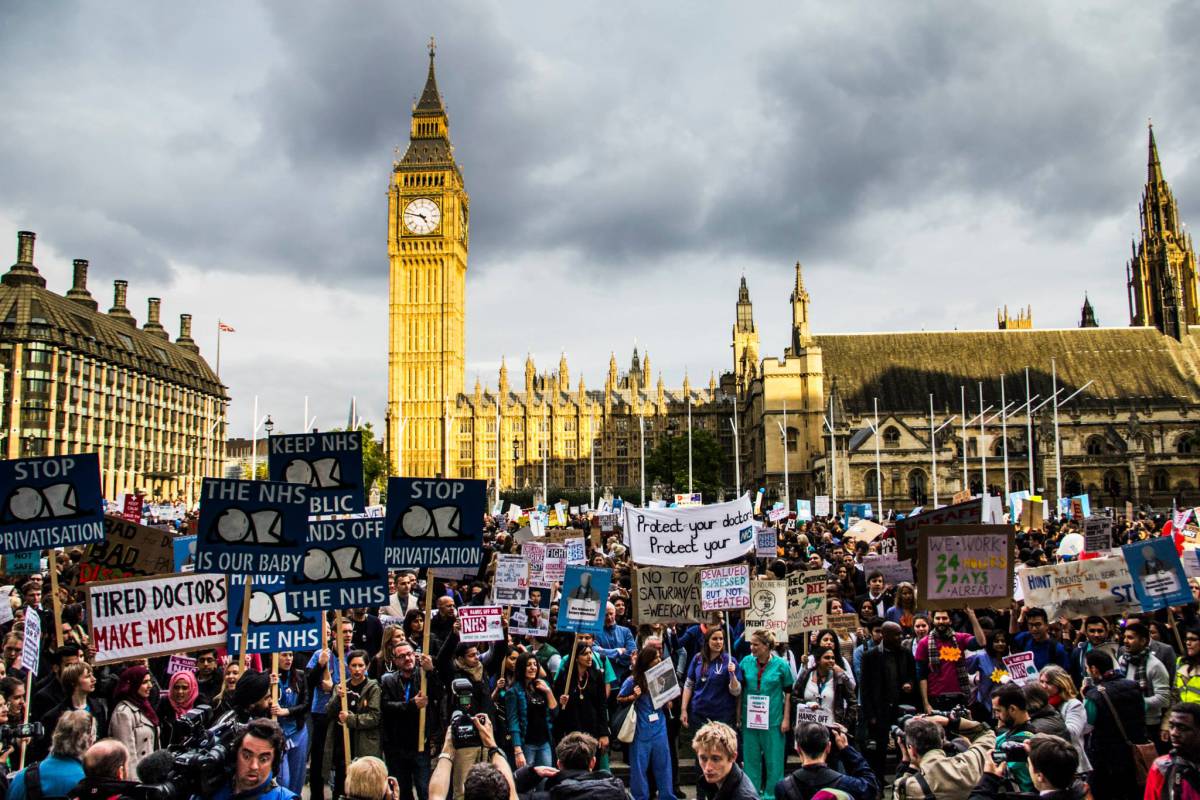
Many fear that the government's refusal to reach a compromise with doctors represents one of the biggest red lights to date concerning the future of the NHS – and many see the Jan. 12 action as a make-or-break moment in the campaign to maintain Britain's public healthcare system.
3 WAYS TO SHOW YOUR SUPPORT



- Log in to post comments


