
Read

User menu

Search form

"Obscene": 70 Top Healthcare CEOs Raked in $9.8 Billion Since 2010

"Obscene": 70 Top Healthcare CEOs Raked in $9.8 Billion Since 2010
Mon, 7/31/2017 - by Jake Johnson
This article originally appeared on Common Dreams

While the Senate GOP's plan to repeal the Affordable Care Act (ACA) was denounced as potentially devastating to the poor, the sick, women, people of color, children, and those with pre-existing conditions, a new analysis published last week finds that no matter what happens, the CEOs of large healthcare companies are likely to continue living lavishly.

Since the Affordable Care Act (ACA) passed in 2010, the "CEOs of 70 of the largest U.S. healthcare companies cumulatively have earned $9.8 billion," according to a report by Axios's Bob Herman.

Herman goes on to add that the CEOs' earnings "far outstrip[ped] the wage growth of nearly all Americans."

"The richest year [for healthcare CEOs] was 2015, when 70 healthcare CEOs collectively made $2 billion," Herman notes. "That was an average of about $28.5 million per CEO and a median of about $17.3 million per CEO. The median household income in 2015 was $56,515, which the average healthcare CEO made in less than a day."

John Martin, former CEO of the pharma giant Gilead Sciences, topped Axios's list: he pulled in $863 million in the "ACA era."

Despite President Donald Trump's repeated insistence that Obamacare has been a "nightmare" and that the entire system is collapsing, Herman observes, "The ACA has not hurt the healthcare industry. Stock prices have boomed, and CEOs took home nearly 11 percent more money on average every year since 2010."

And the Senate GOP's alternative, which Trump has enthusiastically endorsed, would likely be a further boon to industry executives, who would stand to benefit from the bill's massive tax cuts for the wealthy.

Axios's analysis focused on 70 of the largest publicly traded healthcare companies—including some of the largest insurance and pharmaceutical companies—in the United States.

Perhaps the most consequential component of healthcare CEO pay, Herman observes, is the fact that "a gigantic portion of what CEOs make comes in the form of vested stock, and those incentives drive their decision-making."

This means that CEOs are incentivized not to take actions that would benefit the healthcare system overall, but rather to "inflate stock prices" using methods "such as repurchasing shares or issuing dividends to shareholders."

Such moves lead to higher salaries for CEOs, but not to widely shared benefits.

"Stock-heavy pay," Herman concludes, "drives CEOs to do the exact opposite of their buzzword-laden goals of creating a 'patient-centered' health system that focuses on 'value.'"

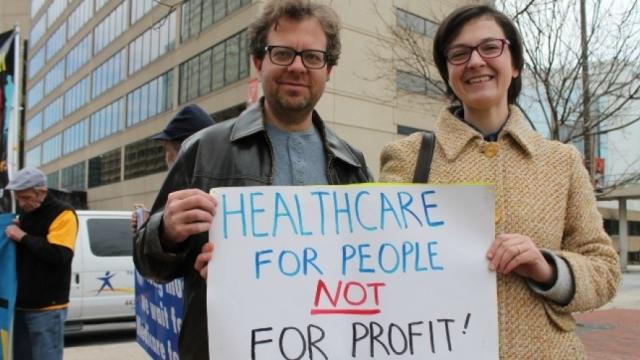
Some commentators portrayed the analysis as both indicative of the fundamental injustice at the heart of the for-profit insurance model and proof of the need for Medicare for All.

Originally published by Common Dreams

3 WAYS TO SHOW YOUR SUPPORT

ONE-TIME DONATION

Just use the simple form below to make a single direct donation.

DONATE NOW

MONTHLY DONATION

Be a sustaining sponsor. Give a reacurring monthly donation at any level.

GET SOME MERCH!

Now you can wear your support too! From T-Shirts to tote bags.

SHOP TODAY

Sign Up

Article Tabs

The world has lost an incredible thinker and doer. I have lost an amazing friend. A void exists where before it was filled with David's optimism, humour and joy.

Kevin Zeese speaks at a rally for Chelsea Manning. By Ellen Davidson.

Kevin fought to bring truth every day. We must not lose this struggle.

To win the climate argument, advocates must show how Covid-19 bailout funds could be redirected – instead of making similar mistakes as the 2008 financial crisis.

The most analogous failure to the impending economic turbulence is the financial crisis of 2008, caused, primarily, by the deregulation of the financial industry.

#MeToo, India sexism, women's rights, sexual abuse

Activists are continuing the fight but are exhausted, balancing careers and a movement, that, to most, has become a personal battle.

The world has lost an incredible thinker and doer. I have lost an amazing friend. A void exists where before it was filled with David's optimism, humour and joy.

Kevin Zeese speaks at a rally for Chelsea Manning. By Ellen Davidson.

Kevin fought to bring truth every day. We must not lose this struggle.

David Graeber at his home in Manhattan in in 2005. A public intellectual, professor, political activist and author, he captivated a cult following that grew globally with each book he published over the last decade.Credit...Jennifer S. Altman for NYT

He wrote about crushing debt, pointless jobs and the negative effects of globalization. And he played a leading role in the Occupy Wall Street movement.

To win the climate argument, advocates must show how Covid-19 bailout funds could be redirected – instead of making similar mistakes as the 2008 financial crisis.

The most analogous failure to the impending economic turbulence is the financial crisis of 2008, caused, primarily, by the deregulation of the financial industry.

The world has lost an incredible thinker and doer. I have lost an amazing friend. A void exists where before it was filled with David's optimism, humour and joy.

Posted 6 days 12 hours ago
David Graeber at his home in Manhattan in in 2005. A public intellectual, professor, political activist and author, he captivated a cult following that grew globally with each book he published over the last decade.Credit...Jennifer S. Altman for NYT

He wrote about crushing debt, pointless jobs and the negative effects of globalization. And he played a leading role in the Occupy Wall Street movement.

Kevin Zeese speaks at a rally for Chelsea Manning. By Ellen Davidson.

Kevin fought to bring truth every day. We must not lose this struggle.