
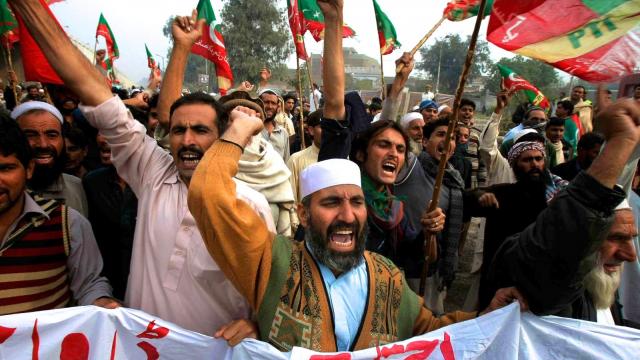
Thousands of people protesting U.S. drone strikes on Saturday blocked a road in northwest Pakistan that is used to move NATO troop supplies and equipment in and out of Afghanistan, the latest sign of rising tension brought on by the U.S. strikes.
The U.S. drone program is deeply unpopular in Pakistan and condemned by Islamabad as counter-productive and a violation of sovereignty, although previous governments have given their tacit support to the strikes.
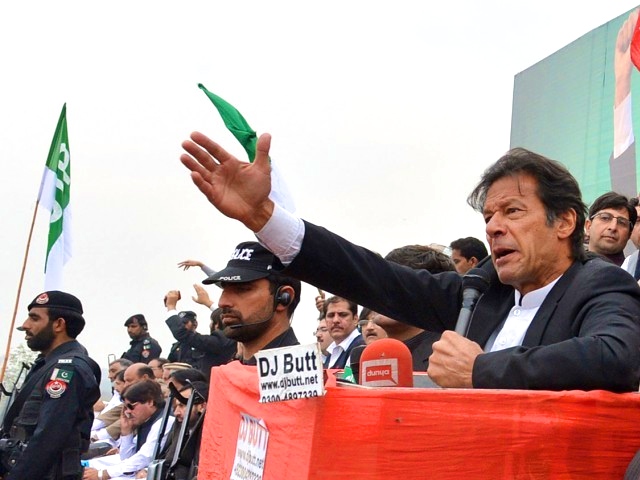
The protest, led by Pakistani politician and former cricket star Imran Khan, had more symbolic value than practical impact as there is normally little NATO supply traffic on the road on Saturdays. The blocked route in Khyber Pakhtunkhwa province leads to one of two border crossings used to send supplies overland from Pakistan to neighboring Afghanistan.
Khan, whose Tehreek-e-Insaf party runs the Khyber Pakhtunkhwa government, called on federal officials to take a firmer stance to force the U.S. to end drone attacks and block NATO supplies across the country.
"We will put pressure on America, and our protest will continue if drone attacks are not stopped," Khan told the protesters.
The demonstrators dispersed after Khan's speech, but his party put out a statement saying they will begin stopping trucks from carrying NATO supplies through Khyber Pakhtunkhwa indefinitely beginning Sunday night, a move that could spark a clash with the federal government.
The U.S. Embassy in Islamabad declined to comment. The U.S. leads the coalition of NATO troops battling the Taliban in Afghanistan.
Friction Between Nations
The tension over the U.S. drone program has further complicated a relationship that Washington views as vital to fight Al-Qaeda and the Taliban, as well as negotiate peace in Afghanistan.
The protest comes only two days after a rare U.S. drone strike outside of Pakistan's remote tribal region killed five people, including at least three Afghan militants, at an Islamic seminary in Khyber Pakhtunkhwa.
The attack outraged Pakistani officials, as did one on Nov. 1 that killed the former leader of the Pakistani Taliban, Hakimullah Mehsud, a day before the Pakistani government said it was going to invite him to hold peace talks.
Khan pushed the Pakistani government to block NATO supplies after the strike on Mehsud, but it has shown little interest in doing so. Pakistani Prime Minister Nawaz Sharif has been a vocal critic of drone strikes, but he has also said he values the country's relationship with the U.S.
Sharif pushed President Barack Obama to end drone strikes in a visit to Washington in October, but the U.S. government has shown no indication that it intends to stop. When Khan failed to persuade the Pakistani government to block NATO supplies earlier this month, he announced that he would hold a protest to do so himself.
"They Are Killing Our People"
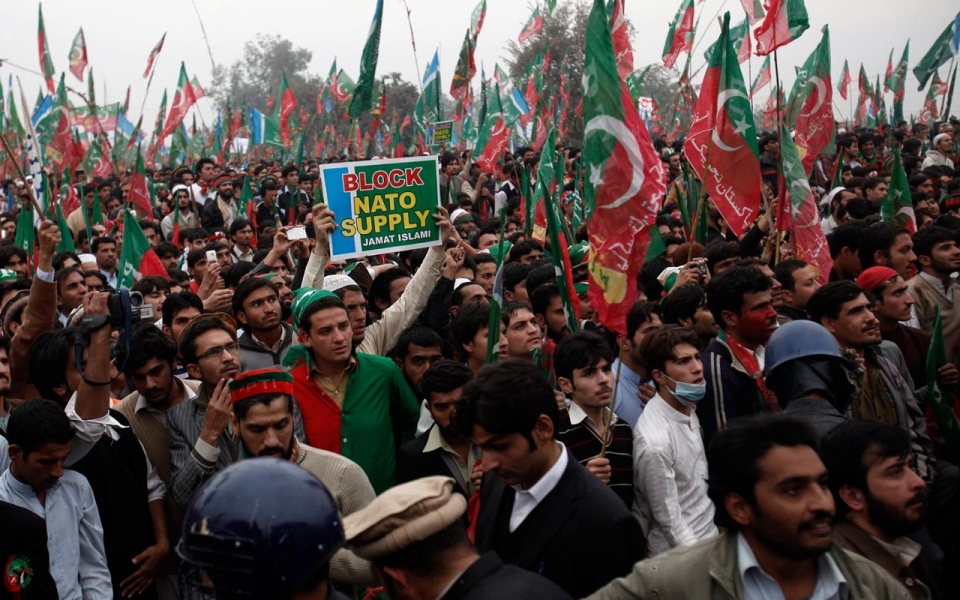
About 10,000 people participated in Saturday's protest. The protesters included members of Khan's party and two other parties that are coalition partners in the Khyber Pakhtunkhwa government. They shouted anti-U.S. slogans, such as "Down with America" and "Stop drone attacks."
"I am participating in today's sit-in to convey a message to America that we hate them since they are killing our people in drone attacks," university student Hussain Shah said. "America must stop drone attacks for peace in our country."
The federal information minister, Pervez Rashid, said the federal government's anti-drone stance was clear and accused Khan of "playing politics" on the issue.
Drone strikes are widely unpopular with Pakistan's public, both because they are seen as violating the nation's sovereignty and also because they are believed to kill many innocent civilians. Human rights organizations have said hundreds of civilians have died in the attacks, although the U.S. insists the number is much lower.
The land routes through Pakistan from the southern port city of Karachi to Torkham and another border crossing in southwest Baluchistan province have been key to getting supplies to NATO troops in Afghanistan. They now increasingly are being used to ship equipment out of Afghanistan as the U.S. seeks to withdraw most of its combat troops from the country by the end of 2014.
The routes have been closed in the past. The Pakistani government blocked the routes for seven months following U.S. airstrikes that accidentally killed two dozen soldiers on the Afghan border in November 2011. Pakistan finally reopened the routes after the U.S. apologized.
3 WAYS TO SHOW YOUR SUPPORT



- Log in to post comments


