
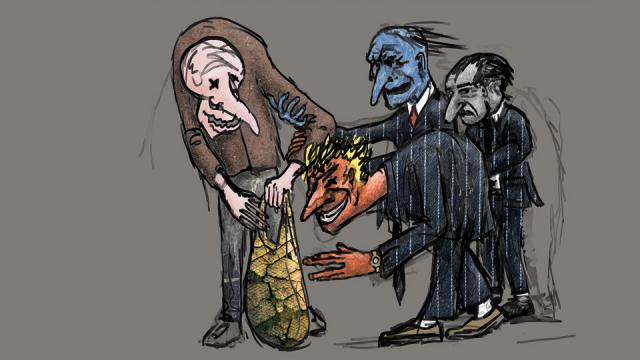
Fifty years ago, average Americans lived in a society where less than $10 of every $100 in personal income went to the nation’s richest 1 percent.
Our top 1 percent are now grabbing just under 20 percent of America’s income, double the 1963 level.
How did this happen? We Americans certainly never voted for this upward redistribution. In all the years since Martin Luther King, Jr.’s “I Have a Dream” speech, no candidates ever campaigned on a platform that called for enriching America’s already rich.
Yet the rich have been enriched. And they keep getting even richer while America’s 99 percent face an economic insecurity that never lets up.
This doesn’t make sense. Americans, after all, live amid democratic institutions. Why haven’t the American people, through these institutions, been able to undo the public policies that squeeze the bottom 99 percent and lavishly reward the crew at the top?
Why, in other words, hasn’t democracy slowed rising inequality?
Four political scientists take a crack at answering exactly this question in the current issue of the American Economic Association’s Journal of Economic Perspectives.
The four analysts — Stanford’s Adam Bonica, Princeton’s Nolan McCarty, Keith Poole from the University of Georgia, and New York University’s Howard Rosenthal — lay out a nuanced reading of our political scene that explores everything from the partisan gerrymandering of legislative districts to voter turnout by income level.
But one particular reality dramatically drives their analysis: Societies that let wealth concentrate at enormously intense levels, the four show, will quite predictably end up with a wealthy class who can concentrate enormous resources on getting their way.
These wealthy underwrite political campaigns. They spend fortunes on lobbying. They keep politicians and bureaucrats “friendly” to their interests with a revolving door that promises lucrative employment in the private sector.
Just how deeply have America’s super-rich come to dominate our political process? Bonica and his co-authors offer up a revealing anecdote: Back in 1980, no American gave out more in federal election contributions than Cecil Haden, the owner of a tugboat company. Haden contributed what would, in today’s dollars, amount to about $1.72 million, almost six times more than any other political contributor in 1980.
In the 2012 election cycle, by contrast, just one deep-pocket couple alone, gaming industry giant Sheldon Adelson and his wife Miriam, together shelled out $103.4 million to bend politics in their favored wealth-concentrating direction.
The Adelsons sit comfortably within the richest 0.01 percent of America’s voting-age population. Over 40 percent of the contributions to American political campaigns are now emanating from this super-rich elite strata.
In the 1980s, campaign contributions from the top 0.01 percent roughly equaled the campaign contributions from all of organized labor. In 2012, America’s top 0.01 percent all by themselves outspent labor by more than four-to-one.
Donors in this top 0.01 percent, Bonica and his colleagues point out, “give pretty evenly to Democrats and Republicans” — and they get a pretty good return on their investment. Both “Democrats as well as Republicans,” the four analysts observe, have come to “rely on big donors.”
What has this reliance produced? Nothing good for average Americans. Back in the 1930s, for instance, Democrats championed the financial industry regulations that helped create a more equal mid-20th century America. In our time, significant numbers of Democrats have joined with Republicans to undo these regulations.
Conventional economists, the new paper by Bonica and his fellow analysts adds, tend to ascribe rising inequality to broad trends like globalization and technological change — and ignore the political decisions that determine how these trends play out in real life.
But new technologies, the four political scientists counter, don’t automatically have to concentrate wealth — and these new technologies wouldn’t have that impact if our intellectual property laws, a product of political give-and-take, better protected the public interest.
But too many lawmakers and other elected leaders can’t see that “public interest.” Cascades of cash — from America’s super rich — have them conveniently blinded.
3 WAYS TO SHOW YOUR SUPPORT



- Log in to post comments


