
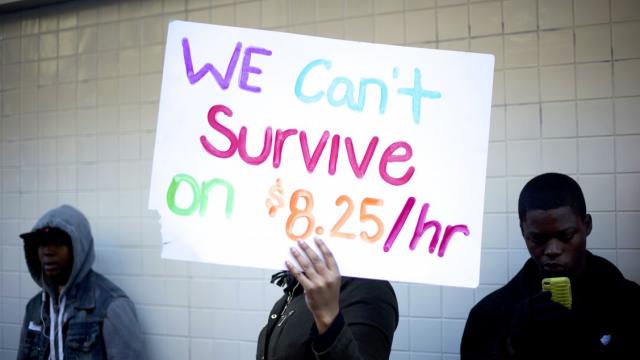
Fifteen dollars shouldn’t be too much to ask – or demand.
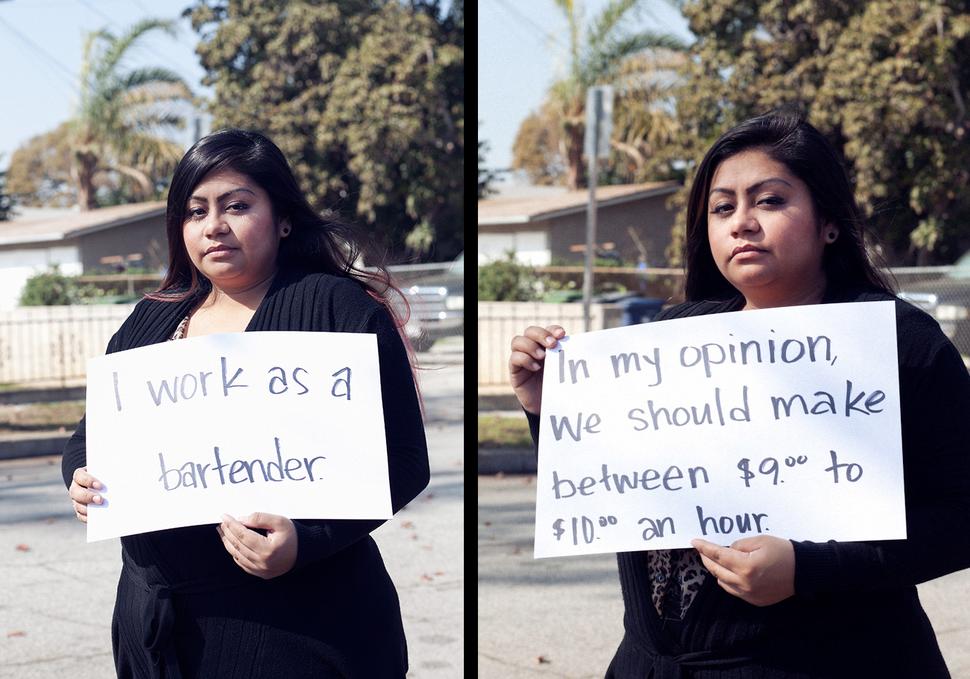
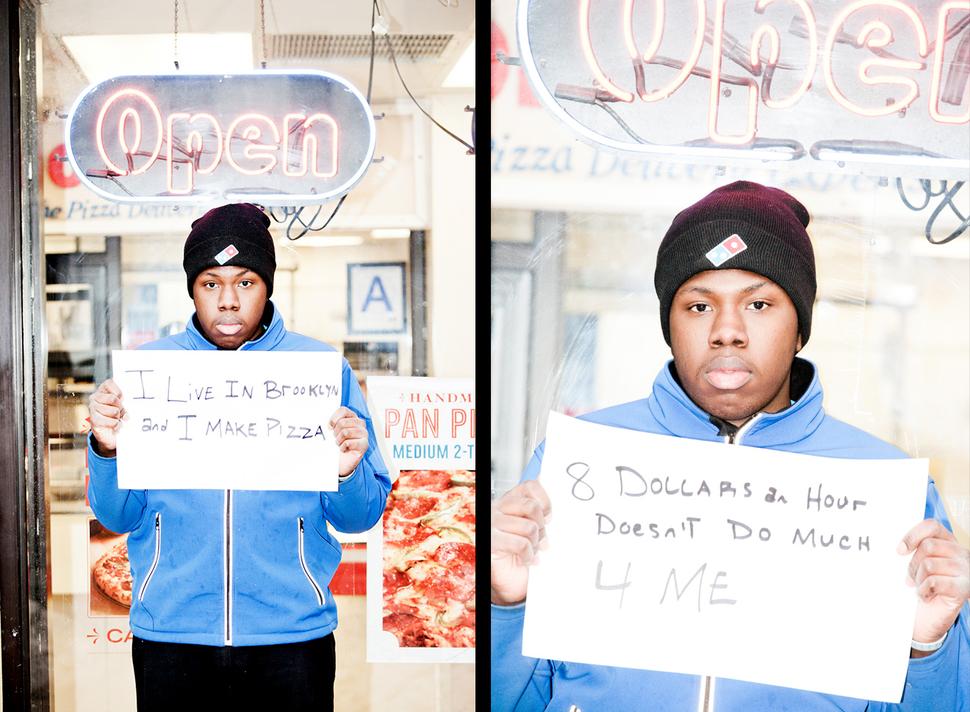
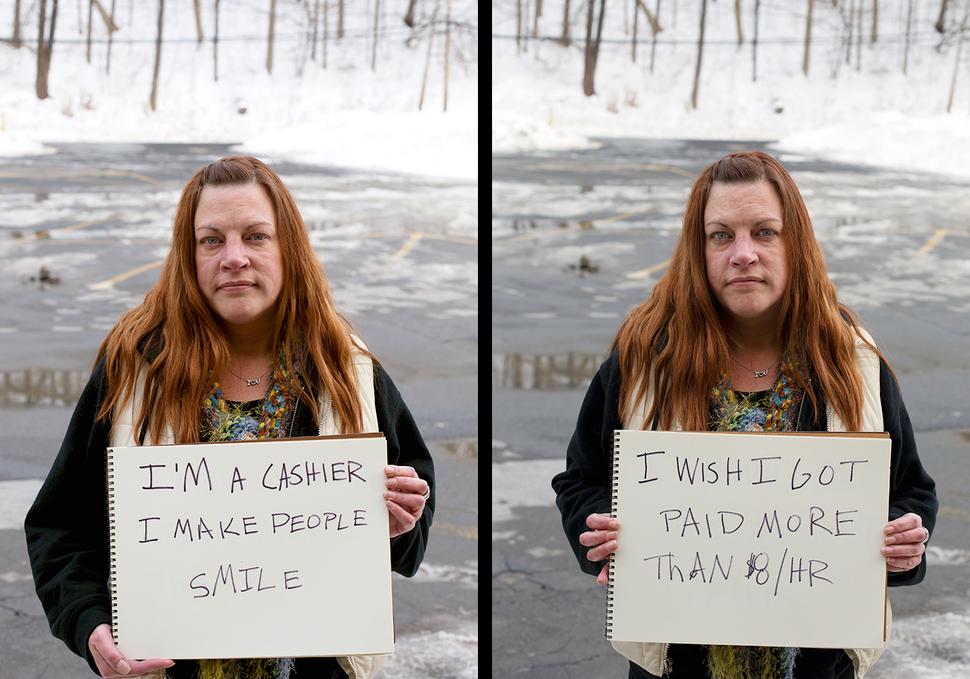
In almost every state, a worker needs more than $15 an hour to make ends meet. Add in student debt, and the minimum living wage shoots up to $18.67 an hour nationally. A family with children needs significantly more.
That’s according to new research from People’s Action Institute, which calculates the national living wage at $17.28. A living wage is the pay a person needs to cover basic needs like food, housing, utilities and clothing, along with some savings to handle emergencies.
In some states, the living wage is much higher. New Jersey, Maryland, and New York have a living wage greater than $20 per hour for a single adult. In Hawaii and Washington, D.C., that figure hits almost $22 per hour. No state has a living wage for a single adult lower than $14.50 an hour.
This is the first report in the annual Job Gap Economic Prosperity Series to factor in the $1.3 trillion in student debt owed by college students nationwide into the calculation of what a living wage should be nationally and in the states.
“Students should not be saddled with thousands of dollars in debt after graduation. However, those who do graduate with debt need jobs that pay enough to make ends meet,” the report says. “And, making ends meet should include not only basic necessities like food and housing, but the ability to put aside money for savings and to pay off existing debt.”
In addition to calling for increasing the federal minimum wage to a living wage and eliminating the tipped subminimum wage, usually paid to people like restaurant servers, the report also calls for expanding tax-free student debt forgiveness and reinvesting in higher education to eliminate the need for student loans to begin with.
“We Just Choose Bills Out of a Hat”
In Iowa, where the living wage is $15.10 an hour for a single person – twice the state minimum of $7.25 – and higher for families with children, people are doubling and tripling up on jobs, rooming together, and even turning to predatory payday loans.
Tonja Galvan is one of those Iowans. She makes a bit more than $20 an hour at the John Deere plant in Ankeny, near Des Moines, where she lives with her mother, daughter, and granddaughter. Even with three generations of the family working – her mother and granddaughter are paid much lower wages – they can never catch up.
“When we can’t pay everything,” Galvan says, “we just choose bills out of a hat to see what we’ll pay and what we’ll push to the next month.”
Galvan sees many other families struggling – and she’s helping take charge in a campaign with the Iowa Citizen for Community Improvement (Iowa CCI). Galvan has joined other workers, teachers, service providers, and other Iowans to press for a higher wage floor, hitting the doors in her community and speaking with county supervisors.
They’ve scored wins in four counties around the state – Johnson, Linn, Polk, and Wappelo – with a phase-in of new wage floors ranging from $10.10 to $10.75. (Johnson County’s will also be pegged to the consumer price index.)
Iowa CCI organizer Matthew Covington calls the increases “a step in the right direction,” but he’s the first to say they’re just a step. His organization is now making sure cities in Polk County match that county minimum, take it higher, and close exemptions for the restaurant and grocery industries. Meanwhile, Iowa CCI also has their sights set on the state legislature.
In Colorado, a coalition of nonprofits, faith groups, and small businesses are taking a different approach for raising the wage floor. They’re turning to the ballot box.
An initiative supported by this coalition, Colorado Families for a Fair Wage, would gradually increase the hourly minimum statewide to $12 by 2020.
Though the corporate opposition has poured money into the state, there’s plenty of business support for increase – and recent researchfrom the University of Denver debunking claims of a negative impact on jobs.
In fact, Lizeth Chacón, executive director of Colorado People’s Alliance (COPA) and co-chair of the coalition, says the number of jobs grew after the state’s last minimum wage increase, in 2006. Those gains were seen in restaurants, small businesses, and rural areas. The number of small businesses in the state also increased.
“Small businesses helped put this proposal together,” says Chacón. “They said, ‘We’re already paying our staff more because we want them to be able to support their families and stay with us.’”
The People’s Action Institute living wage figures show just how needed these fierce campaigns are. As Iowa CCI’s Covington knows, the numbers aren’t academic. “The more we talk about actual costs,” he says, “the more it helps.”
3 WAYS TO SHOW YOUR SUPPORT



- Log in to post comments


