
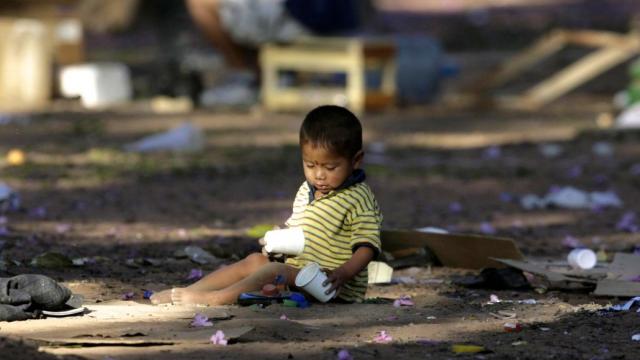
Around 3 million more children in the U.S. are living in poverty than at the beginning of the Great Recession – a worrying statistic that mutes much of the fanfare of the nation's economic turnaround, according to a report released Tuesday on child welfare.
Twenty-two percent of U.S. children were living in poverty in 2013 compared with 18 percent in 2008, according to the Kids Count Data Book, an annual report that ranks states by the well-being of their children. It equates to an increase of 2.9 million children, according to census data from those years.
Poverty rates have nearly doubled among African-Americans and American Indians since 2008, and hardship is most severe in the South and Southwest, the report found.
The report, based on data from the U.S. Census Bureau's American Community Survey, defines children in poverty as those under the age of 18, living in families with annual incomes below $23,624. In all, some 16,087,000 children are deemed to be living in poverty in America.
Minnesota ranked as the best state for overall child well-being, based on indicators including economic standing, education and health. Mississippi ranked the worst.
The report, released Tuesday from the child advocacy group the Annie E. Casey Foundation, showed signs of slight improvement in some areas, including high school graduation rates being at an all-time high and a falling percentage of children without health insurance.
But the bright spots weren't enough to offset a picture that many children have been left behind amid the nation's economic recovery.
Differing Causes
The problems facing children in the U.S. extend beyond – and in some cases drive – increasing poverty rates. More children were raised in single-parent homes in 2013 than in 2008, and fewer lived with parents with secure employment, according to the report. Children living in single parent households are 23 percent less likely to be raised by a parent with a degree beyond high school, the study showed.
Foundation President Patrick McCarthy said that particularly troubling is an increase in the share of kids living in poor communities, regardless of their own families' economic standing. The report says 1 in 7 children live in those areas, marked by poor schools and a lack of a safe place to play.
"They're more likely to fall down the economic ladder, less likely to be employed and more likely to get in trouble," McCarthy said.
McCarthy likened child poverty to a “particularly pernicious form of cancer,” and he prescribed a cocktail of economic policies and fixes to tackle it.
Tax credits and additional support such as food stamps could give low-income families a much-needed boost, and job training could provide help for those struggling to get an economic foothold, according to the report. Businesses, the report added, should implement more family-friendly policies, and a massive infrastructure repair campaign could create countless jobs.
“None of them is a magic bullet. When you put them all together, you start to put the children on a path to success,” McCarthy said.
Struggling in the South
States in the South and Southwest continued a steady run at the bottom of the Kids Count rankings for overall child well-being, with difficulties including economic standing and education.
According to the report, 1 in 3 children from Mississippi live in poverty. Twelve percent of teens from Mississippi and Louisiana are neither in school nor working. Fifteen percent of Nevada children don’t have health insurance, compared with the nation-best 2 percent in Massachusetts.
The Midwest came out on top as the best place in the nation for children. Minnesota nabbed the report's top ranking, taking a spot generally reserved for a Northeast state and rounding out the Midwest's strong pattern of supporting children.
McCarthy said there's not much to make of one state beating another for a top spot. Instead, he focused on the broader regional patterns: New England and Midwestern states generally occupy the top 10 while the South and Southwest struggle in the bottom rankings.
“That's where you see a difference in day-to-day lives,” he said.
3 WAYS TO SHOW YOUR SUPPORT



- Log in to post comments


