
Read

User menu

Search form

The Riskiest Banks are Still Those We Bailed Out

The Riskiest Banks are Still Those We Bailed Out
Mon, 9/24/2012 - by Pat Garofalo
This article originally appeared on Think Progress

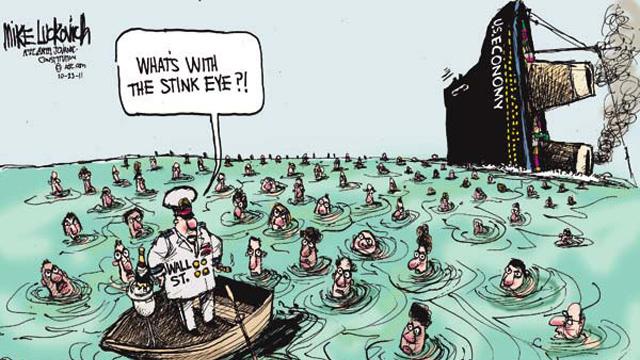
According to a new report from the Bank of International Settlements — which provides research to the world’s central bankers — bailed out banks in both the U.S. and around the world continued to be riskier than non-bailed out banks, even after they received taxpayer dollars during the financial crisis of 2008:

We find no evidence that rescued banks reduced the riskiness of their new lending more than non-rescued banks in response to the crisis and the public rescues. Even as lending volumes decreased across the board in 2009, rescued banks continued to write riskier syndicated loans, as reflected by their involvement in the leveraged loan segment and in the spreads charged on the facilities that they originated. We also find, unsurprisingly, that the syndicated lending of banks that later received a bailout was riskier before the crisis than that of non-rescued institutions. [...] During the crisis, rescued banks did not reduce the riskiness of their new syndicated lending compared to their non-rescued peers. In fact, our results suggest that the relative riskiness of their lending increased.

As Reuters columnist James Saft noted, “This is both astounding and totally predictable. Astounding because it was so clear that those risks were not just foolish but destructive. Predictable because of course the banks realized that they had not been just lucky but had been given a special exemption from death which will be very hard to revoke.”

Despite this and other clear evidence that the banks are totally uninterested in learning any lessons from the financial crisis, Republicans are attempting to bog down or repeal the Dodd-Frank financial reform law.

But several prominent banking executives have said that the size and complexity of today’s mega-banks makes them unmanageable. A recent report found that the financial crisis cost the U.S. economy $12.8 trillion.

3 WAYS TO SHOW YOUR SUPPORT

ONE-TIME DONATION

Just use the simple form below to make a single direct donation.

DONATE NOW

MONTHLY DONATION

Be a sustaining sponsor. Give a reacurring monthly donation at any level.

GET SOME MERCH!

Now you can wear your support too! From T-Shirts to tote bags.

SHOP TODAY

Sign Up

Article Tabs

From a pro-democratic perspective, civil society and new media organisations are surging in the aftermath of the Orban regime.

The country’s new prime minister, Andy Burnham, has promised a break from the politics of the last 40 years—realizing more broadly that Labour must stand up for the 99% against big business, or the party will become irrelevant.

The tragic shooting of Lorenzo Salgado Araujo is just the latest example of ICE having a fundamental disrespect for human life — further proving why the agency should be stripped of funding and shut down, and its rank-and-file agents and leadership prosecuted.

While the U.S., EU and their allies are enabling Rojava—the strongest force against Islamic State— to fall, it is vital for internationalists to continue to support this beacon of democracy and liberation.

June 23, 2026 may be remembered as the beginning of the end of the Democratic Party establishment.

The current wave of food recalls is a direct byproduct of President Donald Trump’s administration deliberately removing the safeguards put in place aimed at protecting American consumers more than a century ago.

From a pro-democratic perspective, civil society and new media organisations are surging in the aftermath of the Orban regime.

We can still celebrate success while simultaneously putting a cap on net worth.

The country’s new prime minister, Andy Burnham, has promised a break from the politics of the last 40 years—realizing more broadly that Labour must stand up for the 99% against big business, or the party will become irrelevant.

Much like the resistance to AI data centers, the opposition to Flock surveillance cameras has brought the left and the right together against billionaires who are trying to force America into becoming even more of a police state.

Much like the resistance to AI data centers, the opposition to Flock surveillance cameras has brought the left and the right together against billionaires who are trying to force America into becoming even more of a police state.

Posted 1 month 3 weeks ago

The country’s new prime minister, Andy Burnham, has promised a break from the politics of the last 40 years—realizing more broadly that Labour must stand up for the 99% against big business, or the party will become irrelevant.

Posted 1 month 3 weeks ago

We can still celebrate success while simultaneously putting a cap on net worth.

Posted 1 month 1 week ago

The current wave of food recalls is a direct byproduct of President Donald Trump’s administration deliberately removing the safeguards put in place aimed at protecting American consumers more than a century ago.

Posted 2 weeks 3 days ago

From a pro-democratic perspective, civil society and new media organisations are surging in the aftermath of the Orban regime.

Posted 2 weeks 6 days ago

The current wave of food recalls is a direct byproduct of President Donald Trump’s administration deliberately removing the safeguards put in place aimed at protecting American consumers more than a century ago.

From a pro-democratic perspective, civil society and new media organisations are surging in the aftermath of the Orban regime.