
Read

User menu

Search form

Supreme Court Endorses Cellphone Privacy Rights In Landmark Ruling

Supreme Court Endorses Cellphone Privacy Rights In Landmark Ruling
Thu, 6/26/2014 - by Jon Swaine
This article originally appeared on The Guardian

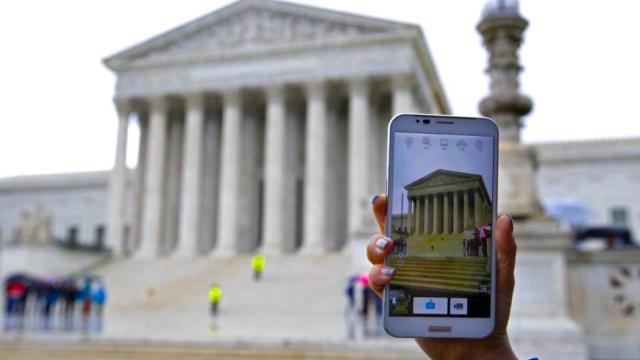
The U.S. Supreme Court delivered a landmark endorsement of electronic privacy on Wednesday, ruling that police must obtain a warrant to search the contents of cellphones seized from people they have arrested.

All nine justices joined the ruling on a case hailed by civil liberties campaigners as a crucial test of the rights of individuals to be protected against intrusion into their ever-expanding digital lives.

The opinion of the court, delivered by chief justice John Roberts, recognized that many owners of modern cellphones “keep on their person a digital record of nearly every aspect of their lives,” which may disclose a uniquely large volume of personal information if searched.

"Modern cell phones are not just another technological convenience," Roberts wrote. “With all they contain and all they may reveal, they hold for many Americans the privacies of life.

Reading his ruling from the bench, Roberts went on: “The fact that technology now allows an individual to carry such information in his hand does not make the information any less worthy of the protection for which the founders fought. Our answer to the question of what police must do before searching a cell phone seized incident to an arrest is accordingly simple – get a warrant.”

The justices considered together two separate cases relating to men whose cellphones were searched after their arrests in California and Massachusetts. Both men were convicted of crimes after information recovered from their phones led police to other evidence.

The court sided with arguments put forward in April by lawyers backed by the American Civil Liberties Union and the Electronic Privacy Information Center, who said that these warrantless cellphone searches were not permitted under the fourth amendment of the constitution, which protects Americans from unreasonable searches.

During the hearings in April, the justices considered opposing arguments from government lawyers that police could search digital content from cellphones in the same way they are allowed to handle physical diaries or photographs held by someone at the time of their arrest.

Several questioned at the time why it should be more necessary to obtain a warrant for the search of digital content than for such physical possessions, which may be seized so that officers can prevent the destruction of evidence or check for weapons.

In his opinion, Roberts acknowledged that by barring officers from making warrantless searches, their jobs would be more difficult. “We cannot deny that our decision today will have an impact on the ability of law enforcement to combat crime,” he wrote.

However, in the end the court ruled that “digital data stored on a cell phone cannot itself be used as a weapon to harm an arresting officer or to effectuate the arrestee’s escape. Officers may examine the phone’s physical aspects to ensure that it will not be used as a weapon, but the data on the phone can endanger no one.”

While joining the court’s main ruling, Justice Samuel Alito filed a separate opinion saying that he would prefer Congress and state legislatures to be given leeway to create new rules that would limit the requirement to obtain a warrant in special cases.

Steven Shapiro, the ACLU's national legal director, hailed the decision as "revolutionary" and said that it would "help to protect the privacy rights of all Americans".

"We have entered a new world but, as the court today recognized, our old values still apply and limit the government's ability to rummage through the intimate details of our private lives," Shapiro said in a statement.

Originally published by The Guardian

3 WAYS TO SHOW YOUR SUPPORT

ONE-TIME DONATION

Just use the simple form below to make a single direct donation.

DONATE NOW

MONTHLY DONATION

Be a sustaining sponsor. Give a reacurring monthly donation at any level.

GET SOME MERCH!

Now you can wear your support too! From T-Shirts to tote bags.

SHOP TODAY

Sign Up

Article Tabs

From a pro-democratic perspective, civil society and new media organisations are surging in the aftermath of the Orban regime.

The country’s new prime minister, Andy Burnham, has promised a break from the politics of the last 40 years—realizing more broadly that Labour must stand up for the 99% against big business, or the party will become irrelevant.

The tragic shooting of Lorenzo Salgado Araujo is just the latest example of ICE having a fundamental disrespect for human life — further proving why the agency should be stripped of funding and shut down, and its rank-and-file agents and leadership prosecuted.

While the U.S., EU and their allies are enabling Rojava—the strongest force against Islamic State— to fall, it is vital for internationalists to continue to support this beacon of democracy and liberation.

June 23, 2026 may be remembered as the beginning of the end of the Democratic Party establishment.

The current wave of food recalls is a direct byproduct of President Donald Trump’s administration deliberately removing the safeguards put in place aimed at protecting American consumers more than a century ago.

From a pro-democratic perspective, civil society and new media organisations are surging in the aftermath of the Orban regime.

We can still celebrate success while simultaneously putting a cap on net worth.

The country’s new prime minister, Andy Burnham, has promised a break from the politics of the last 40 years—realizing more broadly that Labour must stand up for the 99% against big business, or the party will become irrelevant.

Much like the resistance to AI data centers, the opposition to Flock surveillance cameras has brought the left and the right together against billionaires who are trying to force America into becoming even more of a police state.

Much like the resistance to AI data centers, the opposition to Flock surveillance cameras has brought the left and the right together against billionaires who are trying to force America into becoming even more of a police state.

Posted 1 month 4 weeks ago

The country’s new prime minister, Andy Burnham, has promised a break from the politics of the last 40 years—realizing more broadly that Labour must stand up for the 99% against big business, or the party will become irrelevant.

Posted 1 month 4 weeks ago

We can still celebrate success while simultaneously putting a cap on net worth.

Posted 1 month 2 weeks ago

The current wave of food recalls is a direct byproduct of President Donald Trump’s administration deliberately removing the safeguards put in place aimed at protecting American consumers more than a century ago.

Posted 2 weeks 6 days ago

From a pro-democratic perspective, civil society and new media organisations are surging in the aftermath of the Orban regime.

Posted 3 weeks 1 day ago

The current wave of food recalls is a direct byproduct of President Donald Trump’s administration deliberately removing the safeguards put in place aimed at protecting American consumers more than a century ago.

From a pro-democratic perspective, civil society and new media organisations are surging in the aftermath of the Orban regime.