
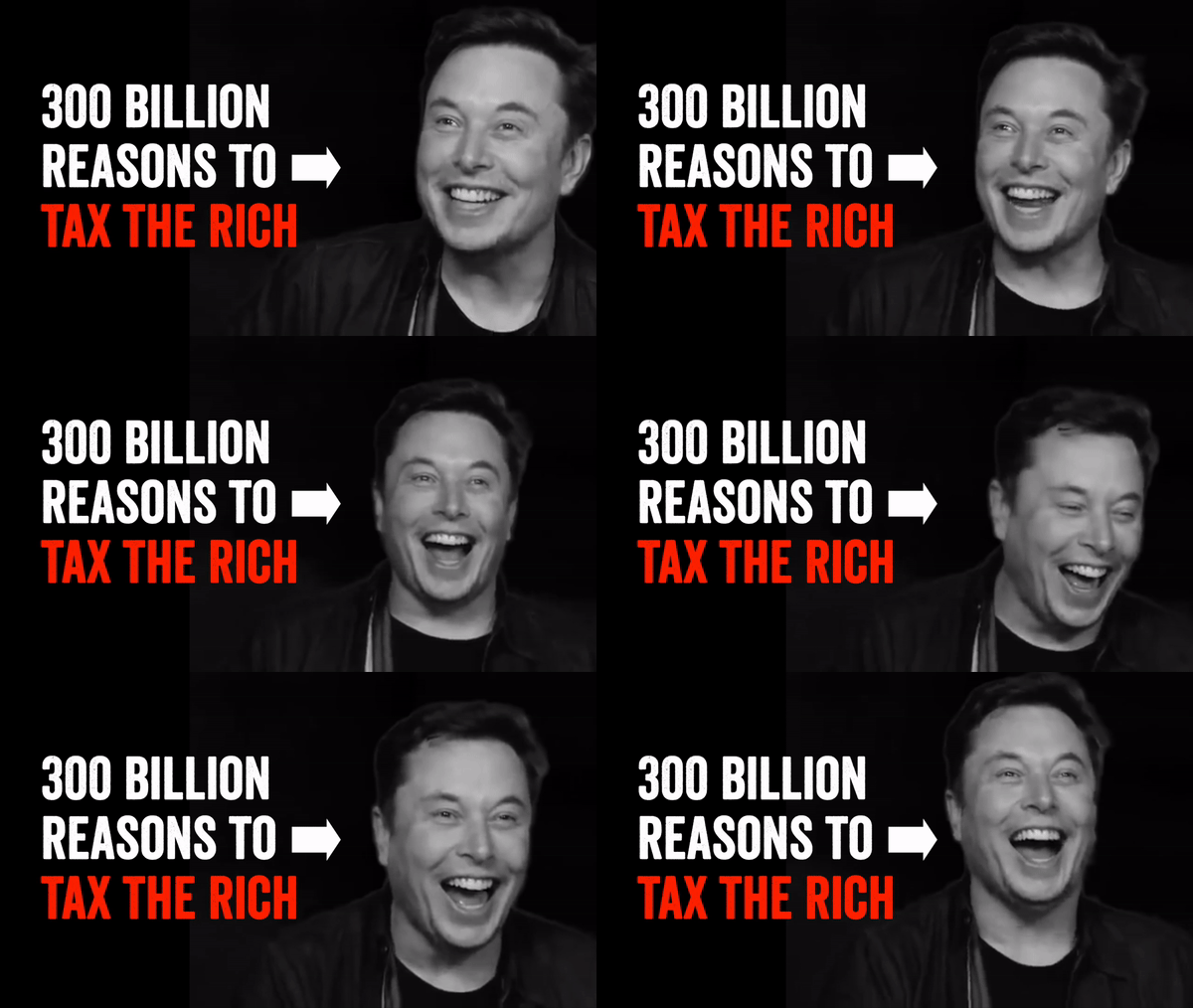
Elon Musk’s wealth now exceeds the gross domestic product of Finland and Denmark — and is nearly as much as the GDP of Norway. According to Forbes, Musk’s fortune is estimated at $384 billion, although Bloomberg puts it higher at $480 billion.
At the same time, the International Monetary Fund puts Finland’s GDP at $304 billion, Denmark’s at $450 billion, and Norway’s at $504 billion. These Nordic countries — each with populations around 5 million — consistently top global happiness rankings.
They are among the world’s most functional societies, known for high taxes, low corruption, strong welfare systems, and healthy, well-educated populations. Yet the world’s richest man, Elon Musk, holds more personal wealth than the entire GDP of Finland — a nation that has eradicated homelessness and boasts one of the best education systems globally.
Meanwhile, the top billionaires continue to grow year after year. Before long, their individual fortunes may surpass that of Norway — a country ranked 13th in global oil production and 4th in oil and gas exports.
Being super-rich is odious. Toxic. There is only so much a person needs to consume. Additionally, wealth offers the ability to buy power. All this is extremely unhealthy, across societies and eco-systems the world over. Put simply, financial inequality is central to many of the global crises we face today.
This enormous wealth should make billionaires like Musk public enemy number one. And yet, despite certain public angst against the super-rich, many of them are aligning themselves with, or even leading, far-right and populist movements that claim to be anti-establishment.
Billionaires are in fact bankrolling the far-right globally, a contradiction that must be exposed. It’s time to tax the super-rich. It's time for every politician that says they are challenging the far-right to tax the rich.
The far right and the far rich
In mid-September, Musk took to a livestream at a far-right rally in London and called for the UK government to be overthrown. Telling a crowd of over 100,000 that “violence is coming,” he urged them to “fight back or die.”
The event, called “Unite the Kingdom,” was one of the largest far-right demonstrations in British history, which brought together anti-establishment themes alongside outright racism. Musk’s appearance reflects his growing alignment with far-right movements globally — from support for Trump's election campaign in the U.S., to vocally backing nationalist parties in Germany.
The scale of the far-right connected London rally correlates with the popularity of the Reform Party, a Trump-style outfit currently leading in national polls.
The incumbent Labour Party is offering a light version of Reform’s racist, xenophobic, anti-migrant policies, while putting forward centre-right economic policies of austerity and neoliberal reforms, leading to increasing unpopularity.
Returning towards its left-wing roots, including taxing the rich, is essential for Labour, the largest party in an archaic system that suits larger parties to challenge Reform.
Reform, and the Brexit movement that it emerged from, is backed by billionaires. Even Musk has flirted with bankrolling the party. Labour exposing these links — alongside pushing for serious taxation on extreme wealth — would undermine Reform’s faux-populism and speak to widespread public support for wealth redistribution.
In the UK, a comprehensive plan to tax the ultra-wealthy could fund essential public services amid a spending crisis, highlight Reform’s ties to elite donors, and show a clear contrast between the politics of status-quo (that got us into this situation) and Reform's pseudo-anti-establishmentarianism.
Labour also needs to stop pushing anti-migrant lighter versions of the far-right's message, too.
In Europe and beyond, opinion surveys show that taxing billionaires is now supported by a strong majority — including many high earners who want to see better public services and a fairer society.
The UK Labour Party is not the only one missing this obvious opportunity. Parties on both sides of the Atlantic — from the U.S. Democrats to Germany’s SPD — over the last four decades have often abandoned redistributive policies, captured by pro-business ideology since the Clinton-Blair-Schröder era.
Neoliberals and corporations have captured these parties. Yet pressure mounts within the remaining leftist groups in these parties to return to economic justice. Here, taxing the rich offers a solid first step.
Of course, wealth taxes and top-down political parties alone won’t solve the crises we face — from climate breakdown to democratic backsliding. Yet, essentially, they could break the ever tightening grip of the billionaire class and fracture their far-right alliance with people who have genuine frustrations with the status-quo.
Spain is one place where a Social Democratic Party has pivoted back towards its roots, introduced wealth taxes, and kept the far-right from power.
Taxing the rich is possible
In 1978, following the death of fascist dictator Francisco Franco, Spain introduced a wealth tax. Over the decades, successive regional governments gradually watered it down or scrapped it altogether.
That changed in late 2022, when the coalition government between the Spanish Socialist Workers' Party (PSOE) and Podemos reinstated the tax. (Since then, Podemos has been replaced by a new incarnation: Sumar).
Globally, the wealthy have successfully pushed the myth that taxing them will drive billionaires out of the country, stifle innovation, or trigger economic decline. These claims, central to neoliberal dogma, are worthless.
In fact, Spain's increased corporate and wealth taxes are encouraging reinvestment into domestic companies — a trend echoed in the 1960s, when tax rates were significantly higher.
The reality is, many of the ultra-rich maintain their wealth by avoiding taxes and keeping assets offshore — undermining their own arguments against progressive taxation.
Spain stands out in Europe for another reason: its centre-left government has successfully resisted the rise of the far right. Notably, this success has gone hand-in-hand with maintaining higher taxes on wealth.
Across Europe, only Switzerland and Norway currently have wealth taxes. But there are many other ways to tax extreme wealth — from genuinely progressive income tax systems to capital gains reforms.
The Nordic countries are no utopia, but they show what is possible — a step towards making society function far more highly. Norway recently held an election where a right-wing populist party narrowly lost after campaigning to eliminate the wealth tax.
Finland, on the other hand, is currently governed by a right-wing coalition that includes the far right. Yet thanks to strong social policies and a widely held belief in redistributing wealth via taxation, these countries function in a way that cannot be said of the US, UK, or much of Europe.
There are many things that need to change in this world. But one thing is clear: anyone who claims to oppose the rise of the far right must, at the very least, support higher taxes on extreme wealth.