
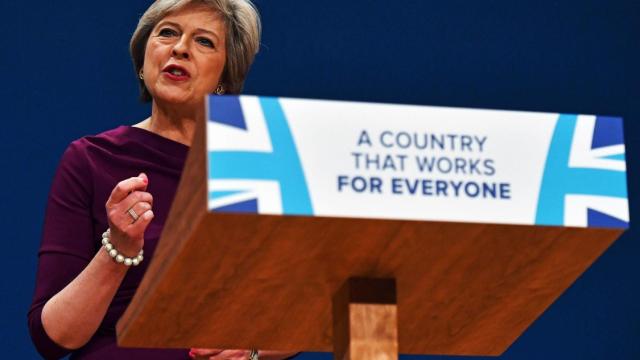
British Prime Minister Theresa May seized an opportunity earlier this month at the Conservative Party Conference to announce to her fellow Tories, and the eagerly poised media, plans to stand up for what she referred to as “ordinary working class people.” However, May failed to provide any concrete proposals for how her government intended to create, as the Party Conference slogan read, “A Country That Works for Everyone.”
More tangible, by contrast, were May’s pledges to cut immigration, build more grammar schools and bankroll the National Health Service while delivering a "hard Brexit" – none of which are policies conducive to forging a new sense of worker optimism.
Ironically, while Tories sat comfortably in their seats making unsubstantiated promises about delivering a more equal Britain, thousands of anti-austerity campaigners gathered outside the conference venue in Birmingham. The campaigners had travelled from across the whole of the U.K. Holding banners that read “Tories Out” and waving huge inflatable scissors in the air, to represent the ongoing cuts to welfare, scores of trade union members and everyday citizens took part in the-austerity march.
“We want to send a message to the Tories here today that their austerity experiment has failed our country, failed our economy and failed our people. And it is time to end it,” Ravi Subramanian, West Midlands Unison regional secretary, said at the time.
Anti-austerity campaigners seem to have plenty of fodder for their protests lately. In September, May refused to rule out delivering more brutal welfare cuts if the U.K. economy nosedives as a result of Brexit. May’s refusal to offer guarantees for Britain’s welfare system came in spite of promises, made in March by the former chancellor George Osborne, that the government had “no further plans to make welfare savings” before the 2020 general election.
Now, with the pound falling to its lowest level on record, the cost of food, clothing and petrol rising, and the prospect of an economy shock from Brexit, the brutal cuts to welfare look like a disturbing possibility. May's harsh voting record on welfare and benefits have fueled fears that the prime minister will quickly abandon her promise to defend “ordinary working class people” when push comes to shove.
Siding with the Rich
Under David Cameron, May consistently voted against raising welfare benefits, even in line with price rises. She also generally voted for the controversial "bedroom tax" bill, whereby social tenants deemed as having an excess bedroom would face a reduction in housing benefits. Furthermore, May voted against paying higher benefits for longer periods to those unable to work due to disability or illness.
In a recent Prime Minister’s Questions session, May attempted to defend austerity as a logic of "living within our means." The opposition Labour Party leader Jeremy Corbyn hit back by delivering some disturbing home truths about the Tories’ commitment to austerity.
“Mr speaker, jobless claims have risen for the fourth month in a row, welfare claims have risen as well. Austerity actually means people being poorer, services being cut, and local facilities being closed,” Corbyn told the House of Commons.
Supporting Corbyn’s concerns about the rise of austerity in Britain, and the social damage it has created for the most vulnerable in society, are the recent findings by the Office for Budget Responsibility (OBR), the entity introduced by Osborne to keep an eye on the Treasury’s figures.
According to the independent watchdog, welfare spending is "plunging to a 30-year low under the Tories" when measured against the whole economy. The OBR revealed that support for children and working-age claimants is falling as a percentage of GDP, and will “hit its lowest for three decades in 2020-21.”
“If welfare spending follows this path, by 2020-21 it will have fallen as a share of GDP for an unprecedented eight consecutive years,” concluded the report.
Anti-Austerity Movement Grows
With fears growing that the welfare state will bear the brunt of the Chancellor’s axe once more, it is hardly surprising that austerity protests are brewing again in Britain.
In September, to coincide with the start of the Paralympics, disability rights activists staged an anti-austerity protest in London. Organized by Disabled People Against Cuts (DPAC), hundreds of activists gathered in Westminster to protest the Tories' cuts to disability benefits. Demonstrators waved banners with the names and photos of individuals who they say died as a consequence of the government’s welfare reform.
In a statement, DPAC said: “Since 2010 deaf and disabled people have been targeted for cuts and seen hard-won rights and freedoms taken away – and as a result, the U.K. is now the first country to be investigated by the UN for grave and systematic violations of disabled people’s rights.”
The investigation into the government's alleged violation of the rights of disabled people will be published in 2017.
3 WAYS TO SHOW YOUR SUPPORT



- Log in to post comments


Comments
DH Fabian replied on
US Support for Austerity
The US has been implementing the austerity agenda for years, from the bottom up. Even this generation of liberals have been fine with it. The important thing is to distract the public from the consequences.
Marc Batko replied on
Keep Hope Alive, Not Gambling!
Keep hope alive, not gambling! Shriveling the financial sector and expanding the public sector are incontestible lessons from the 2008 financial meltdown. The time is right for alternative economics, reducing working hours. person-oriented work, labor-intensive investment, environmental caring, community centers, cloud workers, and generalized security.
Social security would be secure for 75 years if the $181K cap on social security taxes were removed. Hopefully, Trump will take down the whole republican party and send Paul Ryan from Majority Leader to the wilderness! Social security has saved millions from dreadful poverty and kept our economy alive amid outsourcing and corporate profit shiftings to tax havens. Maybe Obama will rehire the fired IRS auditors and the revenue streams will return!