
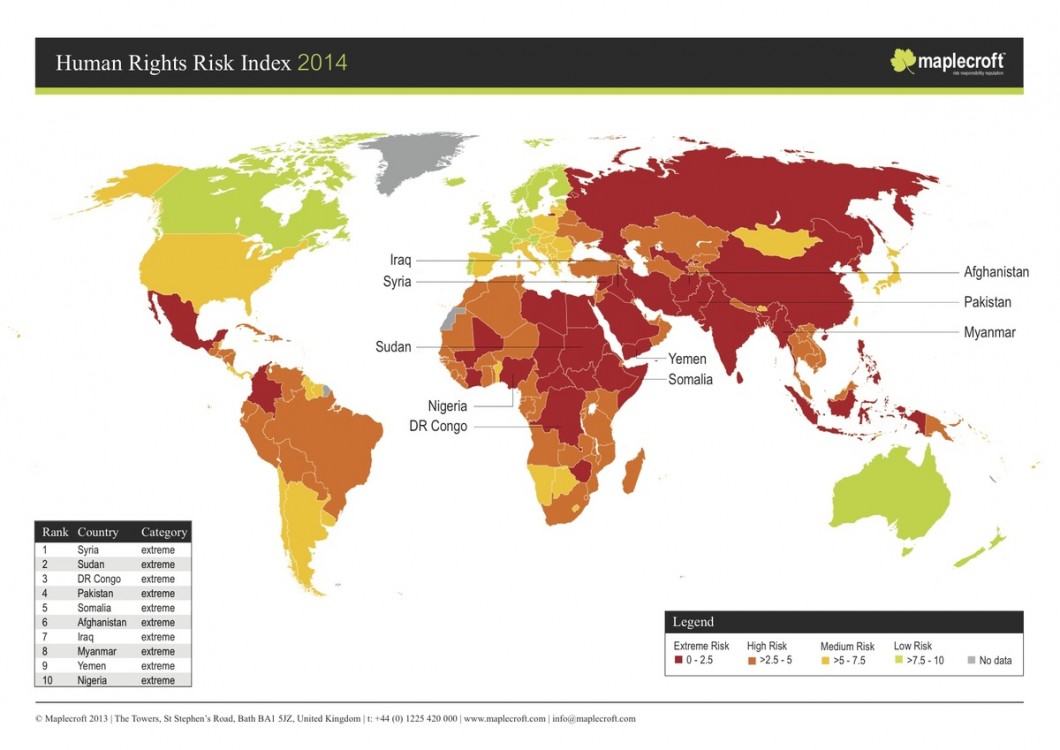
Since 2008 there's been a staggering 70% rise in human rights violations around the world – and now the 2014 Human Rights Risk Atlas, published by the risk analytics company Maplecroft, has revealed the extent to which rural and indigenous workers globally are facing land grabs and displacement as worker and civil rights get sacrificed in the quest for low-cost resources and labor.
The Human Rights Risk Atlas assessed and compared human rights risks and responsibilities in 197 countries. Syria ranked first globally in terms of human rights abuses, with Egypt, Libya, Mali and Guinea-Bissau showing the worst deterioration in human rights abuses since 2008.
Regionally, the Middle East and North Africa (MENA) and Africa at large account for the majority of the increase in violations. In MENA, state repression of social protests elevated the number of countries considered an "extreme risk" for human rights violations from two to seven over the last six years.
U.K. Ranked as a "Medium Risk"
Scandinavia is the best performing region, while the U.K. ranked 165 in the Risk Atlas, earning it classification as "medium risk."
In light of the report, campaigners are pushing for the U.K. government to hold companies accountable for human rights abuses including land grabs and overseas slavery. In recent years, the U.K. has come under attack for its involvement in such violations – one example being revealed in a 2013 report that criticized the country for turning a blind eye to the torture of terror suspects.
The Constitution Project dossier condemned Britain for cooperating in the contentious U.S. practice "extraordinary rendition," which allows the illegal transfer of terror suspects to secret CIA jails in countries that allow torture.
More recently, the U.K. has come under scrutiny for business-related human rights violations. Occupy.com recently reported the likelihood that U.K. supply chains are beset with slavery. Research carried out by the Chartered Institute of Purchasing and Supply (CIPS) shows 11% of business leaders in the U.K. believe modern slavery is taking place somewhere within the production of goods.
This summer news that Thai "ghost ships" enslaving and sometimes killing workers are linked to the production of prawns sold in U.K. and U.S. supermarkets sent an urgent reminder that something more concrete needs to be done to stamp out slave labor.
A six-month investigation revealed that in Asia slaves are being forced to work without pay and under the threat of extreme violence for the production of seafood sold in the major British, U.S. and other European supermarkets.
So what exactly is being done to suppress human rights violations?
In 2011 the UN Human Rights Council unanimously endorsed the UN Guiding Principles on Business and Human Rights (UNGP). The UNGPs are designed to address issues related to workers’ rights and modern slavery. The guiding principles summarize the duties of states and the responsibilities of businesses to respect and protect human rights. The UNGPs also provides guidelines on how these duties and responsibilities should be put into practice.
U.K. Implements a UNGP Action Plan
In 2013 the U.K. was the first country to take steps to actively implement the UNGP into an action plan. On September 4, 2013, Foreign Secretary William Hague and Business Secretary Vince Cable hosted a launch event for the government’s action plan on businesses and human rights. Titled "Good Business: Implementing the UN Guiding Principles on Business and Human Rights," the plan sets out goals for British companies aimed at protecting human rights.
The action plan also builds on the recent amendments to the Companies Act Regulations, which came into force in October 2013 requiring large companies to report non-financial information, including disclosure on human rights where such information is necessary for an understanding of the businesses.
The Human Rights Poll
Now, one year after the glamorous launch event in which William Hague proudly asserted the “U.K.’s leadership” in human rights and business, Britain has launched a human rights poll. The poll, which is currently circulating in the U.K., enables people to vote on whether or not they think legislation is required to prosecute companies in the U.K. for human rights abuses abroad.
The poll was launched by Tradecraft, a U.K.-based fair-trade organization. It found that of the Member of Parliaments (MPs) questioned, 71% were in favor of prosecuting British companies for human rights violations committed abroad.
So what’s going wrong in Britain? Why, despite glamorous and high-profile human rights action plan launches, and the introduction of the Modern Slavery Bill designed to address the issues of modern slavery and trafficking, is the U.K. being classed as a "medium risk" to human rights violations and is home to fresh campaigns to tackle issues related to human rights abuses?
Voluntary Measures Need to be Backed up by Regulation
Problems with the U.K.’s 2013 action plan to implement the UNGPs have been associated with its sole reliance on voluntary mechanisms to raise standards in stamping out human rights violations. The UNGPs recommend a “smart mix” of voluntary approaches and regulation. According to Marilyn Croser, director of CORE, the leading U.K. civil society network on corporate accountability, so far there is a “marked absence of meaningful commitments to guarantee access to remedy for victims of business-related human rights abuses.”
Research carried out by Amnesty International found that victims of human rights abuses face major challenges when seeking remedy. “Current law and policy does not adequately address these particular obstacles,” states Amnesty International.
Ironically, instead of inaugurating regulation to penalize companies in the U.K. involved in irresponsible practices overseas, it is becoming increasingly difficult for developing communities to make damages cases. For example, changes to court costs regime introduced in 2012 have made it more difficult more victims of slave labor to pursue legal cases against U.K. companies engaged in human rights violations.
With human rights violations rising by 70% in the last six years despite measures such as the U.K.’s Modern Slavery Bill and a so called UNGP action plan, it seems that if human rights abuses are going to be finally suppressed, regulation needs to replace rhetoric.
3 WAYS TO SHOW YOUR SUPPORT


- Log in to post comments


