
A new bill in the House could help change the face of rural America by making farming more feasible for millions of young people.
The Young Farmer Success Act (H.R. 1060) would offer a path to student loan forgiveness for farmers who commit to a decade in the profession. A loan forgiveness program already exists for young people entering professions that benefit society—such as nursing, teaching, and government and nonprofit work. This bill would add farming to the list.
During the last Congressional session, a similar loan forgiveness bill for young farmers accumulated 13 co-sponsors, three of whom were Republicans, but then stalled. The National Young Farmers Coalition (NYFC), which advanced both bills, is hoping to build on last year’s momentum, and eventually submit a Senate version.
“Regardless of how you feel about the results of the November election, no one is denying that we need to pay attention to the decline of our rural communities,” said Andrew Bahrenburg, the policy director at NYFC. One solution, he says, is creating more young farmers.
The bill was introduced by Rep. Joe Courtney (D-Connecticut) and is co-sponsored by Rep. John Faso (R-New York) and Rep. Glenn Thompson (R-Pennsylvania). Participating young farmers would be required to farm and make income-adjusted loan payments for 10 years, after which the balance would be forgiven.
“We must help incentivize more young people to pursue careers in agriculture,” Thompson, who represents a largely rural district, said in an email. “Farmers are stewards of the land and cornerstones of our rural communities … Investing in our nation’s ability to put food on the table for our neighbors is not a partisan issue.”
In the next 25 years, two-thirds of the country’s farmland land will change hands, according to NYFC. Without a new group of farmers to replace the generation facing retirement, the land could go out of production, or end up developed into housing tracts.
But farmland prices have risen steadily since the 1980s, doubling between 2004 and 2014. Many debt-saddled young farmers can’t afford to lease, let alone buy land. Student loan debt siphons off income that could potentially go to land, equipment, and infrastructure, and frightens off potential lenders.
“There are lots of young people that want to get into farming, but are prevented from doing so because of student loan debt,” Bahrenburg said.
In 2014, NYFC surveyed more than 700 members with student loans, and found they had an average debt of $35,000. Nearly 30 percent of those surveyed said they delayed or opted out of farming because of an inability to make loan payments on a farming salary. More than 50 percent were farming but struggled to make student loan payments.
To make ends meet, nearly three-quarters of all the farmers NYFC surveyed took jobs off the farm (nationally, that number is closer to half). Slightly more – 82 percent – of first-year farmers relied on off-farm income.
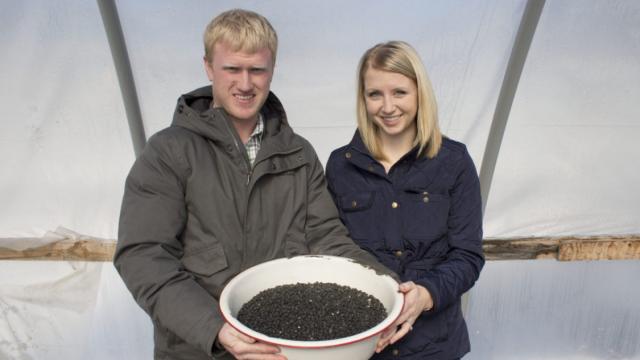
Jason Grimm knows this reality intimately. Grimm, 31, grew up on his family’s farm in North English, Iowa and now rents about 10 acres from his relatives, though he’d like to be farming twice as many. He grows dry beans on the bulk of the land, with 1.5 acres devoted to produce and another two acres for pasture-raised chickens.
When he graduated high school, Grimm didn’t know he’d want to farm. He studied landscape architecture and environmental studies at Iowa State University, graduating with close to $40,000 in student loan debt.
Eight years later, he still has about $25,000 left to pay, and has been chipping away at it with payments of more than $400 per month. Both he and his wife work full-time jobs, and they live in town 15 minutes away from the farm. He farms on weekends.
“I could be investing $400 a month into a land payment, or larger equipment, so I could specialize,” he said. He wants to buy a bean combine to harvest unique varieties of beans that restaurants demand.
Grimm’s day job is as the food systems director at Iowa Valley Resource, Conservation, and Development. “Working with the beginning farmers, it’s amazing to see how many are coming out of college wanting to farm. I feel lucky having access to family land,” Grimm said. “I know many who are bouncing around from farm to farm.”
Such young farmers often have weak safety nets and little government support.
Since the Dust Bowl, the government has offered farmers crop insurance, but it can be expensive and doesn’t offer much for young farmers. Row crop and commodity crop growers can get insurance, but young farmers with less than four years of production history have to use trend-adjusted yields, which results in higher costs for the same coverage. Whole Farm Revenue Protection crop insurance for organic and direct-to-consumer growers requires three years of revenue history for beginning farmers.
The difficulty of launching a farm often forces rural high school students to make a difficult choice, said Bahrenburg, NYFC’s policy director. They can go to college, and probably not return to their hometowns, since few viable livelihoods exist for college-educated people, or they don’t go to college.
“Right now, we’re forcing rural students to make that choice, and we shouldn’t be,” Bahrenburg said. “We need to find ways for young people to pursue viable livelihoods in rural areas.”
Some states are taking steps to remedy this problem. New York has a program to forgive student loans if undergraduates commit to five years of farming. Similar bills are in the works in Wisconsin, New Jersey, New Mexico, and Montana, Bahrenburg said.
And at the national level, NYFC is hopeful the bill will make it farther this time around. The bill would amend the Department of Education’s Public Service Loan Forgiveness Program, as part of a re-authorization of the Higher Education Act.
“We expect to get more traction on both sides of the aisle as both sides grapple with the results of the election and try to connect with rural voters,” Bahrenburg said.
3 WAYS TO SHOW YOUR SUPPORT



- Log in to post comments


