
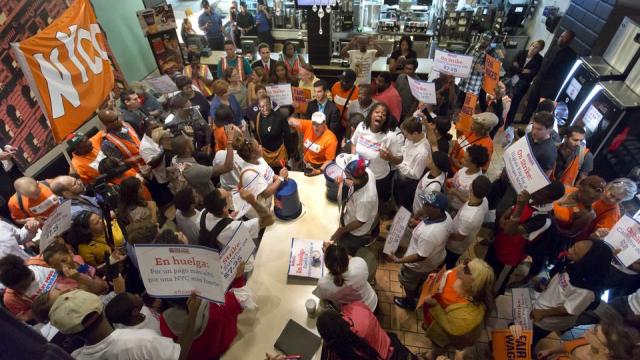
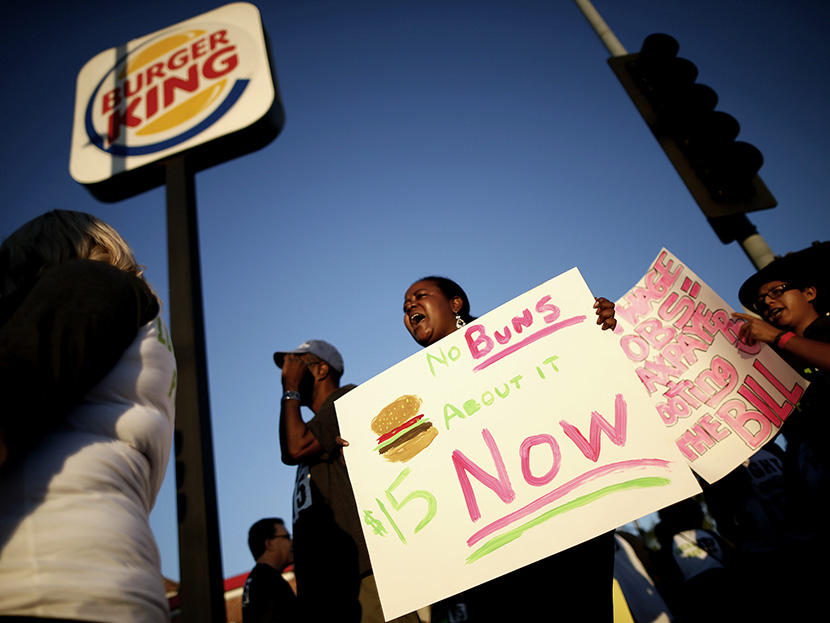
Last week, thousands of Americans stepped away from their jobs at fast-food restaurants and into the streets to make a plea: Pay us enough to support ourselves and feed our families. The workers joining this nationwide protest are our neighbors, friends, fellow citizens. But their strike is not just about their plight. It is about all of us, and the kind of country we want to live in.
As economic inequality grows deeper and wider across the nation, we need to remember how deeply unjust it is. It is unjust by the standards of our civic values and of our faith – indeed, in this diverse society, of all faith traditions.
Dr. King, who died while pleading on behalf of underpaid and exploited workers, said, “It is a crime for people to live in this rich nation and receive starvation wages.” Drawing from the same centuries-old Christian teaching, Pope Francis warned, 50 years later, “No amount of peace-building will be able to last, nor will harmony and happiness be attained in a society that ignores, pushes to the margins, or excludes a part of itself.”
The measures of inequality in our society are abundant. While McDonald’s CEO was paid $13.8 million in 2012 and Burger King’s $6.5 million, the average fast-food worker makes $10,000 to $18,000 a year. While corporate profits have ballooned, many workers qualify for food stamps and housing subsidies. Some have to live in homeless shelters.
The majority of fast-food workers, and of those in retail jobs that are just as poorly paid, are adults – their median age is 28 – and more than a quarter of them are raising children. Many are denied full-time work, as employers limit their hours to keep them from qualifying for health insurance and other benefits. In big cities, their rents are high and even public transportation is a financial strain.
What they ask is simply a wage of $15 an hour and the right to form unions. The plea echoes those of the March on Washington 50 years ago, which called for a national minimum wage of $2 an hour. Adjusted for inflation, that would be $15.26 today, or more than twice what the actual minimum wage is. That, too, is barely enough to feed a family.
Religious leaders, among many others, have called for an increase in the minimum wage as the number of Americans living in poverty has grown, but Congress shows no sign of responding. Certainly the fast-food industry, with high unemployment keeping its labor costs down, is not raising standards on its own. And so, once again, workers are taking to the picket lines.
America’s failure to allow so many of its own workers a sustaining wage is only a symptom of a larger sickness, the “culture of selfishness” that Pope Francis recently decried as he lamented the growing chasm between rich and poor.
For the past ten years, wages and salaries for most workers, especially those at the bottom of the income scale, have remained stagnant. While productivity continued to climb, virtually all the economic gains of the last decade have flowed to the very richest among us. We have behaved more as corporate shareholders than as community shareholders committed to the common good. As support programs for the poor have been cut, we have looked away, embodying what Pope Francis calls the “globalization of indifference.” We have accepted the notion that those at the bottom, no matter how hard they work, are somehow undeserving.
From its earliest days, Christianity has condemned avarice and embraced community. Jesus told parables of the need to pay workers a just wage, as did the Old Testament prophets before him and church leaders and scholars for centuries after him. The call for justice in the treatment of workers is a moral imperative. The doctrine does not change with time or political or economic trends, but has guided spiritual leaders for centuries.
That is why clergy across America are supporting the workers who, at risk to their livelihoods, are taking to the streets in 40 cities. They are appealing not just to their employers but to all who should be their allies. It is our country, our future, and our conscience.
3 WAYS TO SHOW YOUR SUPPORT



- Log in to post comments


