
“When there are #BlackChurchesBurning, there is silence from mainstream media. When 1 QuikTrip & 1 CVS burn, there is 24/7 constant coverage.” -DeRay McKesson (@Deray)
“When we see criminals commit crime after crime without being punished, it makes us want to start a life of crime. They commit hundreds of crimes and live to a ripe old age, in spite of the saying, ‘Everyone who lives right and respects God will prosper. But no one who sins and rejects God will prosper or live very long.’” -Ecclesiastes 8: 11-13 (Contemporary English Version)
Not long after unarmed teenager Michael Brown was shot to death by Officer Darren Wilson in Ferguson, Missouri, the entire mainstream news media fixated on one night of riots in which a QuikTrip was burned. While the majority of protests were peaceful, the media used the images of that one angry night to define the Ferguson protests. On one particular day when Baltimore rioters burned down two CVS stores, the corporate media showed that fire from every angle, and used that one image from that one day to define the movement that demanded justice for Freddie Gray.
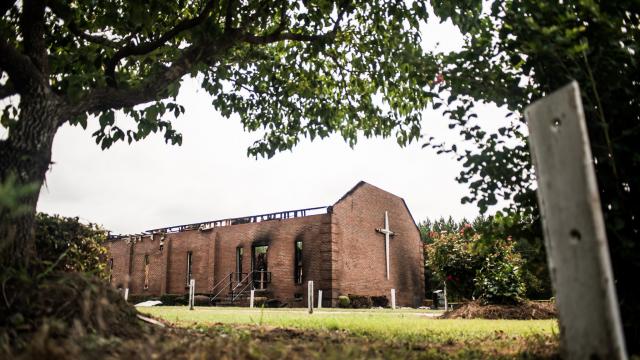
Since the terrorist attack that killed nine at Emanuel AME church in Charleston, South Carolina, five other predominantly black churchesacross the South have been burned. At least three of those fires have been ruled as arson. The latest black church fire in Greeleyville, South Carolina, happened just an hour’s drive from Charleston. Yet, somehow the mainstream media has only given these church fires a passing mention.
To the average news consumer, this could be an editorial oversight for a network news desk. But to anyone who has been paying attention to the pointed way in which the corporate news media has been covering the #BlackLivesMatter movement, ignoring the assault on black churches in favor of, say, Donald Trump’s latest gaffe or the escaped New York prisoner’s childhood, is par for the course.
In Knoxville, Tennessee, just four nights after the Emanuel AME slayings, a church van at the College Hill Seventh Day Adventist Church was set on fire, along with several bags of dirt and a pile of straw. A wall of the church was also scorched. Two days later, on June 23, a fire gutted the God’s Power Church of Christ’s two-story building in Macon, Georgia, in the early hours of the morning.
Early on June 24, arsonists destroyed a building at the Briar Creek Baptist Church in Charlotte, North Carolina, causing $250,000 worth of damage. Two nights later, the Glover Grove Baptist Church in Warrenville, South Carolina, was destroyed by fire. While the cause has yet to be determined, Rev. Bobby Jones, who is also an electrician, claims the church’s electrical system and gas lines were in perfect working order before the fire.
A June 26 fire at the Greater Miracle Apostolic Holiness Church in Tallahassee, Florida, and a fire at the predominantly-white Fruitland Presbyterian Church in Gibson County, Tennessee, were likely caused by an electrical short and a lightning strike, respectively, according to the LA Times.
The fire that destroyed the Mount Zion AME church on the night of June 30 has been previously targeted by hate groups. Gary Cox and Timothy Welch, who were members of the local Ku Klux Klan, admitted to burning that same church in 1995.
Black churches have been considered important organizing spaces for black-led social justice causes since at least the Civil Rights Movement, but also going as far back as the abolition era. As Frederick C. Harris wrote in an essay published by Trinity College, “…In the aftermath of slavery, black churches became the center of black life, operating not only as places of worship for congregants but also as the incubator behind schools, business enterprises, charity, politics, and recreation.”
Twenty years ago, a string of fires at 29 predominantly-black churches across the South, taking place over an 18-month period, prompted the creation of the National Church Arson Task Force. The task force investigated at least 827 arsons, bombings, and attempted bombings of religious buildings between 1995 and 1999. Roughly one-third of those arsons were at black churches, and 185 of those churches were in the South.
While the people suspected to be complicit in those arsons were widely believed to be local vandals and not part of an organized conspiracy, the fact that black churches in the South are burning once again just a little over a week after a racially-motivated terrorist attack at a Southern black church lends credibility to the theory that some of these fires may be the work of racist organizations.
The fact remains that there are still many questions to be asked and national conversations to be had before we can truly know who’s behind this latest wave of black church burnings. The national news networks must be willing to devote as much coverage to the burnings of these black churches and devote news cycles to analyzing the attacks and finding the perpetrators as they were willing to devote to the burnings of two businesses during waves of Black Lives Matter protests.
Anyone who intentionally burns down a house of worship, regardless of religion or denomination, deserves to be brought to justice. And any intentional burning of a church, particularly in the wake of a racially-motivated mass shooting, must be a topic of national discussion by major news networks.
3 WAYS TO SHOW YOUR SUPPORT



- Log in to post comments


