
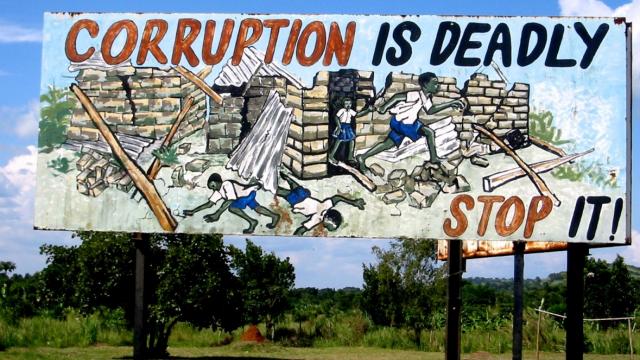
More than 3.5 million lives a year could be saved if the G20 cracked down on the corrupt business practices, money laundering and tax evasion that cost the world’s poorest countries at least a trillion dollars a year, according to a new report.
The Trillion Dollar Scandal study, by the campaigning and advocacy group ONE, says developing countries’ efforts to fight poverty, disease and hunger are being damaged by “a web of corrupt activity” that siphons hundreds of billions of dollars from their economies every year.
ONE’s report stresses that the sums involved are not international aid money – “which is making a tangible difference” – but money that is stealthily drained off through anonymous shell companies and “shady deals” for natural resources.
The consequences, it says, can be measured in human lives.
“In developing countries, corruption is a killer,” said David McNair, ONE’s transparency and accountability policy director.
“Up to 3.6 million lives could be saved if we end the web of secrecy that helps the criminal and corrupt. When governments are deprived of their own resources to invest in the essentials – like nurses and teachers – the human cost is devastating.”
ONE estimates that such practices result in between $972 billion (£585 billion) and $2.02 trillion flowing out of developing countries each year. According to the report, $20 trillion is held in offshore tax havens – including $3.2 trillion in undeclared assets thought to have come from developing countries.
Were the latter sum to be taxed, it says, it could yield revenues of $19.5 billion a year.
Not only would ending the “scandal” save 3.6 million lives a year in low-income countries between 2015 and 2025, it would also help prevent 4.3 million deaths a year in lower-middle-income countries over the same period.
In sub-Saharan Africa alone, it says, the money recovered would pay for the education of 10 million children a year; cover the cost of 500,000 primary school teachers; provide antiretroviral drugs for more than 11 million people with HIV and Aids, and buy almost 165m vaccines.
The report, which is being launched in the runup to November’s G20 summit in Brisbane, urges the group’s members to “shine a light on anonymous shell companies” by making public information on who owns companies and trusts, and identifying corrupt and criminal individuals and businesses.
The report says the illegal manipulation of cross-border trade is the biggest source of losses to poor countries, adding: “The secrecy that allows that activity to thrive may also help to conceal financial flows related to criminal bribery and theft by government officials, human trafficking and/or the illegal sale of arms and contraband, depending on the circumstances.”
The G20, it suggests, should also introduce tough payment disclosure laws to increase transparency in the oil, gas and mining industries; crack down on tax evasion and publish open data so that citizens can track money from “resources to results” thereby holding governments to account for the provision of essential services.
It focuses on the use of shell companies, citing a case in which a licensing payment that the Nigerian subsidiaries of Shell and Italy’s ENI made in 2011 to develop a lucrative, offshore oil block allegedly ended up in the bank account of a private firm owned by Nigeria’s former oil minister.
The British-Dutch company insists it paid the Nigerian government, not the private firm, adding that it has acted lawfully “at all times”.
The report also mentions allegations of tax evasion leveled against a mining firm in Zambia that is controlled by the Swiss commodity trader Glencore Xstrata – allegations the companies have always denied.
The Kenyan anti-corruption campaigner, John Githongo, said the time had come for the world’s richest nations to act.
“For too long, G20 countries have turned a blind eye to massive financial outflows from developing countries, which are channeled through offshore bank accounts and secret companies,” he said.
“Introducing smart policies could help end this scandal and reap massive benefits for our people at virtually no cost. The G20 should make those changes now.”
3 WAYS TO SHOW YOUR SUPPORT
- Log in to post comments


