
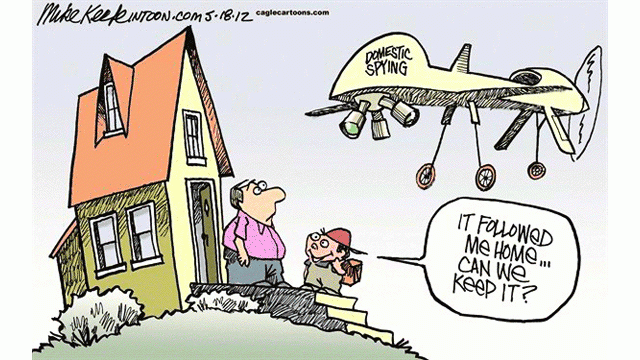
More than a third of Americans worry their privacy will suffer if drones like those used to spy on U.S. enemies overseas become the latest police tool for tracking suspected criminals at home, according to an Associated Press-National Constitution Center poll.
Congress has directed the Federal Aviation Administration to come up with safety regulations that will clear the way for routine domestic use of unmanned aircraft within the next three years.
The government is under pressure from a wide range of interests to open U.S. skies to drones.
Oil companies want them to monitor pipelines. Environmentalists want them to count sea lions on remote islands. Farmers want them to fly over crops with sensors that can detect which fields are wet and which need watering. They're already being used to help fight forest fires. And the list goes on.
Manufacturers are also keen to cash in on what they expect to be a burgeoning new drone market. Government and commercial drone-related expenditures are forecast to total $89 billion worldwide over the next decade.
On the leading edge of that new market are state and local police departments, who say that in many cases drones are cheaper, more practical and more effective than manned aircraft. Most of them would be small drones, generally weighing less than 55 pounds (25 kilograms). They could be used, for example, to search for missing children or to scout a location ahead of a police raid.
But privacy advocates caution that drones equipped with powerful cameras, including the latest infrared cameras that can "see" through walls, listening devices and other information-gathering technology raise the specter of a surveillance society in which the activities of ordinary citizens are monitored and recorded by the authorities.
Nearly half the public, 44 percent, supports allowing police forces inside the U.S. to use drones to assist police work, but a significant minority — 36 percent — say they "strongly oppose" or "somewhat oppose" police use of drones, according to a survey last month.
When asked if they were concerned that police departments' use of drones for surveillance might cause them to lose privacy, 35 percent of respondents said they were "extremely concerned" or "very concerned." An almost identical share, 36 percent, said they were "not too concerned" or "not concerned at all."
Twenty-four percent fell in the middle, saying they were "somewhat concerned" about a potential loss of personal privacy.
David Eisner, president and chief executive of the constitution center in Philadelphia, said he was surprised by the level of support for police use of drones.
"I had assumed that the idea that American police would be using the same technology that our military is using in Afghanistan would garner an almost hysterical response," Eisner said. Support for drone use "shows that people are feeling less physically secure than they'd like to because they are willing to accept fairly extreme police action to improve that security."
There was a gender gap in the poll, with men were more concerned about a loss of privacy if police start using drones than women — 40 percent to 30 percent. There was an even wider gap between white and black respondents, with 48 percent of blacks strongly concerned about a loss of privacy compared to 32 percent of whites.
Responding to public concern, a drone industry trade group and the International Association of Police Chiefs have separately released voluntary guidelines for drone use in recent months.
"A lot of the public doesn't understand how the technology is being used," said Gretchen West, vice president of the Association for Unmanned Vehicle Systems International. "Law enforcement use (drones) to do the same thing they've used manned aircraft for years, it's just that (drones) are more affordable and usually a more efficient option."
Associated Press Deputy Director of Polling Jennifer Agiesta and AP News Survey Specialist Dennis Junius contributed to this report.
3 WAYS TO SHOW YOUR SUPPORT



- Log in to post comments


