
This three-part series tracks Indigenous resistance to corporations that put profit over a liveable planet. In Part Two, that resistance arrives in London — the heart of global capitalism — confronting power at its source while strengthening struggles on Indigenous lands. Read Part One here.
Extra-judicial killings carried out against a population terrorised for power, greed and control. No, this is not Trump’s U.S. It is the everyday reality of life for West Papuans, who for decades have faced a “slow genocide” inflicted by the Indonesian state, global powers and corporations.
These are some of the main takeaways from “Bringing It All Back Home,” a report by Samira Homerang Saunders and Prof. David Whyte, which documents how British corporations have driven decades-long destruction of the West Papuan people and their homeland, the world’s third largest rainforest.
Capitals of global capitalism – alongside London – profit from plundering Indigenous lands worldwide. New York corporations, for example, drive Amazon rainforest destruction. For centuries, Indigenous peoples have resisted extractivism that continues to plunder them.
So how do we stand with Indigenous peoples, beyond boycotting products such as palm oil? In November 2025, Indigenous protests in London included the launch of “Bringing It All Back Home,” confronting corporate power head-on. The message was unmistakable: violence on Indigenous lands is rooted in decisions made in global financial capitals.
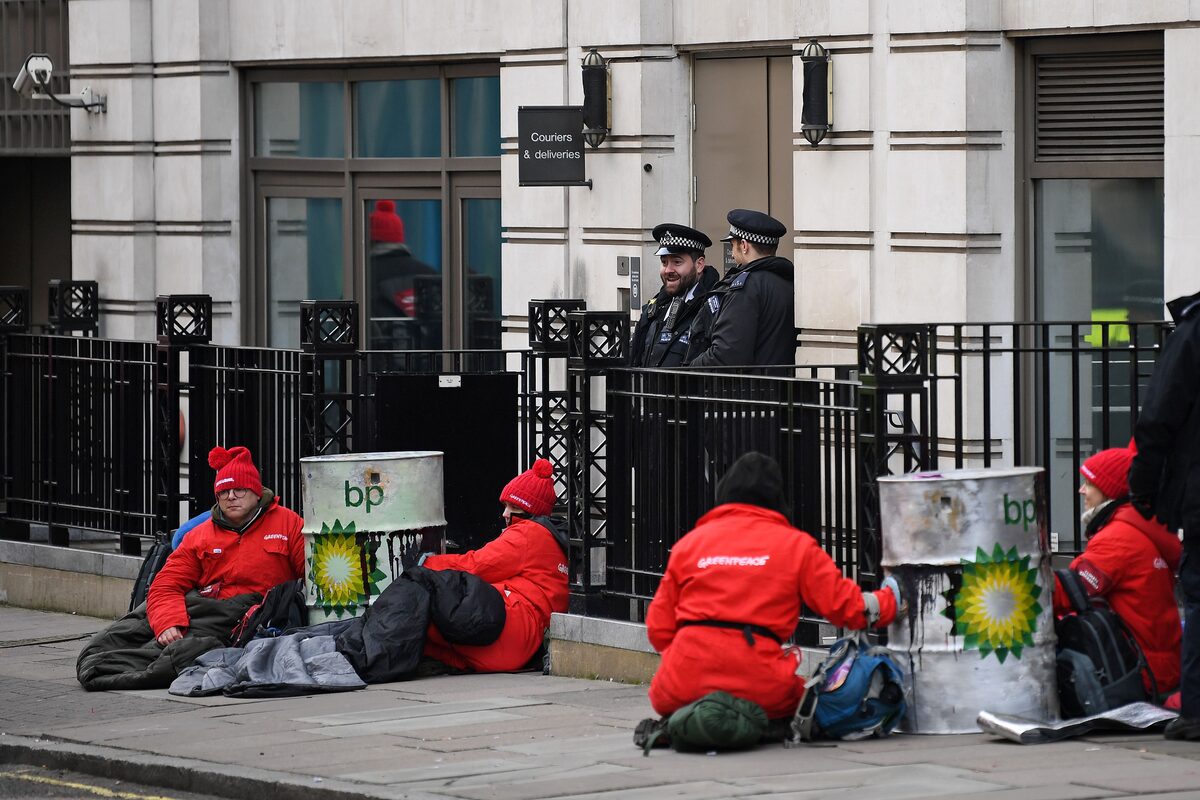
Outside BP's headquarters in London
On a chilly November evening, around 60 people gathered near Buckingham Palace and marched toward a new front of British colonialism: the oil company British Petroleum.
BP runs the Tangguh Bay liquefied natural gas processing facility in Bintuni Bay, western West Papua. The report details allegations that BP colluded and paid Indonesian security forces accused of violently suppressing protests and displacing local communities.
This was repeated across West Papua by corporations mainly involved in agricultural plantation, mining and gas production. The UN's High Commission for Human Rights estimates 60,000 to 100,000 West Papuans were displaced between 2018-2022.
In terms of climate impacts, Bintuni Bay is one of the world's largest and most ecologically-rich mangrove wetlands. If BP extracts all the gas from there, the climate impact will equal Europe's pledge for emission reductions between 2015-2030.
At the protest, Bella Wenda, a West Papuan living in exile in the UK, spoke to New Internationalist about how forced displacement has killed some members of her family.
“I'm literally shaking right now, because of the personal effect for me, but it is [also the] bigger effect on the world,” she said.
Wenda is involved in the Free West Papua campaign, demanding a free vote on independence from Indonesia and demanding an end to state- and corporate-led atrocities.
The November protest also saw participants from other struggles for liberation and autonomy, including Climate Resistance, The International League of Peoples' Struggle, Energy Embargo for Palestine,
Jewish Anti-Zionist Action, Free Occupied Cyprus, and Anak Bayan.
These movements plan more joint actions in 2026.
Anak Bayan is a Filipino Youth group demanding democracy and resisting devastating mining projects. A participant from the organisation who spoke at the November protest said:
“We, the militant Filipino youth, stand in solidarity with the struggle of West Papua. Just as the rural communities and Indigenous people of the Philippines are bombed and displaced and so are the Indigenous people of West Papua... We are both victims of imperialist plunder.”
Concerted political action taken locally in coordination with international campaigns can force change. In 2018, Mexican Indigenous farmers from the El Bajío community brought shares in mining company Fresinlo to attend a protest at the company's annual general meeting in London, and demanded the company cease mining and restore their lands as part of a broader campaign.
In an ongoing legal case, in Mexico, a court-appointed legal review has deemed the mining company should pay as much as $630 million in compensation. The company continues to challenge this decision.
Divestment pressure can also create change. In 2020, Europe's last Indigenous people the Sámi won a divestment victory, when local and international pressure forced Credit Suisse to divest from the Nussir mining project in northern Norway.
Yet despite the success, this long opposed Nussir mine is under construction with new investors. Sámi resistance continues.
Act locally, act globally
Sámi land defender Kornelia Elise Kristensen, a board member of the environmental group Natur og Ungdom (Nature and Youth), is involved in what is now Norway’s longest-ever direct-action camp to stop the mine's construction. After commencing last summer, the camp continues; in late January, more than 70 activists joined the largest blockade to date.
Kristensen says the mine threatens land, water and air, with plans to dump toxic waste regularly from the mine into a pristine fjord fished by local Sea Sámi for centuries.
“The mining waste will include lots of toxic minerals that are going to be mushed up in tiny bits and it's going to poison the fish,” she said, “precisely as happened in the 1970s, when a mine dumped waste into the sea and stopped cod spawning in that area.”
On land, the mine threatens the mountain as well. “It will release toxic gases through vents that are reindeer calving grounds,” Kristensen warned, adding that the mine will also cause reindeer to lose their newborns and expose Sámi herders to further danger and disruption.
After decades of losses to power lines, roads and extraction, she says the project would devastate more than 70% of remaining herding lands.
Norway’s reindeer quotas and extractive projects have drawn comparisons to the U.S. government’s extermination of the buffalo as a tool of Indigenous dispossession.
Around the world, over half of projects supposedly aimed to extract green minerals are on Indigenous people's lands.
In October, the Sámi also took this fight to London, protesting outside the offices of Hartree, one of the latest investors in the planned mine.
“It is important because the main investors are not from Norway,” Kristensen explains.
“It's clear that it has an effect, because Hartree's response was that this was the first protest we've had outside [their headquarters] all year. If they want to come to our areas and won't talk to us, we have to go to their area to talk with them. It's important to show the resistance and the consequences.”
Kristensen points to how the investors are normally fed information by the mining company that ignores the impact of the mine.
“Yet if I go to London, it's another thing [for them to] to meet me and I say this is ruining my life.”