
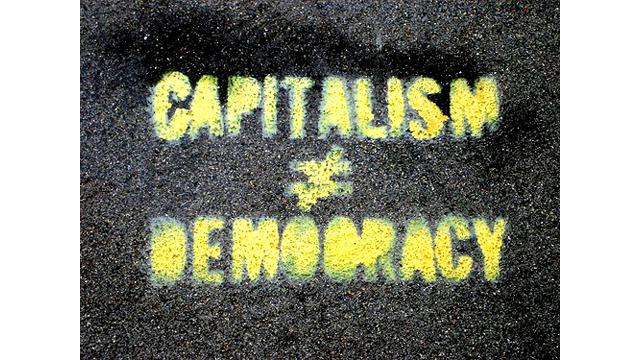
Photo: TJOwens.
How much is democracy worth to you?
If you’re like most people, it’s priceless. But for the hedge funds and insurance companies on Wall Street, it does have a price tag. And now, thanks to a new report by Global Exchange, we know the number on it: approximately $4.2 billion. That’s how much the Finance, Insurance, and Real Estate (F.I.R.E.) sector has invested in political influence through campaign contributions and lobbying since 2006. That comes to $1,331 a minute spent on political power.
The new report is called “Meet the F.I.R.E. Sector: How Wall Street Is Burning Democracy.” It was developed by Elect Democracy, a nonpartisan effort by Global Exchange to expose and challenge the impact of corporate money in U.S. politics. The report contains extensive research tracking Wall Street’s investment in political power, and analyzes exactly how Wall Street has secured what Global Exchange calls “industry-loyal voting practices” in Congress: by shoveling stacks of campaign cash in the direction of Congressional hopefuls from both major political parties.
That money lets these industries get what they want in Washington. The F.I.R.E. sector contributed $879 million to members of Congress since 2006, and took positions on 383 bills during the 112th Congress. For instance, they supported Free Trade Agreements with Korea, Panama, and Colombia in 2007, and backed the bailout in 2008. Bills they opposed include the Dodd-Frank Wall Street Reform and Consumer Protection Act of 2009, the Limited Homeowner and Investor Loss in Foreclosure Act of 2010, and the Stop Student Loan Interest Rate Hike Act of 2011.
At every turn, the F.I.R.E. sector demands special treatment for Wall Street while consumers, homeowners, and students get stuck with the bills. As Senator Bernie Sanders put it an interview with MSNBC this May, "Wall Street is extraordinarily powerful. Congress doesn't regulate them. The big banks regulate what Congress does."
That’s no exaggeration. The Wall Street banks that received the lion’s share of the $700 billion bailout in 2008 comprise the most vocal and deep-pocketed opposition to regulation of risky financial practices.
Luckily, the F.I.R.E sector does have a weakness. It only works in the dark. When people know that their representatives are only supporting Wall Street causes because they’ve been bought off, they tend to stop wanting to vote for those representatives.
Elect Democracy has used the report to develop a new legislative scorecard that makes it easy for you to trace how your legislators voted on key issues such as the bank bailout, Wall Street reform, and free trade agreements. Not only that, but you can see for yourself how much money they received in campaign contributions from the F.I.R.E. sector, as well as what we call their “industry loyalty voting rate.”
Global Exchange researchers calculated that rate for each Congressperson by comparing how often their votes matched the F.I.R.E. sector’s lobbying position on the seven bills examined in the scorecard. As it turns out, the representatives who received the 25 biggest campaign contributions from the F.I.R.E. sector voted identically to Wall Street’s lobby position 73 percent of the time, while the average House “loyalty rate” was a mere 56 percent.
Many complex factors affect how legislators vote, but corporate sponsorship shouldn’t be one of them. Even on Wall Street’s gilded beltway, the F.I.R.E sector companies can’t literally buy political representation—at least, not yet. Instead, they use money to buy influence over voters to elect certain legislators, who they then use lobbyists to influence.
Most Americans value democracy and despise corruption, so a spotlight on this process could leave the F.I.R.E. sugar daddies powerless. The more toxic bank money candidates accept, the more vulnerable they are to having the source of their money exposed.
The goals of this project are not to tell anyone who to vote for, but to get everyone to follow the money; not to influence the outcome of any one election, but to spark dialogue about accountability and transparency, and to stop Wall Street from burning our priceless democracy; to together expose how Wall Street’s campaign money is toxic for democracy, and amplify the message that our democracy is not for sale.
Hillary V. Lehr has worked with Rainforest Action Network, co-founded the California Student Sustainability Coalition, and is currently taking on Wall Street money in politics as Campaign Director for Global Exchange’s Elect Democracy project.
3 WAYS TO SHOW YOUR SUPPORT
- Log in to post comments


