
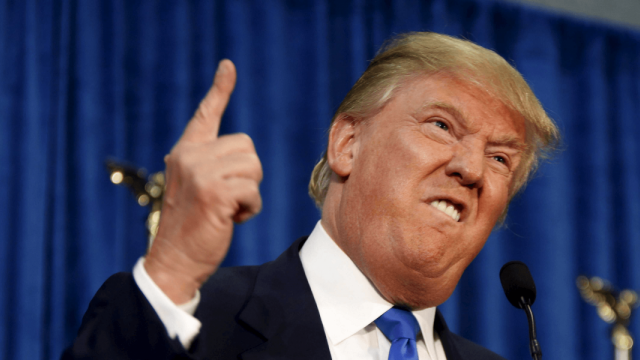
“There's an old saying in Tennessee — I know it's in Texas, probably in Tennessee — that says, fool me once, shame on — shame on you. Fool me — you can't get fooled again." - George W. Bush
Another Bushism up in smoke. People have been fooled again, and by the same old snake oil sold by Bush 15 years ago and the Reagan regime 20 years before that. The latest incarnation – the Tax Cuts and Jobs Act that Donald Trump signed in December – is just Republican business as usual.
The supply-side fraud that keeps getting sold and resold holds that steep tax cuts primarily favoring the rich will stimulate investment, boost employment and ultimately pay for themselves by generating more revenue. What they really do is inflate the national debt while concentrating wealth and political power into fewer and fewer hands.
We’ve seen this movie before, so we know how it turns out. The Reagan tax cuts, in 1981 and 1986, were not a significant spur to growth, which picked up as a natural business-cycle rebound from the severe early-1980s recession. The cuts did not pay for themselves, but instead reduced revenue by 11 percent in their first two years. Total public debt as a percentage of national output surged from about 30 percent when Reagan took office to 50 percent when he left. So much for Republican fiscal discipline.
And yet there is a sacred rightwing mythology which assures the faithful that Reaganomics reduced federal spending, scaled back the welfare state and unleashed the redemptive power of the private sector. In fact, it was about slashing taxes, leaving the welfare state largely intact and launching a huge expansion in military spending with borrowed money. “Reagan proved that deficits don’t matter,” said Dick Cheney years later, casually tossing aside decades of Republican hand-wringing over deficit spending.
The national debt did come down in the 1990s – under a Democratic administration whose first significant act was to raise taxes. Then came the Bush tax cuts of the early aughts, and the national debt went from 55 percent of output to 77 percent.
What about the resulting economic tide that’s supposed to lift all boats? Turns out, a tiny handful of boats tend to rise a lot higher than all the others. In 1980, the top 1 percent of earners took home about 10 percent of pretax income. By 2015 they took around 22 percent.
This should surprise no one. You would expect tax cuts that favor the wealthy to increase wealth and income concentration for a simple mathematical reason known as the “Matthew effect,” after the Biblical passage that describes the rich getting richer and the poor getting poorer. Economists know this as “cumulative advantage.”
Simple example: Taxpayer A makes $50,000 and saves 10 percent, or $5,000. Taxpayer B makes $1,000,000 and saves 10 percent, or $100,000. B’s wealth has just grown by 20 times the growth of A’s. Once invested, the gap will widen in dollar terms: After 10 years at 7 percent growth, A’s savings with be worth $10,000 and B’s will be worth $200,000. Tax law can be a powerful engine of inequality.
There is no reason to believe that the Trump tax cuts won’t exacerbate inequality and concentrate an even greater share of national wealth in the hands of the top earners. According to the Tax Policy Center, the Trump tax regime lowers taxes by an average of $900 this year for the middle fifth of households, and by $53,000 for the top 1 percent.
This matters for at least two reasons. First, there is ample evidence that economic inequality means slower growth, which is no good for anyone. Second and most important, unequal wealth means unequal political power. There is plenty of research – here, here and here – demonstrating what should be intuitive anyway, that the politically powerful respond to the economically powerful and generally ignore everyone else. Increased concentration of wealth begets increased concentration of political power, in a self-reinforcing cycle that leads in a straight line to plutocracy.
Donald Trump and his congressional sycophants have done their bit to advance the decades-old Republican goal of empowering the rich at everyone else’s expense. It will take a Herculean effort, something like the Progressive Movement of a century ago, to reverse the rising tide of planned inequality. Meantime, at least we know the real meaning of “make America great again.”
Follow the author: @cgayNYC
3 WAYS TO SHOW YOUR SUPPORT


- Log in to post comments


