
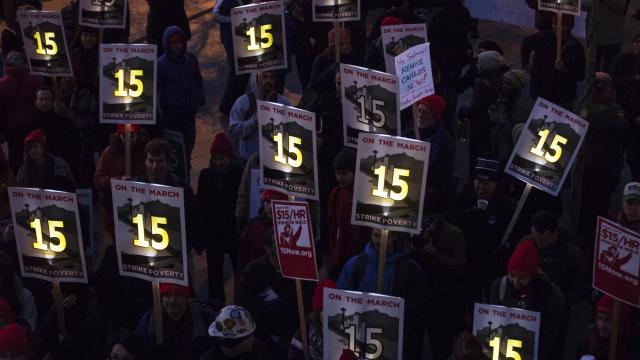
Have you noticed how often conservatives who disagree with a policy proposal call it a “job killer?” They’re especially incensed about proposals to raise the federal minimum wage. They claim it will force employers to lay off workers worth hiring at the current federal minimum of $7.25 an hour but not at a higher minimum.
But as Princeton University economist Alan Krueger pointed out recently in the New York Times, “research suggests that a minimum wage set as high as $12 an hour will do more good than harm for low-wage workers.”
That’s because a higher minimum puts more money into the pockets of people who will spend it, mostly in the local economy. That spending encourages businesses to hire more workers. Which is why many economists, like Krueger, support raising the federal minimum to $12 an hour.
What about $15 an hour?
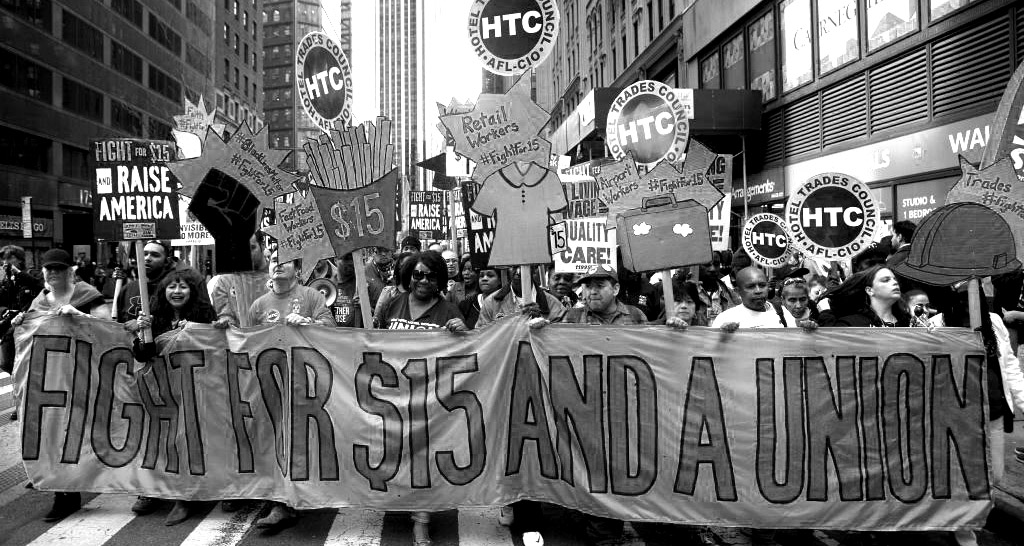
Across America, workers at fast-food and big-box retail establishments are striking for $15. Some cities are already moving toward this goal. Bernie Sanders is advocating it. A national movement is growing for a $15 an hour minimum.
Yet economists are nervous. Krueger says a $15 an hour minimum would “put us in uncharted waters, and risk undesirable and unintended consequences” of job loss.
Yet maybe some jobs are worth risking if a strong moral case can be made for a $15 minimum. That moral case is that no one should be working full time and still remain in poverty.
People who work full time are fulfilling their most basic social responsibility. As such, they should earn enough to live on. A full-time worker with two kids needs at least $30,135 this year to be safely out of poverty. That’s $15 an hour for a forty-hour workweek.
Any amount below this usually requires government make up the shortfall – using tax payments from the rest of us to finance food stamps, Medicaid, housing assistance, and other kinds of help.
What about the risk of job loss? Historically, such a risk hasn’t deterred us from setting minimum work standards based on public morality.
The original child labor laws that went into effect in many states at turn of last century were opposed by business groups that argued such standards would raise the costs of business and force employers to lay off large numbers of young workers.
But America decided the employment of young children was morally wrong.
The safety laws enacted in the wake of the tragic Triangle Shirtwaist Factory fire of 1911, which killed 145 workers, were also deemed “job killers.”
“We are of the opinion that if the present recommendations [for stricter building codes] are insisted upon…factories will be driven from the city,” argued New York’s association of realtors.
But New York and hundreds of other cities enacted them nonetheless because they viewed unsafe sweatshops morally objectionable. It was the same with the 1938 legislation mandating a forty-hour workweek with time-and-a-half for overtime, along with the first national minimum wage.
“It will destroy small industry,” predicted Georgia Congressman Edward Cox. It’s “a solution of this problem which is utterly impractical and in operation would be much more destructive than constructive to the very purposes which it is designed to serve,” charged Rep. Arthur Phillip Lamneck of Ohio.
America enacted fair labor standards anyway because it was the right thing to do. Over the years America has decided that certain kinds of jobs – jobs that were done by children, or were unsafe, or required people to work too many hours, or below poverty wages – offend our sense of decency.
So we’ve raised standards and lost such jobs. In effect, we’ve decided such jobs aren’t worth keeping. Even if a $15 an hour minimum wage risks job losses, it is still the right thing to do.
3 WAYS TO SHOW YOUR SUPPORT



- Log in to post comments


