
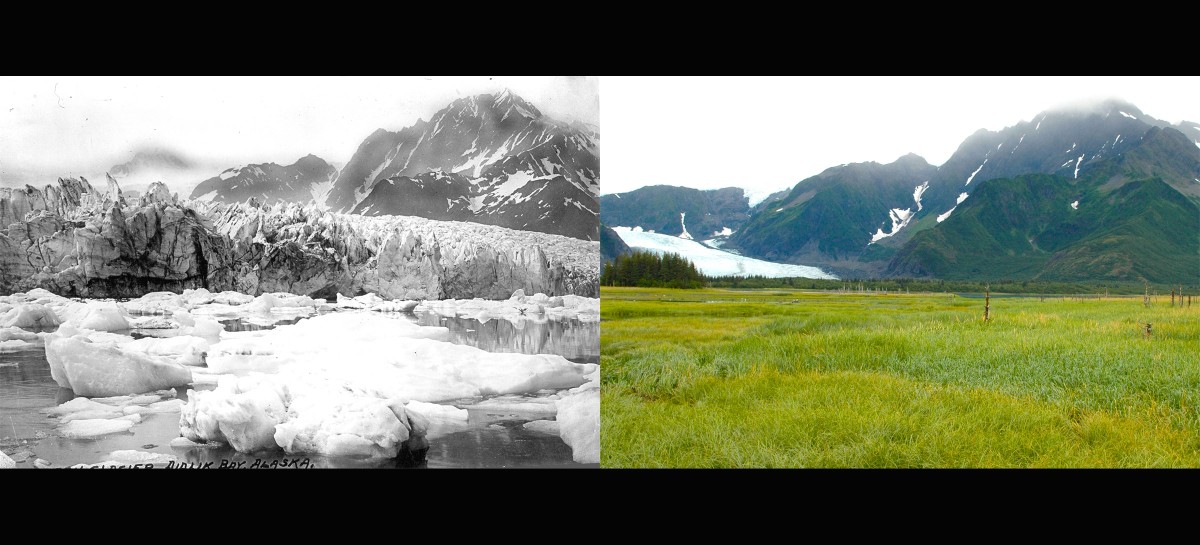
Man-made greenhouse gas emissions have become the dominant cause of melting in glaciers from the Alps to the Andes that is raising world sea levels, a study said on Thursday.
Human emissions accounted for an estimated 69 percent of loss of ice from glaciers from 1991-2010, overtaking natural climate variations that had been the main driver of a retreat since the mid-19th century, researchers wrote in the journal Science.
Until now, scientists have struggled to quantify the impact of human behavior on glaciers because the frozen rivers of ice take decades, perhaps centuries, to respond to rising temperatures and shifts in snow and rainfall.
The study published last week used historical observations of glaciers around the world, except in Antarctica, twinned with computer models to simulate all factors that could explain the retreat. It found that natural variations were not enough on their own, meaning man-made greenhouse gases played an increasing role.
"This is more evidence of human influence on the climate," Ben Marzeion, of the University of Innsbruck in Austria and lead author of the study, told Reuters.
The scientists estimated that human influences accounted for only about 25 percent of glaciers' total retreat since 1850 - meaning that natural swings in the climate, such as changes in the sun's output, have long been dominant.
Little Ice Age
Many glaciers grew during a period known as the Little Ice Age from 1350 to 1850, perhaps caused by a natural decline in the sun's output or sun-dimming volcanic eruptions.
Michael Zemp, head of the World Glacier Monitoring Service at the University of Zurich, said snowfall declined after around 1850. Rising temperatures from about the 1890s, when wider burning of coal meant more greenhouse gases, hastened the thaw.
"The big majority of glaciers have been retreating over the past century," he told Reuters. "We even have an accelerated retreat in recent decades." Glaciers have also varied widely – many Alpine glaciers advanced in the 1970s and 1980s.
Thursday's study estimated that water from melting glaciers has contributed a total of 13.3 cm (5 inches) from 1851-2010 to rising sea levels. Without human influences the rise would still have been 9.9 cm (4 inches).
Zemp said that greenhouse gases already in the atmosphere meant that glacier retreat and related sea level rise would continue for decades, even if emissions were to stop now.
Pinning down a human influence on temperatures has been easier. A U.N. scientific panel said last year that it was at least 95 percent probable that mankind was the main cause of higher surface temperatures since 1950.
Meanwhile, another Reuters report last week by Stian Reklev and Kathy Chen asserted that Tibet's glaciers are now at their warmest in 2,000 years:
The Tibetan plateau, whose glaciers supply water to hundreds of millions of people in Asia, were warmer over the past 50 years than at any stage in the past two millennia, a Chinese newspaper said, citing an academic report.
Temperatures and humidity are likely to continue to rise throughout this century, causing glaciers to retreat and desertification to spread, according to the report published by the Chinese Academy of Sciences' Institute of Tibetan Plateau Research.
"Over the past 50 years, the rate of temperature rise has been double the average global level," it said, according to the report on the website of Science and Technology Daily, a state-run newspaper.
Glacier retreat could disrupt water supply to several of Asia's main rivers that originate from the plateau, including China's Yellow and Yangtze, India's Brahmaputra, and the Mekong and Salween in Southeast Asia.
In May, Chinese scientists said Tibetan glaciers had shrunk 15 percent – around 8,000 square km (3,100 square miles) – over the past 30 years.
The new report said a combination of climate change and human activity on the plateau was likely to cause an increase in floods and landslides there. However, rising temperatures had also improved the local ecosystem, it said.
The scientists urged the government to work to reduce human impact on the region's fragile environment.
But Beijing is building a series of large hydropower projects there, with construction of several mega-dams expected to start by 2020. China has built thousands of dams in the past few decades in a bid to reduce its reliance on imported fossil fuels.
India, too, is planning a number of hydro plants along the Brahmaputra River – more than 100 proposals are under consideration – as the country strives to boost electricity generation.
3 WAYS TO SHOW YOUR SUPPORT



- Log in to post comments


