

Part I and Part II of this series have centered Indigenous rights as essential for maintaining a planet we can all inhabit. This third and final installment delves into the work of acclaimed Sami artist Máret Ánne Sara, who has taken center stage at London's Tate Modern through April 12, calling for ecological justice and a mindshift in terms of how humans relate to the Earth.
When visitors enter London's Tate Gallery, they encounter Goavve, reindeer hides stretching floor to ceiling in the gigantic space, suspended by chains and electrical cables. The Northern Sami word Goavve describes the climate change condition where snow melts and refreezes, trapping lichen reindeer’s main food.
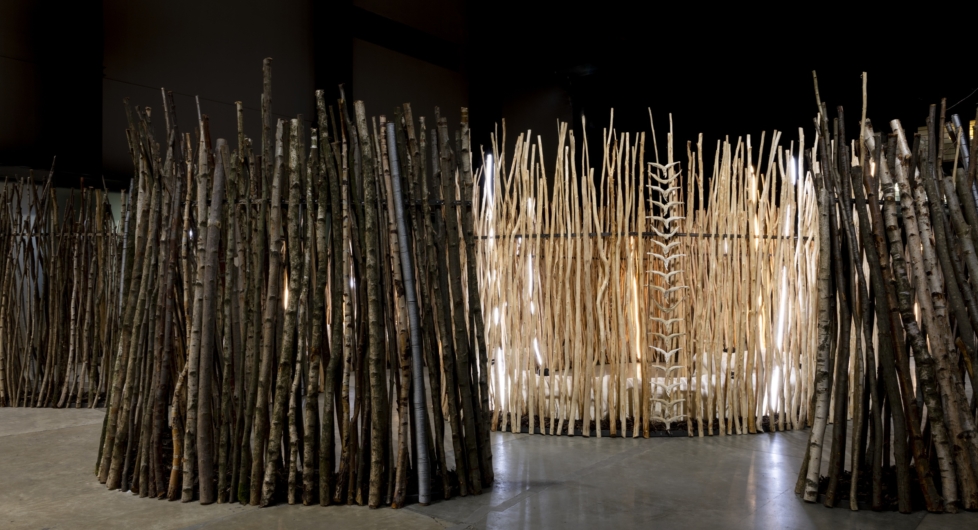
The second half of Máret Ánne Sara’s artwork, at the Tate, is a maze of birch-bark struts. Seen from above, Geabill resembles a cross-section of a reindeer’s nose—an organ capable of heating air by 80°C in a single second. The reindeer's nose is expanded bigger than us, to make us rethink our place within nature's ingenuity.
Visitors move through this interior space on a transformative journey, arriving at an inner sanctuary of benches lined with reindeer hides. Through headphones, Sámi knowledge keepers call on participants to rethink their place, relationships, and impact on the world.
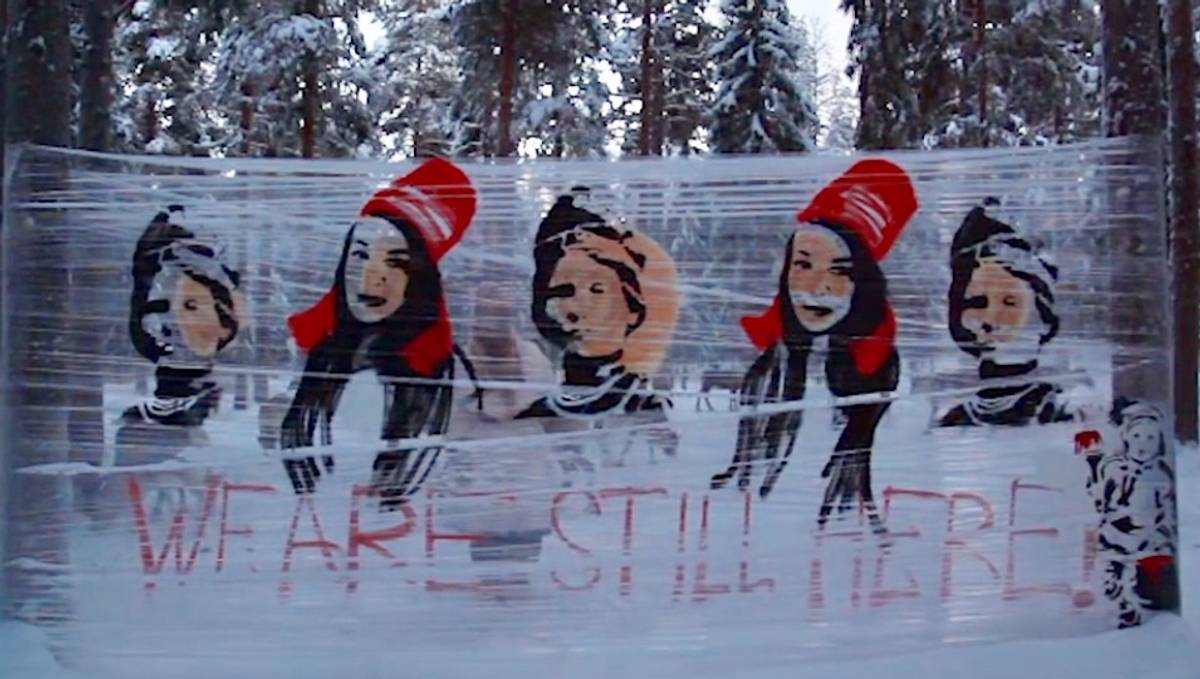
The Sámi, Europe’s last Indigenous people, have survived colonization by Norway, Sweden, Finland and Russia, and are surviving climate collapse. Now they face green colonialism, as countries argue for an expansion of mining to resolve the climate meltdown colonialism created, to paraphrase Gunn-Britt Retter, Head of Sami Council's Arctic Unit.
In other words, the homelands of the Sámi are being threatened by mining for so-called transition minerals to be used for “green technologies.”
Art in the Lion's Den
When Sara’s show opened in October, Sámi activists fighting against the Nussir mine in northern Norway rallied outside the London offices of its investor, Hartree. Until recently, another London firm, Baker Steel Resources, also backed the project.
Beowulf, the mining company threatening the Sámi in northern Sweden, is headquartered just a 15-minute walk from Tate Modern. These miners are backed by London-based bank HSBC. London, again, is central in financing destructive plunder.
I asked Sara what it meant to exhibit in Tate Modern’s main space.
“Placing this work within reach of various mining headquarters exposes what capitalism strives to conceal: that our survival, our culture, and the planet itself are being sacrificed for profit,” she said. “There is no real intention of salvation for any life, in the core of these projects.”
She also explained how the Tate Modern occupies a former power station that once fueled London, a city whose consumption further drives exploitation.
All our senses
Both halves of the installation Goavve-Geabbil carry scents: the hides in suspension smell like sweat, when you're stressed. Geabbil offers a sweet odour.
Blended with other sounds, Joiking is the soundtrack to the main hall. This traditional singing and the Sami's languages were banned until the mid-20th century, alongside other violent policies of assimilation by Norway, Sweden, Finland and Russia.
Sara tells me Joiking is more than singing: it is about channeling a natural part of the world. I ask why Sara engages her audience's four senses.
“Indigenous science recognizes the constant flow of non-verbal information between humans, animals and the environment,” she says. “All of the senses are engaged: sight, sound, smell and touch as well as mind and spirit.”
She tells how her father, when she was a child, committed fear in his body language, and even smell, in a confrontation with Norwegian police. Reindeer omit a similar smell when getting rounded up, called váivahuvvon hádja.
“When I realised the connection between my memory of my father’s changing smell and the reindeer’s váivahuvvon hádja, it became such a clear way to communicate an important notion in Indigenous philosophy and science: that we humans are operating similarly to animals, but have lost our understanding of it,” she continues.
“For me, using smell is a way to tap into that kind of deep instinct and memory and to remind us that biologically, energetically, spiritually, we are still connected to all life in nature.”
Art for survival's sake
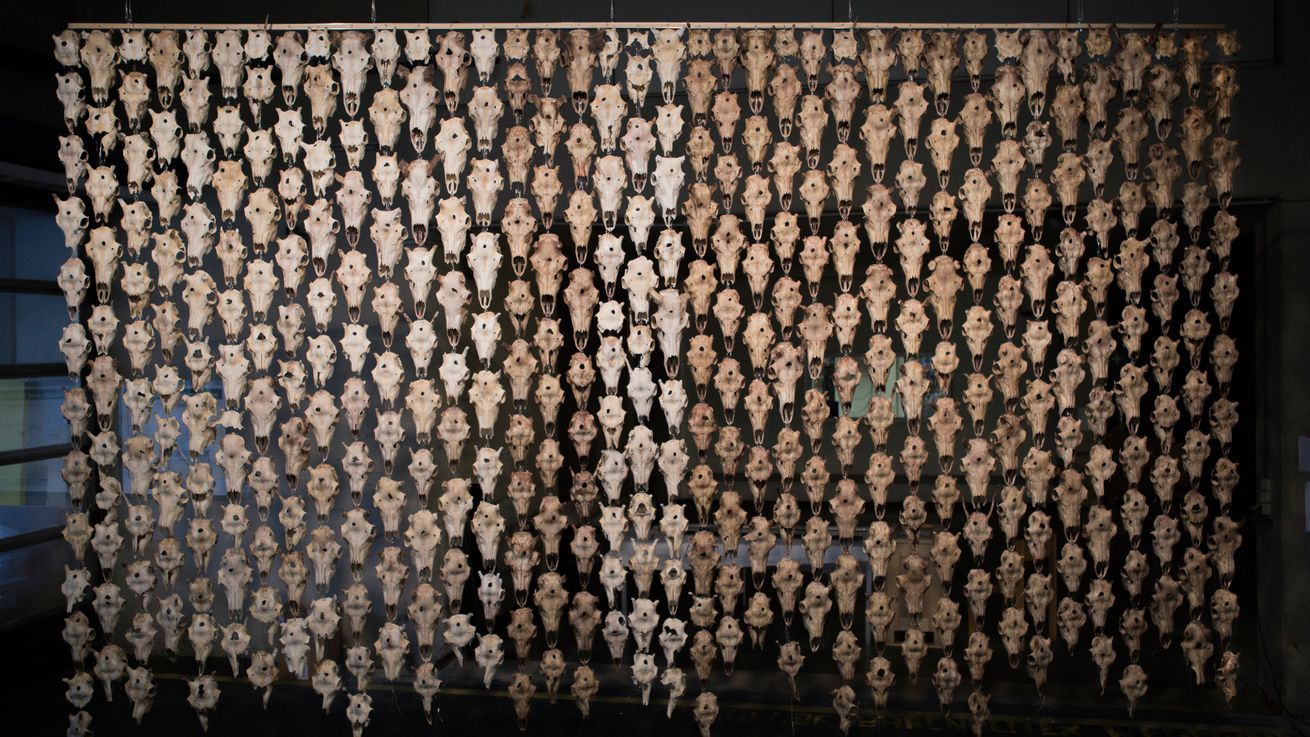
Sara came to global attention with her work Pile o Sapmi, a symbol of protest — displayed outside a Norwegian court in 2016 — against the state's plans to slaughter reindeers. The art protest was later recreated outside the Norwegian Parliament.
Both nation states’ and corporations’ failure to seek consent is a thread running through the audio from Sami knowledge keepers. Beyond the exhibition, it is available online.
Sara explains, “Asking for permission should not be exoticised or romanticised. It has an existential point — it’s about cultivating openness and humility. It’s about understanding that you are not alone in this world, and recognising your own role and responsibility within it.”
“In Sámi culture, asking permission is a way of acknowledging relationships and responsibility. Whether you take from the land, move through it, or make use of its resources, you acknowledge that you are part of a living system that gives and takes in return. This is not only a gesture of respect; it is a practical form of accountability that supports balance.”
The artist goes on to describe how colonial systems extract without consent or permission.
“For me, bringing this into the work is a way of countering the arrogance of extractivist systems,” she continues. “The act of listening and asking becomes a radical gesture — a form of resistance to domination. If the globalized world could relearn this lesson, perhaps we could begin to restore some of the balance that has been lost.”
How wisdom is interwoven within Sami stories emanates through the audio. Sara explains, “Storytelling teaches not through instruction, but through imagination and example. These stories don’t provide direct answers, but rather the ethical tools to navigate and sustain the world. These stories also grow with you throughout your life, taking on new meanings as you mature.”
She warns us that Indigenous stories should stop being discounted as “trivial.”
Colonialism continually derides and disrespects Indigenous people and their stories. At the same time, there are one-track stories that the globalized capitalist world happily repeats as mantra. The dominant narrative tells us we need to grow constantly for our prosperity, even as we overconsume the world beyond its limits.
Capitalism’s recent attempts to greenwash itself in order to justify more growth is a thread running through this series, even when it really means more destruction. I put it to Sara that many of the audience may want humanity to look beyond extractivist capitalism, but think this is impossible. Like her art installation, her response demands deeper consideration.
“I feel that the path we are currently walking as a human species is failing. In Sámi philosophy, everything is interconnected — nature is not a collection of objects but a living network of relationships, a kind of natural democracy,” she says.
“I’ve come to realise that individual efforts in Sámi are no longer enough; we need collective shifts, a fundamental transformation in how we understand our place in the world. Through this project, I’m thinking about strategies for the future, and how we might move forward together.
“And maybe most importantly, I see that Indigenous science and environmental empathy are by no means only accessible to Indigenous people. Every one of us has the same set of tools and every one of us belongs to nature.”