
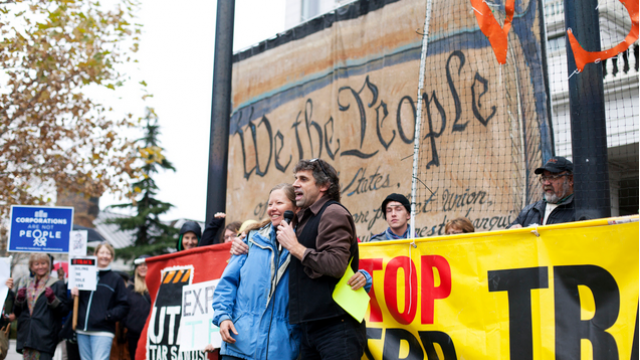
The newest round of Trans-Pacific Partnership (TPP) negotiations began Tuesday in Salt Lake City, Utah, where trade representatives will work towards finalizing the text of this sprawling secret agreement.
Last week's publication of the controversial "Intellectual Property" chapter by Wikileaks confirmed our worst fears: the TPP carries draconian copyright enforcement provisions that threaten users' rights and could stifle innovation well into the 21st Century. Public opposition to the TPP continues to grow as a result of the leaked document; an opaque policymaking process that seems geared towards appeasing Big Content does not provide much in the way of legitimacy.
In the past week, 23 Republicans and 151 Democrats in the House of Representatives wrote letters to the Obama administration indicating their unwillingness to comply with the Executive's request for power to fast-track trade agreements through Congress. Fast-track authority, also known as Trade Promotion Authority, limits congressional approval over trade agreements to a yes or no, up or down vote.
If a bill granting fast-track were to pass, hearings would become extremely limited, and lawmakers would have no ability to make amendments. It would give the Obama administration unchecked power to shape TPP and other agreements like the EU-U.S. trade deal, the Transatlantic Trade and Investment Partnership (TTIP).
There are some Congress members who are actively pushing for fast-track and are vowing to introduce legislation to enact it by 2014. Thankfully, these letters from the House show the White House is going to have difficulty in finding support in Congress to pass such a bill. Still, the Obama administration is going to push hard for the passage of fast-track.
The U.S. trade office is negotiating TPP as if it already has fast-track authority, by deciding for itself which countries to negotiate with and what issues are on the table.
Without fast-track, it's inconceivable that the TPP would survive congressional debate. And that's the point of all of this secrecy: the TPP's myriad harmful provisions for users wouldn't survive the sunlight of transparency, so it's being negotiated in the dark. And since negotiators only get to hear corporations' concerns while drafting these policies, it only makes sense that its agenda would exclude users' interests.
So we need to demand that our lawmakers oppose fast-track. Let's ask them to call for a hearing and exercise their authority to oversee the U.S. trade office’s secret copyright agenda.
Meanwhile, as reported in this article by Tom Harvey writing for the Salt Lake City Tribune:
Outside Salt Lake City’s Grand America Hotel on Tuesday, the rains fell, the speakers rose, the marchers chanted. Inside, top trade negotiators from the United States and 11 other Pacific Rim nations perhaps discussed imports and exports, profits and products, prices and patents. The exact topics aren’t known. The talks were closed.
And that concerns critics most of all as parties from the Trans-Pacific Partnership launched a 19th round of negotiations — this time in Utah — in search of a sweeping free-trade agreement.
Tuesday’s rally, organized by a coalition called the Citizens Trade Campaign, of Washington, D.C., drew 100 or so protesters, who worry that the high-level talks have been conducted behind closed doors with only multinational corporations given access to proposed provisions.
Watched over by a small contingent of Salt Lake City police and other security officers, demonstrators carried various signs on the lawn and sidewalk in front of the hotel. Among them: “Protect Us From Corporate Protectionism,” “Obama: Exorcise Your Corporate Demons” and “Mormon Environmental Stewardship Alliance.”
One group held a U.S. flag, with the stars replaced by corporate logos such as those for McDonald’s, CBS, Coca-Cola and Microsoft.
Among Utahns who spoke were Dale Cox, president of the state AFL-CIO; Wayne Holland, a United Steelworkers Union representative; and former Salt Lake City Mayor Rocky Anderson.
Cox pointed to the North American Free Trade Agreement as a model for the proposed Pacific accord, which he warned would lead to the loss of more U.S. jobs. “They’re here to take jobs from us to other countries,” Cox said.
Holland echoed those remarks, saying, “We cannot allow NAFTA in the Pacific.”
Raphael Cordray, of Utah Tar Sands Resistance, said her group fears a final agreement would allow foreign corporations to sue local or state governments that pass laws affecting businesses’ profits.
“That’s what people don’t understand about these trade agreements,” Cordray said in an interview. ” … They can actually take away some of the sovereignty that we have in our local communities.”
Carol Guthrie, senior adviser for media affairs of the Office of the U.S. Trade Representative, which is negotiating for the United States, said her office had worked hard to introduce “unprecedented transparency” into the negotiations. She also touted the importance of foreign trade to Utah jobs.
“More than 100,000 jobs in Utah alone are supported by trade,” Guthrie said. “Twenty percent of Utah’s manufacturing jobs are supported by trade. Twenty percent of Utah’s exports go to the region represented by the Trans-Pacific Partnership.”
Besides the United States, nations belonging to the Trans-Pacific Partnership are Australia, Brunei, Canada, Chile, Malaysia, Mexico, New Zealand, Peru, Singapore, Japan and Vietnam.
Groups plan to protest throughout the week, with the talks set to last through Sunday.
Originally published by Electronic Frontier Foundation
3 WAYS TO SHOW YOUR SUPPORT



- Log in to post comments


